English

Blaise Pascal
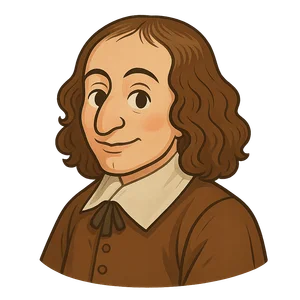
Blaise Pascal was a French mathematician, physicist, inventor, philosopher…
Reads at Grades 6–8 Listens at Grades 4–8
Print & create
Answer keys·No prep·Free with an account
28 worksheets · answer keys · full story · quiz · Ages 10-12 · CEFR B2
Plus adds 279,000+ more stories in 27 languages, audio for every one, and printables for all of them.
Just want Blaise Pascal?
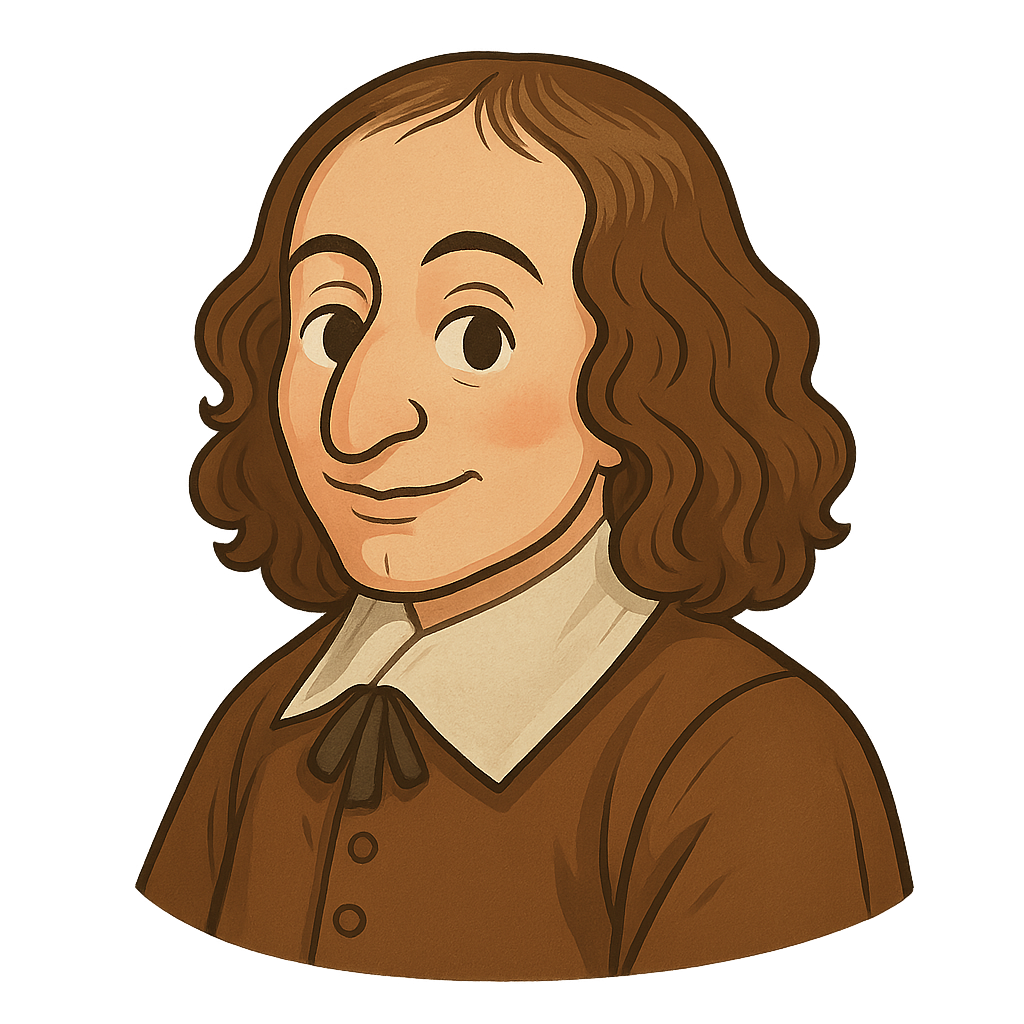
Hello, my name is Blaise Pascal, and I was a mathematician, physicist, and inventor who loved to solve puzzles about the world. My story begins on June 19th, 1623, in a town called Clermont-Ferrand in France. When I was just a young boy, my mother passed away, which was a very sad time for my family. In 1631, my father, Étienne, decided to move me and my sisters to the busy city of Paris to give us a better education. My father was a brilliant mathematician himself, but he had a very specific plan for my studies. He wanted me to learn languages and other subjects before I ever touched a math book. He even went so far as to hide all of his mathematics books from me, but that only made me more curious. It was like a secret world I just had to explore, so I began to learn about shapes and numbers all on my own.
My father's rule against mathematics couldn't stop my curiosity. I would draw shapes on the floor tiles and try to figure out their properties. By the time I was only 12 years old, I had secretly worked out many of the fundamental rules of geometry without ever reading a book on the subject! When my father discovered what I had been doing, he was so astonished and impressed that he finally gave me a copy of the works of the great ancient mathematician, Euclid. It was the greatest gift he could have given me. I dove into my studies, and by the age of 16, in the year 1639, I wrote my very first serious mathematical paper. It was about a complex topic called conic sections, and my work on it eventually became known as Pascal's Theorem. For a teenager, presenting my ideas to the mathematicians of Paris was an incredible moment.
Blaise Pascal
Hello, my name is Blaise Pascal, and I was a mathematician, physicist, and inventor who loved to solve puzzles about the world. My story begins on June 19th, 1623, in a town called Clermont-Ferrand in France. When I was just a young boy, my mother passed away, which was a very sad time for my family. In 1631, my father, Étienne, decided to move me and my sisters to the busy city of Paris to give us a better education. My father was a brilliant mathematician himself, but he had a very specific plan for my studies. He wanted me to learn languages and other subjects before I ever touched a math book. He even went so far as to hide all of his mathematics books from me, but that only made me more curious. It was like a secret world I just had to explore, so I began to learn about shapes and numbers all on my own.
My father's rule against mathematics couldn't stop my curiosity. I would draw shapes on the floor tiles and try to figure out their properties. By the time I was only 12 years old, I had secretly worked out many of the fundamental rules of geometry without ever reading a book on the subject! When my father discovered what I had been doing, he was so astonished and impressed that he finally gave me a copy of the works of the great ancient mathematician, Euclid. It was the greatest gift he could have given me. I dove into my studies, and by the age of 16, in the year 1639, I wrote my very first serious mathematical paper. It was about a complex topic called conic sections, and my work on it eventually became known as Pascal's Theorem. For a teenager, presenting my ideas to the mathematicians of Paris was an incredible moment.
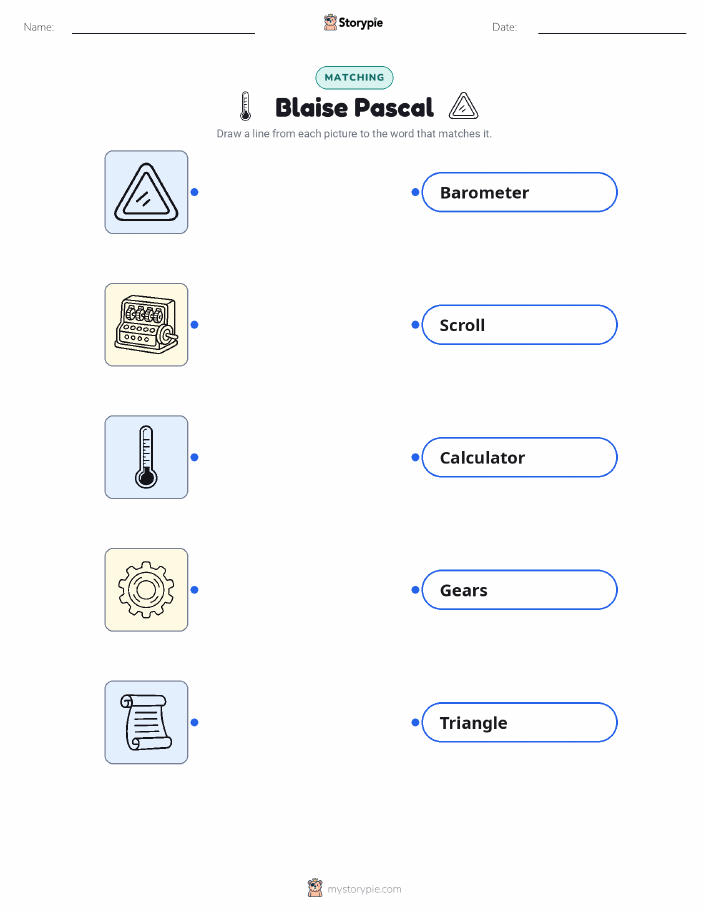
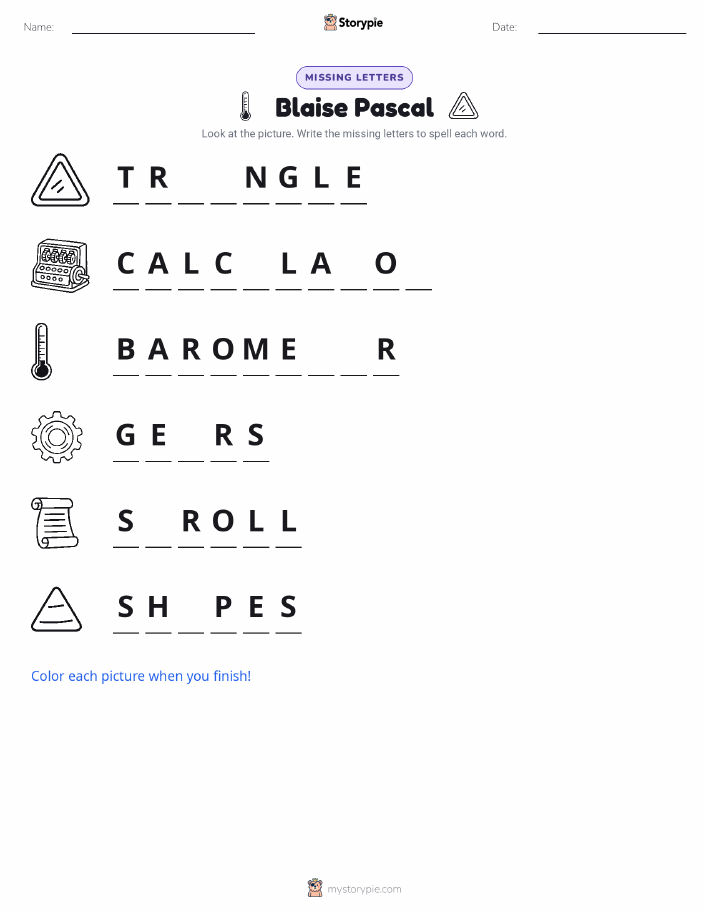
My father's work soon gave me a new problem to solve. He took a job as a tax collector, which was an important but very difficult role. I would watch him spend hours and hours doing endless, tiring addition and subtraction by hand. He looked so exhausted, and I knew there had to be a better way. This inspired me to create a machine that could do the work for him. Beginning around 1642, I spent several years designing and building my invention. I called it the 'Pascaline.' It was a small brass box filled with gears and wheels that turned and clicked. By dialing the wheels, my father could add and subtract huge numbers automatically, saving him so much time and effort. It was a proud achievement for me, as the Pascaline became one of the very first mechanical calculators ever created.
My curiosity wasn't limited to just numbers; I was also fascinated by the physical world around me. I became very interested in the experiments of an Italian scientist named Evangelista Torricelli. He had proposed a radical idea: that we all live at the bottom of an 'ocean of air' that presses down on everything. I wanted to find a way to prove that this invisible air had weight and that its pressure changed. In 1648, I designed a famous experiment to test this theory. I asked my brother-in-law, Florin Périer, to take a device called a barometer and carry it up a tall mountain near our home, the Puy-de-Dôme. As I had predicted, the column of liquid in the barometer dropped as he climbed higher. This proved that the 'ocean of air' was thinner and had less pressure at the top of the mountain. This discovery led to an important principle in physics now known as Pascal's Law.
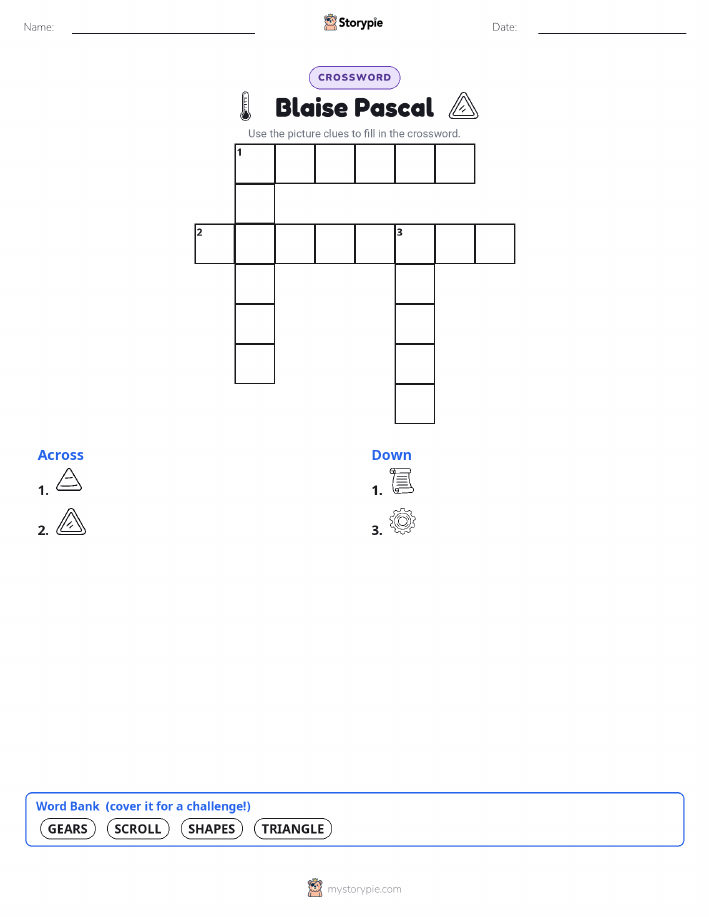
Even a game could spark my curiosity. In 1654, a friend asked me a question about how to divide the winnings in a game of chance that had been interrupted. This puzzle intrigued me, so I began writing letters to another brilliant French mathematician, Pierre de Fermat, to discuss it. Through our correspondence, we developed a way to mathematically predict the likelihood of certain outcomes. What started as a question about a game grew into an entirely new branch of mathematics called probability theory, which is used today in everything from weather forecasting to economics. Around this time, I also spent a lot of time studying a special arrangement of numbers. Today, it is famous all over the world as Pascal's Triangle. It looks like a simple pattern, but it is filled with mathematical secrets and connections that are still studied by students everywhere.
My life was full of questions, not just about numbers and science, but also about faith and the meaning of our place in the universe. I lived to be 39 years old, and my life came to an end in the year 1662. Though my time on Earth was not long, I am proud that my work has continued to inspire others. My ideas helped lay the groundwork for the calculators and computers we use today. My experiments with air pressure were a step toward understanding weather, and a computer programming language was even named 'Pascal' in my honor. I hope my story shows you that curiosity is one of the most powerful tools you have, and that you are never too young to discover something that could change the world.
Wow facts
About
Blaise Pascal was a French mathematician, physicist, inventor, philosopher, and writer who made foundational contributions to probability theory, projective geometry, and the study of fluids and pressure.
Take a Quiz
Question 1 of 5
What motivated me to invent the mechanical calculator known as the Pascaline?
Explore next



Want to do even more?
Go beyond exploring. Unlock tools that turn every story into real learning.

Storypie Plus for families
Full stories, quizzes, and printables. Nights and car rides, sorted.
- Unlimited audio stories
- Create Mode: your child stars in the story
- Offline downloads
- Printable worksheets & coloring pages

Why Storypie for Schools
Students engaged. Prep in seconds. Evenings back to you.
- Worksheets & Quizzes
- Classroom Management
- Formative Assessment
- Custom Curriculum & Lesson Plans
- 27 Languages

Why Storypie for Homeschool
Curriculum done. They'll ask for more. Hours back in your day.
- Worksheet Generator
- First-Person Audio Stories
- Built-in Comprehension Quizzes
- Custom Curriculum & Lesson Plans
- Print & Go Activities