

 English

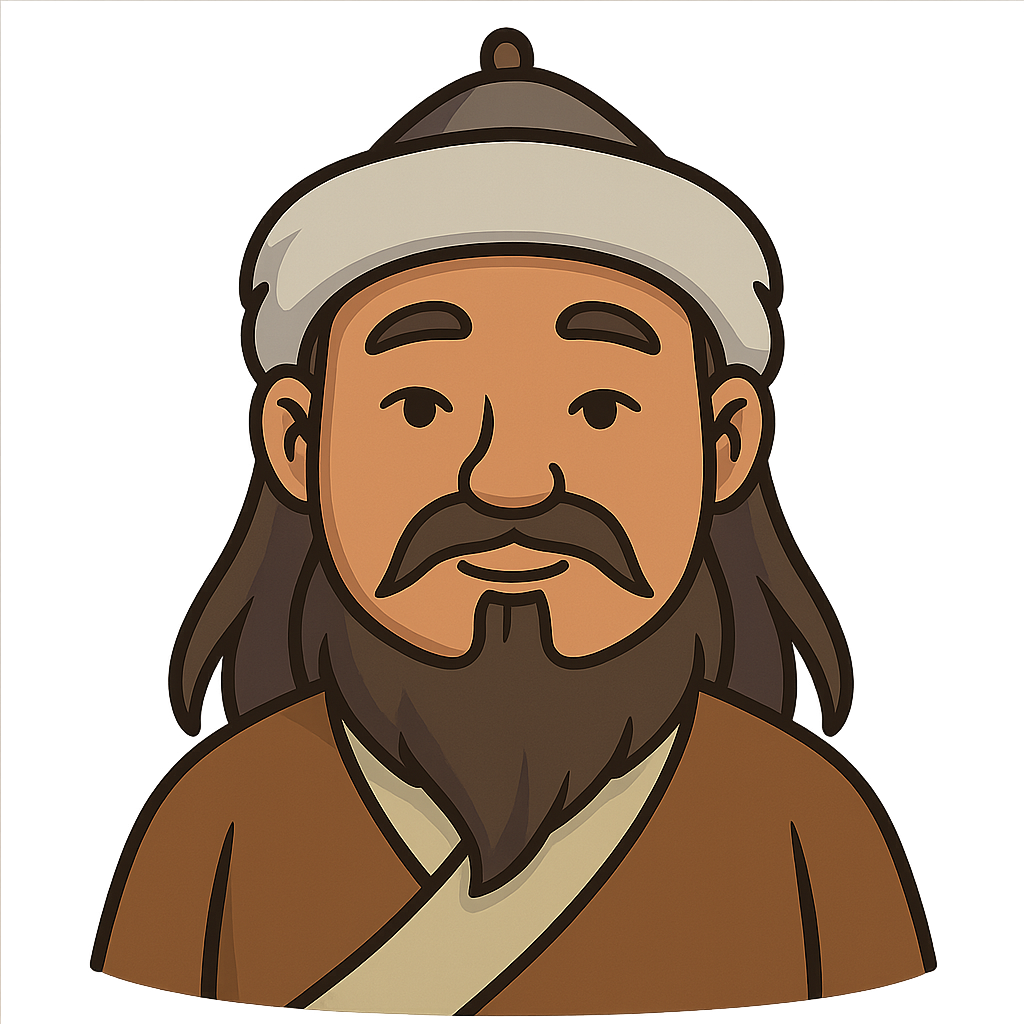
My Story, by Genghis Khan
You may know me as Genghis Khan, the ruler of a great empire. But before I was a Khan, I was a boy named Temüjin. I was born around the year 1162, not in a grand palace, but under the wide-open sky of the Mongolian steppe, near a sacred mountain called Burkhan Khaldun. My world was one of vast grasslands, thundering horse herds, and the felt tents, or gers, that my nomadic tribe called home. Life was a constant lesson in survival, taught by the harsh winds and the changing seasons. My father, Yesügei, was a respected leader of our clan, and my mother, Hoelun, was a woman of incredible strength. They taught me to ride horses almost before I could walk, to read the signs of the weather, and to understand the deep bonds of loyalty that held our people together.
My childhood, however, was torn apart when I was only nine years old. My father was cruelly poisoned by our enemies, the Tatars. His death shattered our world. Without his leadership, our clan turned their backs on us, abandoning my mother, my siblings, and me on the harsh steppe to fend for ourselves. We were left with nothing. Those were years of hunger and fear, where we survived on wild roots and the few fish we could catch. It was during this time that I learned a bitter but valuable lesson: division among the Mongol tribes was a weakness that invited disaster. My resolve hardened when I was captured by a rival clan and forced to wear a wooden collar like a common criminal. But even in captivity, my spirit refused to break. One night, I saw my chance and made a daring escape, a moment that marked the end of my life as a helpless victim and the beginning of my journey as a leader determined to unite my people.
A Boy Named Temüjin
My escape was just the beginning of a long and difficult path. I started with nothing, but I had a clear vision: to bring all the feuding Mongol tribes together under a single banner. I began by seeking out old allies of my father and slowly gathering followers who were drawn to my determination. My first and most important alliance was sealed through my marriage to my beloved wife, Börte. Her kidnapping by a rival tribe soon after our wedding forced me into my first major campaign, and my successful rescue of her earned me great respect. I was joined by loyal companions who became my sworn brothers and generals, and together, we began the great work of unification. It was not a simple task. The steppes were a web of shifting loyalties, and I had to fight many battles, sometimes even against those who were once my friends, like the powerful warrior Jamukha. Each victory taught me more about strategy, and each defeat taught me the importance of resilience.
For two decades, I fought, negotiated, and forged alliances. I learned that true strength came not just from the sword, but from the loyalty of your people and the fairness of your rule. Finally, the day came in the year 1206 when the leaders of every tribe I had united gathered for a great assembly, a kurultai. On the banks of the Onon River, under the eternal blue sky, they declared me the leader of all the Mongols. It was there that they gave me my new name, a title of great honor: Genghis Khan, meaning 'universal ruler.' My dream had become a reality. But I knew this was not an end, but a beginning. To ensure our unity would last, I created a code of laws called the Yassa, which applied to everyone, from the highest noble to the humblest herder. It promoted discipline, honesty, and loyalty. I also established the Yam, an incredible system of horse-mounted messengers who could carry messages across our lands with astonishing speed, connecting our new nation like never before.
The Uniter of Tribes
With our people united and governed by fair laws, we were no longer a collection of warring tribes but a powerful Mongol Nation. Our strength allowed us to build one of the largest empires the world had ever seen, an empire that stretched from the shores of the Pacific Ocean deep into the heart of Asia. But my goal was never just conquest. It was to create a new world for my people. In the lands we governed, we brought an era of peace and stability. We made the legendary Silk Road safe for merchants and travelers, allowing goods, ideas, and knowledge to flow freely between the East and the West. For the first time in centuries, a person could travel from one end of Asia to the other in relative safety. Cultures that had long been separated began to connect and learn from one another, all under the protection of our empire. My life's journey came to an end in August of 1227, but my work did not. I passed my leadership to my sons, like my successor Ögedei Khan, who continued to expand and govern the empire we had built together. My story is not just one of a boy who survived hardship, but of a leader who united a people and, in doing so, changed the course of history forever. It is a reminder that from the most humble beginnings, a single person with a strong will and a clear vision can truly change the world.
An Empire for My People
Activities
Take a Quiz
Test what you learned with a fun quiz!
Get creative with colors!
Print a coloring book page of this topic.








 Free for Educators