English

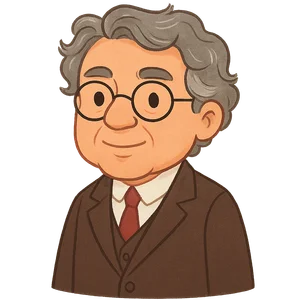
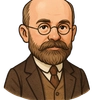
Jagadish Chandra Bose
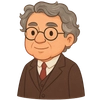
Jagadish Chandra Bose was a pioneering Indian scientist whose work spanned physics and biology.
Reads at Grades 3–5 Listens at Grades 1–5
Print & create
Answer keys·No prep·Free with an account
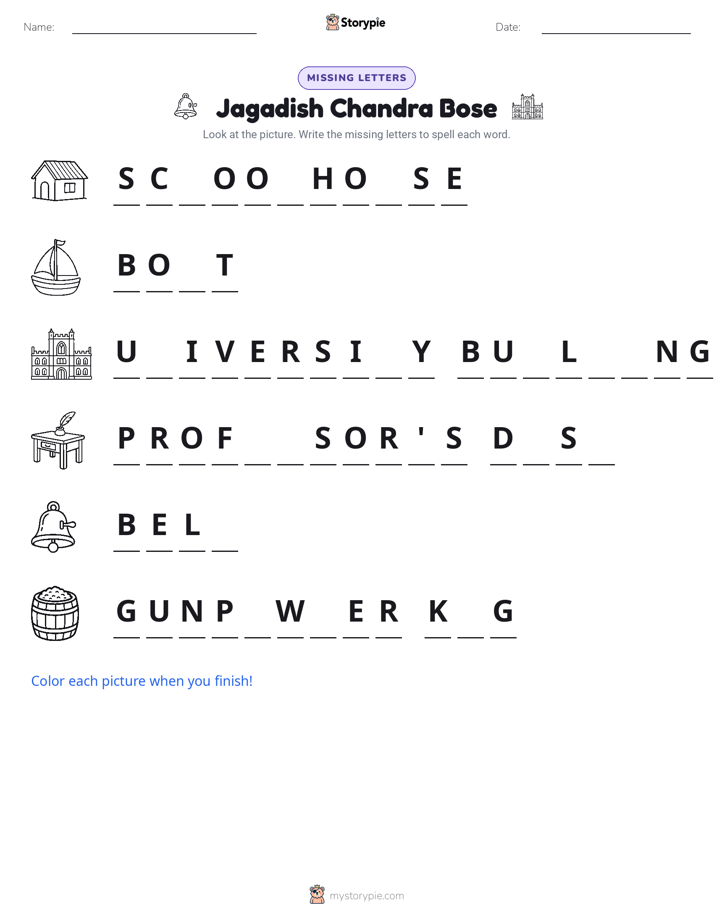
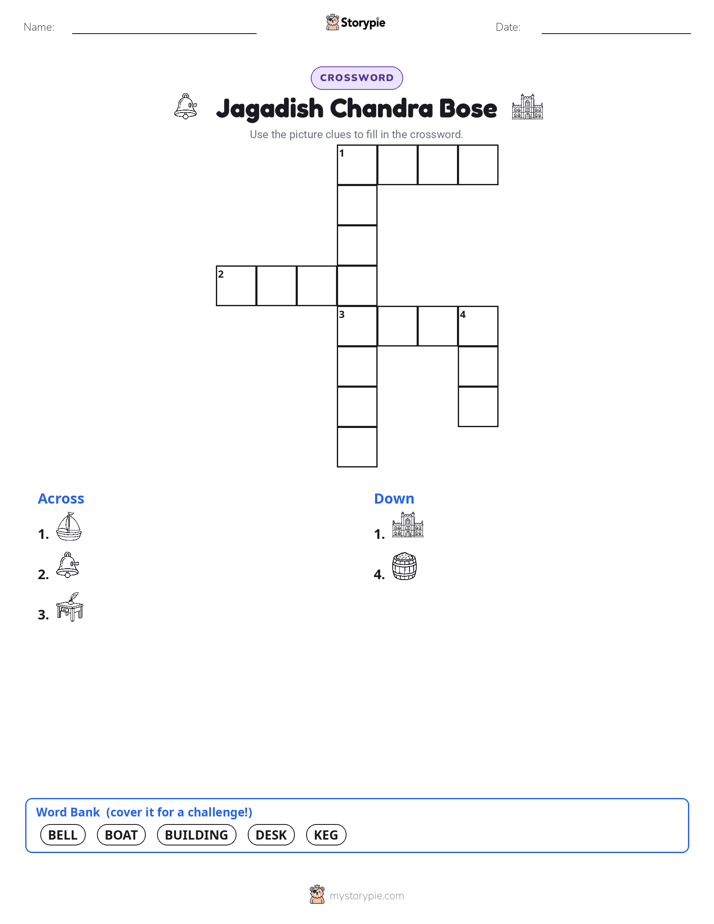
28 worksheets · answer keys · full story · quiz · Ages 8-10 · CEFR B1
Plus adds 279,000+ more stories in 27 languages, audio for every one, and printables for all of them.
Just want Jagadish Chandra Bose?
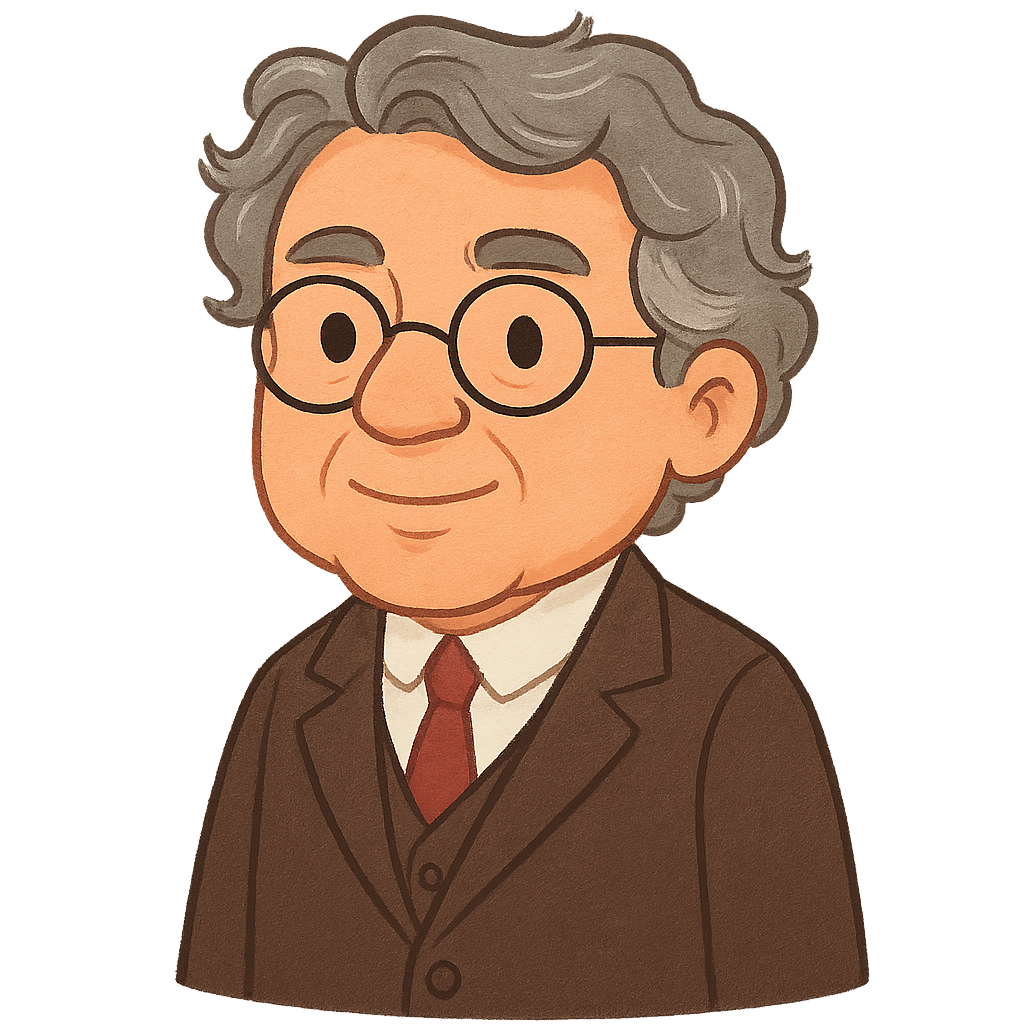
Hello, my name is Jagadish Chandra Bose. My story begins on November 30th, 1858, in a place called Mymensingh, which was part of British-ruled India at the time. As a young boy, I was completely fascinated by the world of nature around me. I would spend hours listening to my mother tell me wonderful stories about plants and animals, which sparked my curiosity. My father made a very important decision for my education. Instead of sending me to a school where I would learn English, he sent me to a local school. There, I learned to read and write in my native language, Bengali. My classmates were the children of fishermen, farmers, and all sorts of people from my community. This experience taught me something very important: to love my country and all of its people before anything else. It shaped the way I saw the world for the rest of my life.
As I grew older, my love for learning took me far from my village. First, I moved to the big city of Calcutta to study at St. Xavier's College. But my journey didn't stop there. In 1880, I sailed all the way to England to continue my education. At first, I hoped to study medicine and become a doctor, but I had to stop because of my poor health. I did not let that discourage me. Instead, I decided to study natural sciences at the world-famous Cambridge University. I worked hard and graduated in 1884. The next year, in 1885, I returned to India, excited to share what I had learned. I became a professor at Presidency College in Calcutta. However, I faced a great injustice. I was offered much less pay than the British professors simply because I was Indian. I knew this was wrong, so I protested for three long years until I was finally paid the same salary as my colleagues. It was a difficult fight, but it was a matter of fairness and respect.
Jagadish Chandra Bose: The Scientist Who Talked to Plants
Hello, my name is Jagadish Chandra Bose. My story begins on November 30th, 1858, in a place called Mymensingh, which was part of British-ruled India at the time. As a young boy, I was completely fascinated by the world of nature around me. I would spend hours listening to my mother tell me wonderful stories about plants and animals, which sparked my curiosity. My father made a very important decision for my education. Instead of sending me to a school where I would learn English, he sent me to a local school. There, I learned to read and write in my native language, Bengali. My classmates were the children of fishermen, farmers, and all sorts of people from my community. This experience taught me something very important: to love my country and all of its people before anything else. It shaped the way I saw the world for the rest of my life.
As I grew older, my love for learning took me far from my village. First, I moved to the big city of Calcutta to study at St. Xavier's College. But my journey didn't stop there. In 1880, I sailed all the way to England to continue my education. At first, I hoped to study medicine and become a doctor, but I had to stop because of my poor health. I did not let that discourage me. Instead, I decided to study natural sciences at the world-famous Cambridge University. I worked hard and graduated in 1884. The next year, in 1885, I returned to India, excited to share what I had learned. I became a professor at Presidency College in Calcutta. However, I faced a great injustice. I was offered much less pay than the British professors simply because I was Indian. I knew this was wrong, so I protested for three long years until I was finally paid the same salary as my colleagues. It was a difficult fight, but it was a matter of fairness and respect.
Some of my most exciting work involved studying things that are all around us but are completely invisible. I became very interested in radio waves. Can you imagine sending a message through the air without any wires. In 1895, I decided to show everyone what these invisible waves could do. I held a public demonstration in Calcutta that amazed the audience. From one side of a large room, I sent a signal using my invention. On the other side of the room, with no wires connecting the two, a bell started to ring, and a small amount of gunpowder burst into a tiny explosion. It was like magic, but it was science. Even though this invention was very important, I believed that scientific knowledge should belong to everyone. I chose not to try to make money from my early radio inventions because I wanted other scientists to be able to use my ideas to build and discover even more.
After my work with radio waves, I turned my attention back to my first love: plants. I had a strong belief that plants were not just quiet, unmoving things. I was convinced they could feel and react to the world, much like animals do. To prove this, I needed a special tool, so I invented one. I called it the crescograph. This amazing machine was so sensitive that it could measure the tiniest movements in plants, movements that were impossible to see with the naked eye. Using the crescograph, I made incredible discoveries. I showed that plants respond to sunlight and warmth, almost as if they are happy. I also showed that they can feel tired and even get hurt by things in their environment. My invention proved that plants have a secret life we never knew about. To make sure this important work could continue, I founded the Bose Institute in Calcutta. I opened it on my birthday, November 30th, in the year 1917, as a place for science and discovery.
I lived to be 78 years old, and my journey came to an end in 1937. People today remember me for two very different, but equally important, things. My early experiments with invisible waves helped other scientists who later invented the radio that we know today. And my work with the crescograph opened up a new way of understanding the amazing, hidden world of plants. I hope my story inspires you to always stay curious about the world around you and to share everything you learn with others for the good of everyone.
Wow facts
About
Jagadish Chandra Bose was a pioneering Indian scientist whose work spanned physics and biology. He is credited with groundbreaking research in radio waves and for inventing the crescograph to demonstrate that plants have life and feel sensations.
Take a Quiz
Question 1 of 5
What was the crescograph, and what did it help Jagadish Chandra Bose prove?
Explore next



Want to do even more?
Go beyond exploring. Unlock tools that turn every story into real learning.

Storypie Plus for families
Full stories, quizzes, and printables. Nights and car rides, sorted.
- Unlimited audio stories
- Create Mode: your child stars in the story
- Offline downloads
- Printable worksheets & coloring pages

Why Storypie for Schools
Students engaged. Prep in seconds. Evenings back to you.
- Worksheets & Quizzes
- Classroom Management
- Formative Assessment
- Custom Curriculum & Lesson Plans
- 27 Languages

Why Storypie for Homeschool
Curriculum done. They'll ask for more. Hours back in your day.
- Worksheet Generator
- First-Person Audio Stories
- Built-in Comprehension Quizzes
- Custom Curriculum & Lesson Plans
- Print & Go Activities