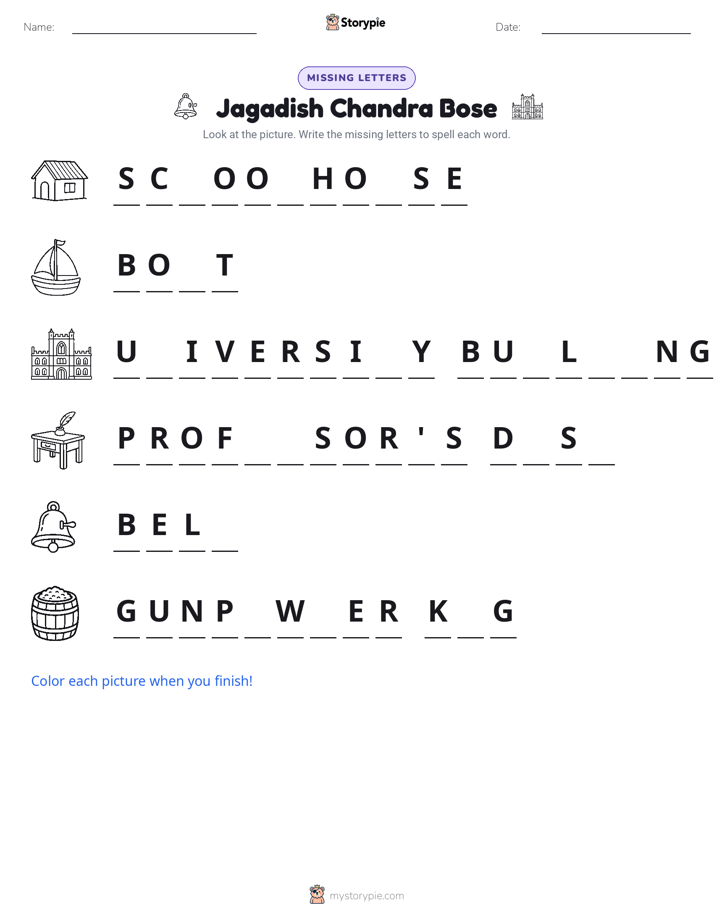
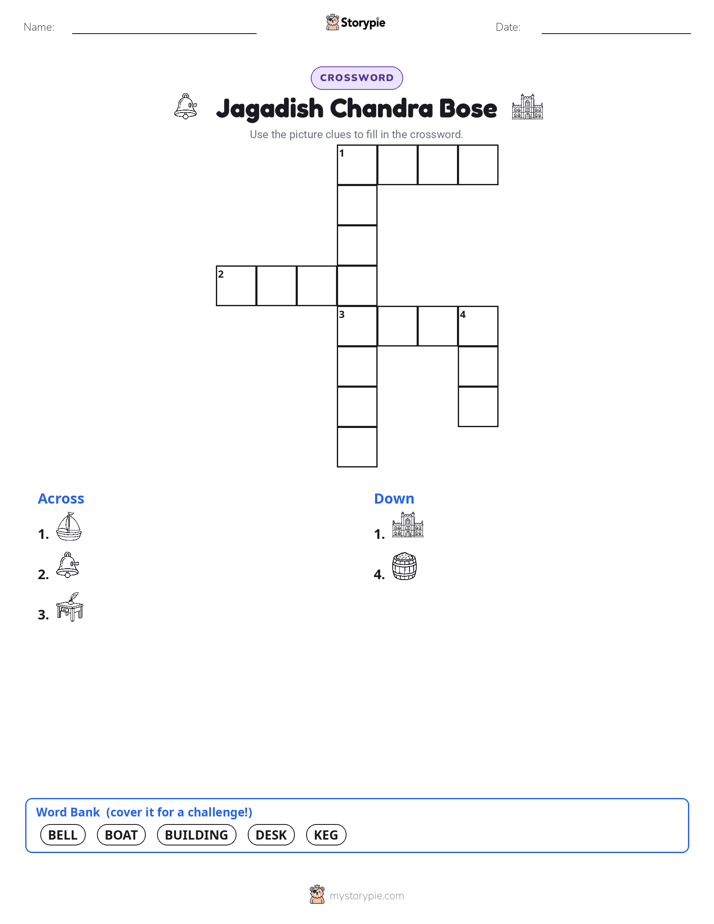
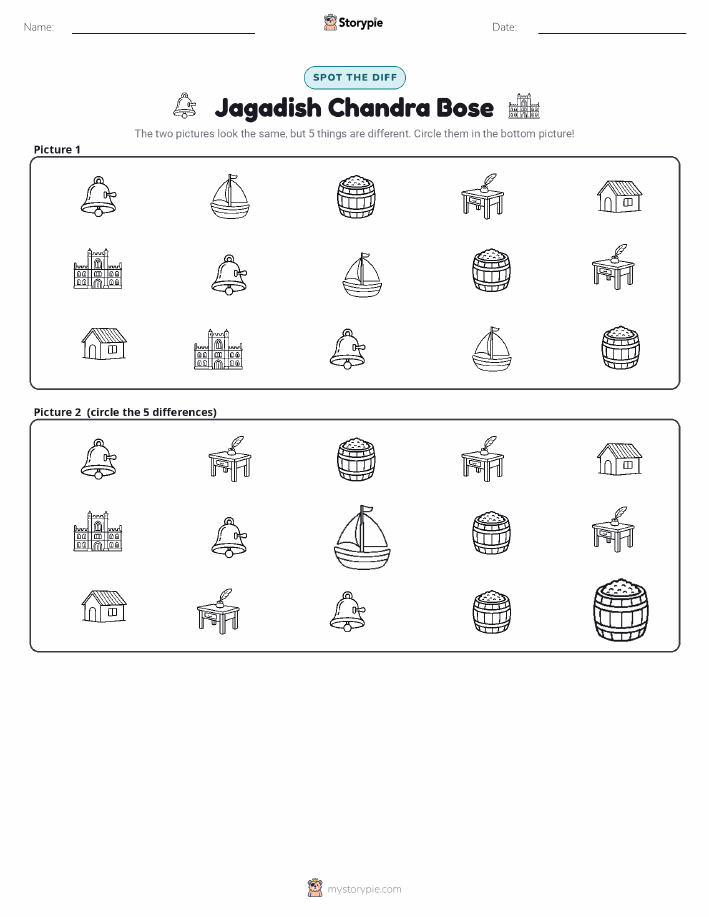
English

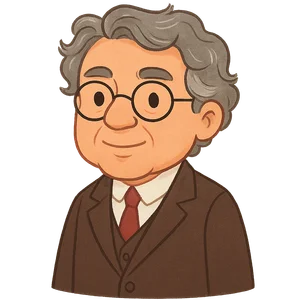
Jagadish Chandra Bose
Jagadish Chandra Bose was a pioneering Indian scientist whose work spanned physics and biology.
Reads at Grades 6–8 Listens at Grades 4–8
Print & create
Answer keys·No prep·Free with an account
28 worksheets · answer keys · full story · quiz · Ages 10-12 · CEFR B2
Plus adds 279,000+ more stories in 27 languages, audio for every one, and printables for all of them.
Just want Jagadish Chandra Bose?
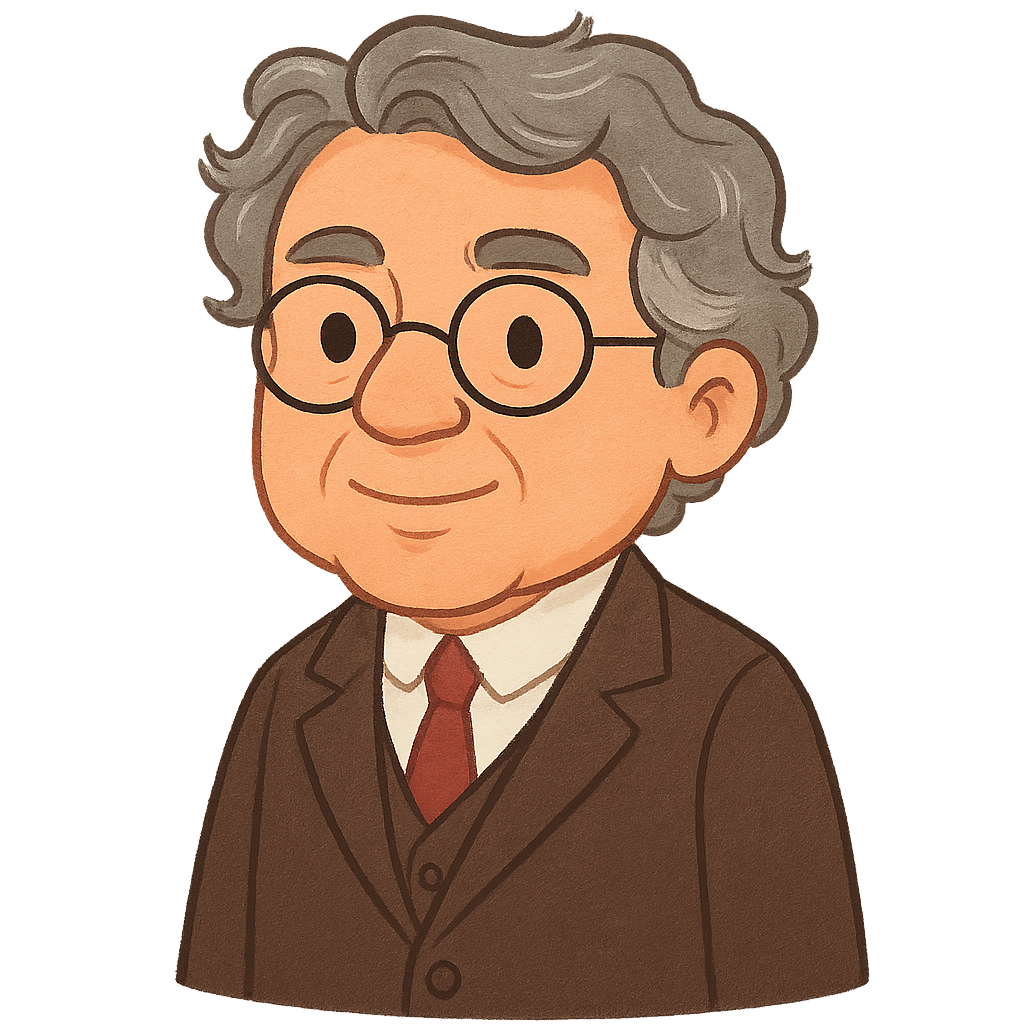
Hello, my name is Jagadish Chandra Bose, and I was a scientist who explored the hidden worlds of both invisible waves and living plants. My story begins in a time and place of great change. I was born on November 30th, 1858, in Mymensingh, Bengal, which at that time was part of British India. My father made a decision that shaped my entire life: instead of sending me to an English-language school, he enrolled me in a local school where I learned in my own language, Bengali. There, I sat beside children from all backgrounds, rich and poor. My classmates were the sons of fishermen and farmers, and they shared stories with me about animals, birds, and aquatic creatures. These tales of heroes from our history and the wonders of the natural world filled me with a deep love for my country and an endless curiosity. I didn't just learn facts from books; I learned to observe the world around me and ask questions about how everything worked, from the smallest insect to the tallest tree.
After finishing my early studies in Calcutta, I felt a strong pull to learn more about the world. In 1880, I sailed to England to continue my education. At first, I thought I would study medicine, but I quickly discovered that my true passion was not for healing the human body, but for understanding the fundamental laws of the universe. Physics and the natural world called to me. I enrolled at the University of Cambridge, where I had the chance to learn from some of the most brilliant scientific minds of the age. It was an incredibly exciting time, and in 1884, I graduated with a degree in Natural Sciences. I returned to India in 1885 with great hopes and took a position as a professor of physics at Presidency College in Calcutta. However, I immediately faced a significant challenge. Because I was Indian, I was offered a salary much lower than that of my British colleagues. This was unjust, but it fueled my determination. I decided to prove, through my work and dedication, that scientists from India were equal to any in the world.
Jagadish Chandra Bose: A Life of Discovery
Hello, my name is Jagadish Chandra Bose, and I was a scientist who explored the hidden worlds of both invisible waves and living plants. My story begins in a time and place of great change. I was born on November 30th, 1858, in Mymensingh, Bengal, which at that time was part of British India. My father made a decision that shaped my entire life: instead of sending me to an English-language school, he enrolled me in a local school where I learned in my own language, Bengali. There, I sat beside children from all backgrounds, rich and poor. My classmates were the sons of fishermen and farmers, and they shared stories with me about animals, birds, and aquatic creatures. These tales of heroes from our history and the wonders of the natural world filled me with a deep love for my country and an endless curiosity. I didn't just learn facts from books; I learned to observe the world around me and ask questions about how everything worked, from the smallest insect to the tallest tree.
After finishing my early studies in Calcutta, I felt a strong pull to learn more about the world. In 1880, I sailed to England to continue my education. At first, I thought I would study medicine, but I quickly discovered that my true passion was not for healing the human body, but for understanding the fundamental laws of the universe. Physics and the natural world called to me. I enrolled at the University of Cambridge, where I had the chance to learn from some of the most brilliant scientific minds of the age. It was an incredibly exciting time, and in 1884, I graduated with a degree in Natural Sciences. I returned to India in 1885 with great hopes and took a position as a professor of physics at Presidency College in Calcutta. However, I immediately faced a significant challenge. Because I was Indian, I was offered a salary much lower than that of my British colleagues. This was unjust, but it fueled my determination. I decided to prove, through my work and dedication, that scientists from India were equal to any in the world.
In a small laboratory at the college, I began my own research. I was fascinated by the invisible electromagnetic waves that had recently been discovered. With limited resources, I designed and built my own equipment, creating instruments that were remarkably sensitive and advanced for their time. My work focused on very short wavelengths, which no one had explored much before. In 1895, I held a public demonstration in Calcutta that stunned the audience. I used my invention to send invisible radio waves from one side of a large room to the other, passing through walls. These waves triggered a device that rang a bell and even set off a small explosion of gunpowder. I had successfully demonstrated wireless communication, and I did this before the more famous experiments of Guglielmo Marconi. However, my view on science was different from many others. I firmly believed that knowledge should be a gift to all of humanity, not something to be owned or sold. For this reason, I chose not to patent my invention for commercial gain, hoping others would be free to use and build upon my discoveries.
Around the year 1900, my scientific curiosity began to shift from the world of physics to the world of biology. I became completely captivated by a profound question: do plants have a life and feelings similar to animals? Most scientists at the time would have said no, but I was determined to find out for myself. To investigate this, I knew I needed a special tool—one that could detect movements far too small for the human eye to see. So, I invented an instrument I called the crescograph. I perfected this device around 1918, and it was an incredible machine capable of magnifying the tiniest motions of a plant by thousands of times. With the crescograph, I was able to show the world what I had long suspected. My experiments demonstrated that plants respond to light and other stimuli, that they grow tired just as we do, and that they can even be harmed by poisons, showing a clear reaction. Many people were skeptical of my findings, but my work opened up a new window into the secret life of plants, revealing a complex and hidden world no one had ever witnessed before.
Throughout my career, I dreamed of creating a place in India where scientists could conduct research with complete freedom, driven only by their thirst for knowledge. I wanted to build a modern research institution where Indian researchers would have the resources and support to make world-changing discoveries. On November 30th, 1917, my 59th birthday, this dream became a reality. I founded the Bose Institute in Calcutta, a center for scientific research. I dedicated this institute to the nation, calling it a 'temple of science.' By this, I meant it would be a place where the pursuit of knowledge was pure and sacred, conducted for the benefit of all humanity rather than for personal or corporate profit. The founding of the Bose Institute was one of the proudest moments of my life, as it established a lasting legacy and a home for future generations of Indian scientists to continue the search for truth.
My life was a journey of exploration, from the invisible radio waves that travel through space to the subtle, silent life of plants. I spent my years trying to understand the unity of all life and the physical laws that govern our universe. I lived a full life of discovery and was 78 years old when I passed on. Today, I am remembered as one of India's first modern scientists, a person who helped prove that science has no borders and that great discoveries can come from anywhere in the world. My early work with radio waves helped lay the foundation for the wireless communication we all use today, and my revolutionary discoveries about plants forever changed how we see and understand the natural world. My hope was always that my work would inspire others to look at the world with wonder and curiosity.
Wow facts
About
Jagadish Chandra Bose was a pioneering Indian scientist whose work spanned physics and biology. He is credited with groundbreaking research in radio waves and for inventing the crescograph to demonstrate that plants have life and feel sensations.
Take a Quiz
Question 1 of 5
What motivated me to invent the crescograph?
Explore next





Want to do even more?
Go beyond exploring. Unlock tools that turn every story into real learning.

Storypie Plus for families
Full stories, quizzes, and printables. Nights and car rides, sorted.
- Unlimited audio stories
- Create Mode: your child stars in the story
- Offline downloads
- Printable worksheets & coloring pages

Why Storypie for Schools
Students engaged. Prep in seconds. Evenings back to you.
- Worksheets & Quizzes
- Classroom Management
- Formative Assessment
- Custom Curriculum & Lesson Plans
- 27 Languages

Why Storypie for Homeschool
Curriculum done. They'll ask for more. Hours back in your day.
- Worksheet Generator
- First-Person Audio Stories
- Built-in Comprehension Quizzes
- Custom Curriculum & Lesson Plans
- Print & Go Activities