English

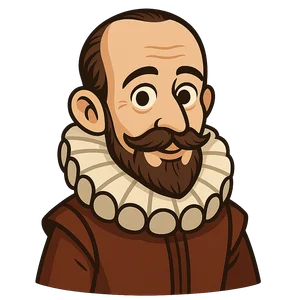
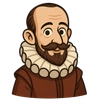
Miguel de Cervantes
Spanish writer widely regarded as the greatest writer in the Spanish language and one of the world's…
Reads at Grades 6–8 Listens at Grades 4–8
Print & create
Answer keys·No prep·Free with an account
28 worksheets · answer keys · full story · quiz · Ages 10-12 · CEFR B2
Plus adds 279,000+ more stories in 27 languages, audio for every one, and printables for all of them.
Just want Miguel de Cervantes?
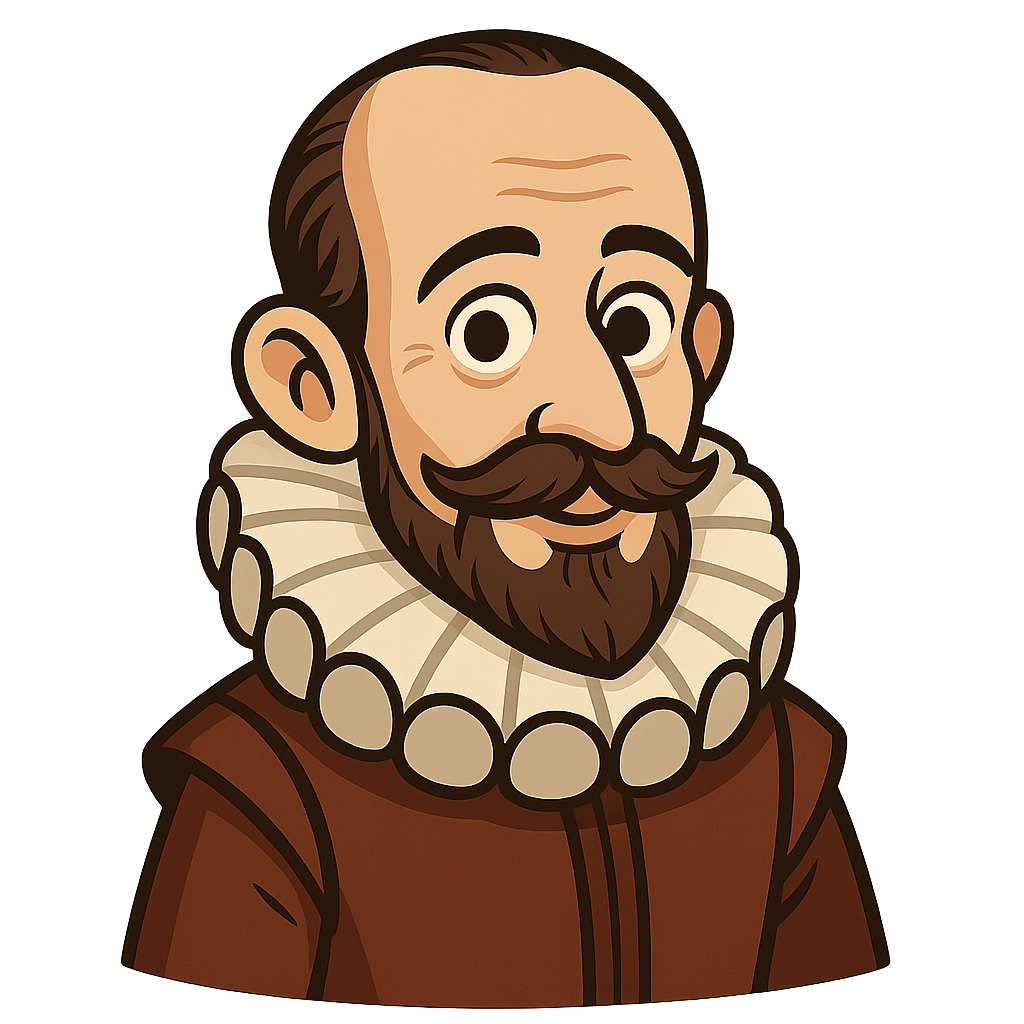
Hello, my name is Miguel de Cervantes, and I am delighted to share the story of my life with you. My journey began on September 29th, 1547, in a town in Spain called Alcalá de Henares. My father was a surgeon, a job that required him to travel constantly in search of work, which meant my family and I moved around quite a bit. This constant change didn't stop me from finding my greatest passion: books. I adored reading stories of brave knights and thrilling adventures. I also loved to watch plays whenever I had the chance. The world of make-believe, filled with chivalry and heroism, captured my imagination from my earliest days and planted the seeds for the stories I would one day write myself.
As I grew older, I yearned for an adventure of my own, just like the heroes in my books. Around the year 1569, I left Spain and traveled to Italy, where I decided to become a soldier. My desire for adventure was soon met in a very real and dangerous way. On October 7th, 1571, I fought in a massive naval battle known as the Battle of Lepanto. I fought with great courage that day, but I was wounded three times. One of those injuries was to my left hand, and it was so severe that I lost the use of it for the rest of my life. Instead of being ashamed, I was incredibly proud of my wound, seeing it as a mark of honor for having served my country. From that day on, I earned a nickname: 'El Manco de Lepanto,' which means 'The One-Handed Man of Lepanto.'
My life as a soldier was filled with risk, but my greatest trial was yet to come. In 1575, I was sailing back home to Spain, looking forward to a hero's welcome. However, our ship was attacked by pirates, and I was captured. I was taken to Algiers, a city in North Africa, and sold into slavery. For five long and difficult years, I was a captive. But even in the darkest of times, I never lost hope. I was determined to be free and tried to escape four different times. Each attempt failed, but I never gave up. Finally, in 1580, my family, with the help of a religious group, managed to raise enough money to pay the ransom for my release. After five years, I was finally free to return to Spain.
Miguel de Cervantes: The Man Who Dreamed of Giants
Hello, my name is Miguel de Cervantes, and I am delighted to share the story of my life with you. My journey began on September 29th, 1547, in a town in Spain called Alcalá de Henares. My father was a surgeon, a job that required him to travel constantly in search of work, which meant my family and I moved around quite a bit. This constant change didn't stop me from finding my greatest passion: books. I adored reading stories of brave knights and thrilling adventures. I also loved to watch plays whenever I had the chance. The world of make-believe, filled with chivalry and heroism, captured my imagination from my earliest days and planted the seeds for the stories I would one day write myself.
As I grew older, I yearned for an adventure of my own, just like the heroes in my books. Around the year 1569, I left Spain and traveled to Italy, where I decided to become a soldier. My desire for adventure was soon met in a very real and dangerous way. On October 7th, 1571, I fought in a massive naval battle known as the Battle of Lepanto. I fought with great courage that day, but I was wounded three times. One of those injuries was to my left hand, and it was so severe that I lost the use of it for the rest of my life. Instead of being ashamed, I was incredibly proud of my wound, seeing it as a mark of honor for having served my country. From that day on, I earned a nickname: 'El Manco de Lepanto,' which means 'The One-Handed Man of Lepanto.'
My life as a soldier was filled with risk, but my greatest trial was yet to come. In 1575, I was sailing back home to Spain, looking forward to a hero's welcome. However, our ship was attacked by pirates, and I was captured. I was taken to Algiers, a city in North Africa, and sold into slavery. For five long and difficult years, I was a captive. But even in the darkest of times, I never lost hope. I was determined to be free and tried to escape four different times. Each attempt failed, but I never gave up. Finally, in 1580, my family, with the help of a religious group, managed to raise enough money to pay the ransom for my release. After five years, I was finally free to return to Spain.
Returning home was not the triumphant experience I had imagined. Though I was a decorated war hero, I found it very hard to find a good job. I eventually became a tax collector, which was a thankless and difficult position. My work even led to me being put in prison on a couple of occasions due to problems with my accounts. It was during these challenging years, when my adventures had seemingly ended, that I rediscovered my love for writing. I decided to put my stories on paper, and in 1585, I published my very first novel, a pastoral romance titled La Galatea. It was a start, but my most famous and enduring story was still just an idea waiting to be born.
It was perhaps during one of my stays in prison that the idea for my greatest character came to me. I imagined a gentleman who had read so many books about knights and chivalry that he lost his senses and decided to become a knight-errant himself. His name was Don Quixote. In 1605, I published the first part of his story, and to my delight, people across Spain loved it. They were charmed by the adventures of my idealistic knight, Don Quixote, and his faithful, down-to-earth squire, Sancho Panza. Readers laughed as Don Quixote famously mistook a field of windmills for fearsome giants and charged at them with his lance. His journey was funny, but it was also filled with wisdom about dreams and reality. Ten years later, in 1615, I published the second part of their story, completing the masterpiece that would define my life.
My own life was as packed with adventure, hardship, and imagination as any of the books I had read as a boy. I lived to be 68 years old, and I continued writing until the very end of my days. Today, my novel Don Quixote is considered one of the most important books ever written and has been translated into more languages than almost any other work of literature. I am remembered for creating a timeless story about the power of imagination, the value of friendship, and the importance of chasing your dreams, no matter how impossible they may seem to others.
Wow facts
About
Spanish writer widely regarded as the greatest writer in the Spanish language and one of the world's pre-eminent novelists, best known for his novel Don Quixote.
Take a Quiz
Question 1 of 5
In your own words, describe what happened to Cervantes after he was captured by pirates in 1575.
Explore next





Want to do even more?
Go beyond exploring. Unlock tools that turn every story into real learning.

Storypie Plus for families
Full stories, quizzes, and printables. Nights and car rides, sorted.
- Unlimited audio stories
- Create Mode: your child stars in the story
- Offline downloads
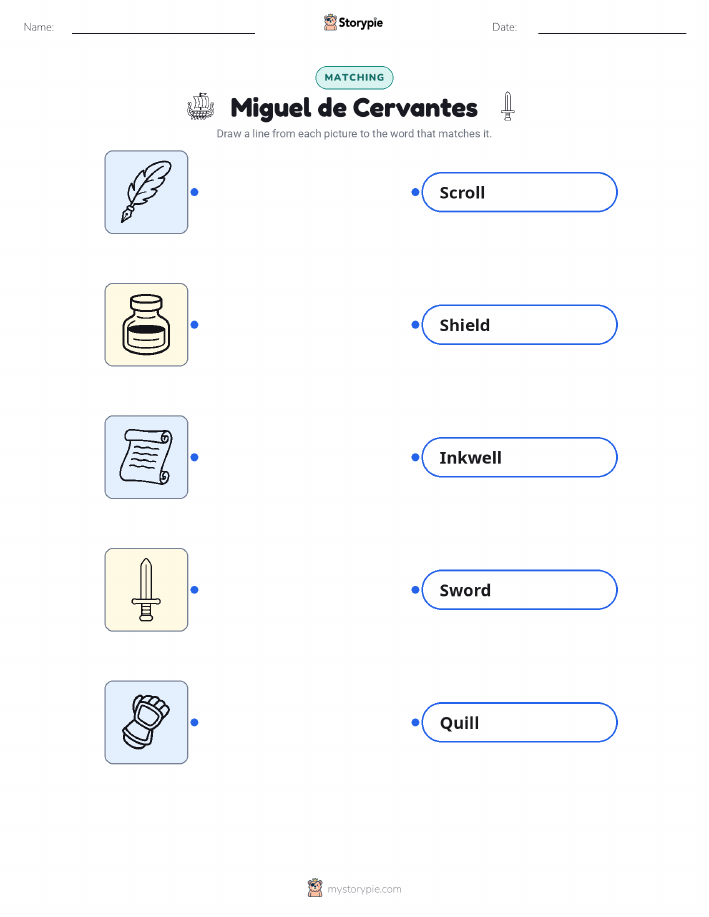
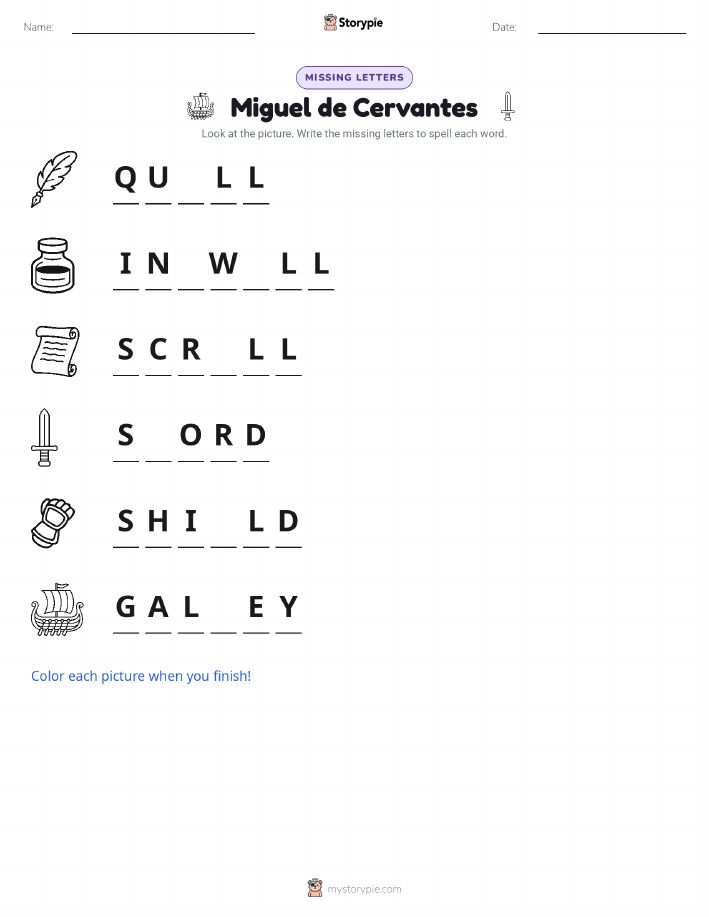
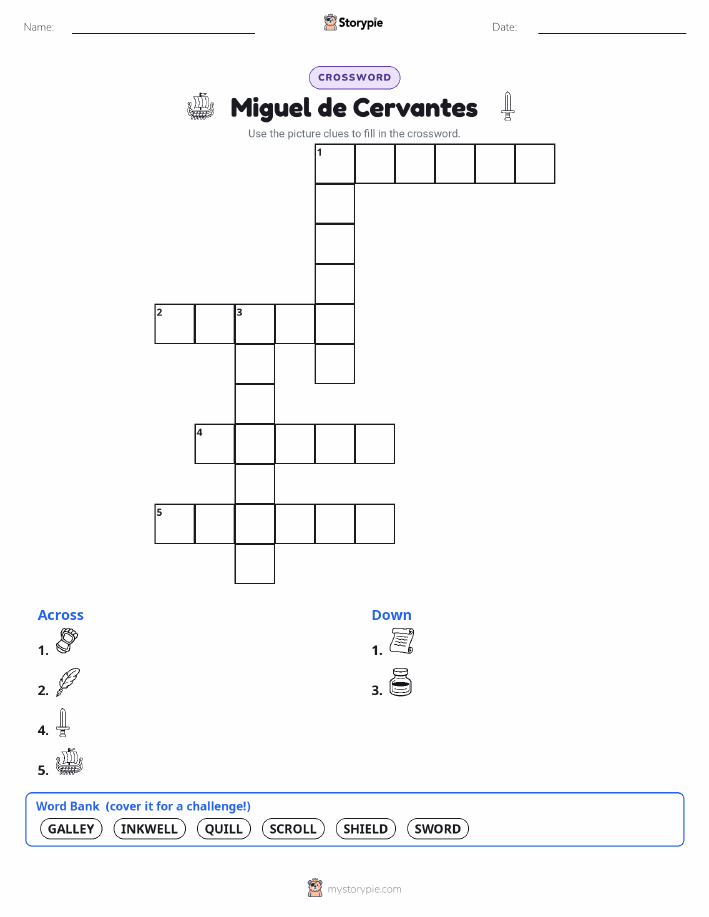
- Printable worksheets & coloring pages

Why Storypie for Schools
Students engaged. Prep in seconds. Evenings back to you.
- Worksheets & Quizzes
- Classroom Management
- Formative Assessment
- Custom Curriculum & Lesson Plans
- 27 Languages

Why Storypie for Homeschool
Curriculum done. They'll ask for more. Hours back in your day.
- Worksheet Generator
- First-Person Audio Stories
- Built-in Comprehension Quizzes
- Custom Curriculum & Lesson Plans
- Print & Go Activities