English

René Descartes
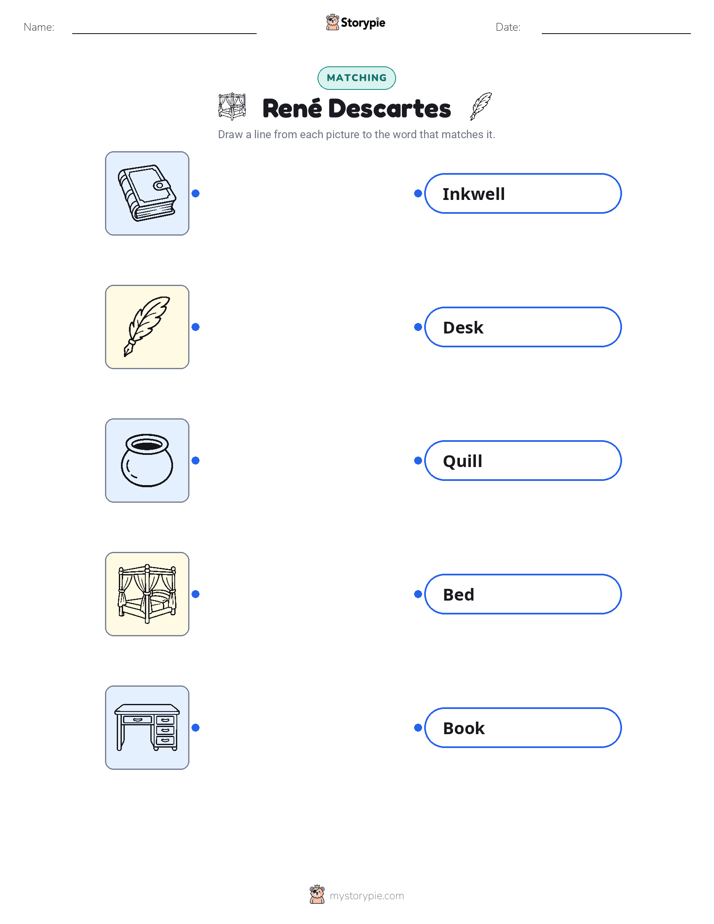
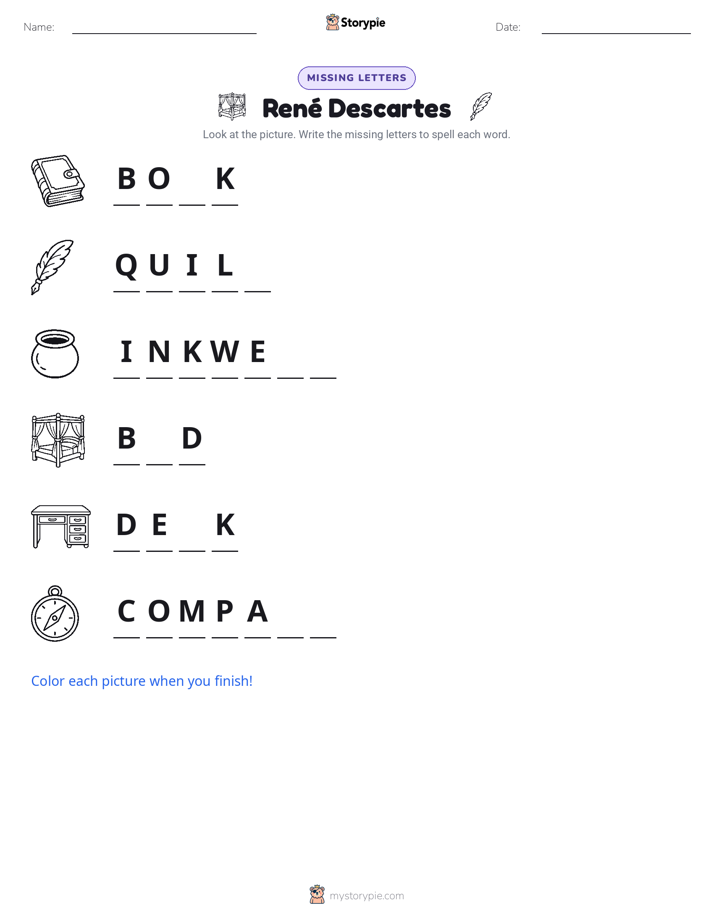
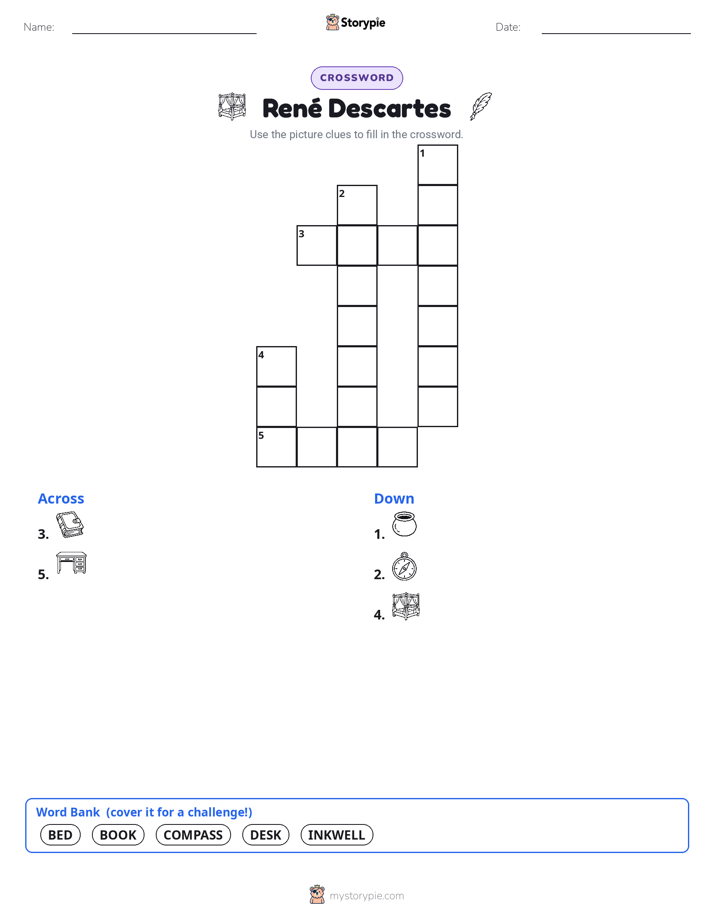
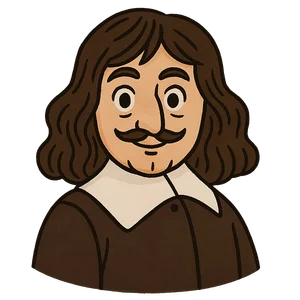
René Descartes was a French philosopher, mathematician…
Reads at Grades 6–8 Listens at Grades 4–8
Print & create
Answer keys·No prep·Free with an account
28 worksheets · answer keys · full story · quiz · Ages 10-12 · CEFR B2
Plus adds 280,000+ more stories in 27 languages, audio for every one, and printables for all of them.
Just want René Descartes?
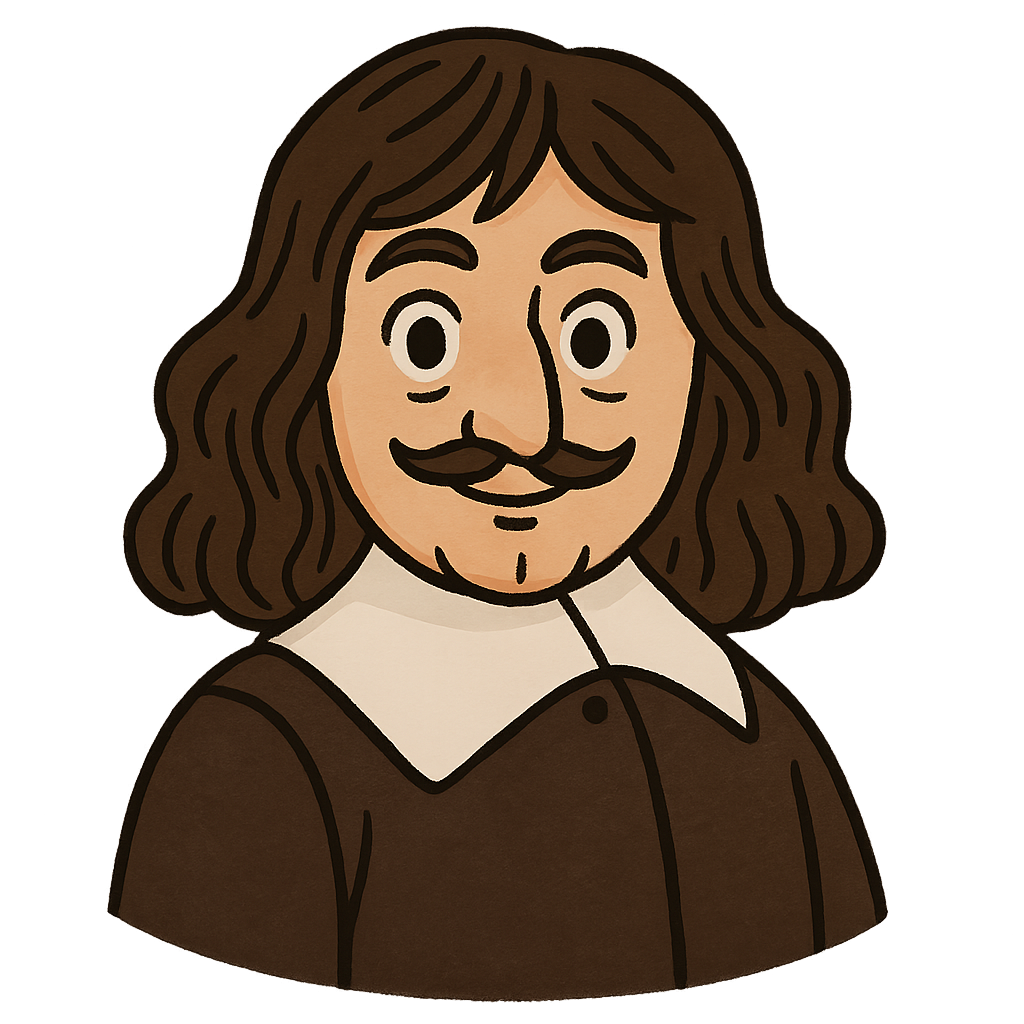
Hello, my name is René Descartes, and I am often called the Father of Modern Philosophy. My story begins in France, where I was born on March 31st, 1596. As a child, I was often sick, which meant I couldn't run and play like other children. Instead, I spent my days in bed, with only my books and my thoughts for company. This quiet time allowed my mind to wander and to question everything I read. In 1607, I was sent to a wonderful school called the Collège Royal Henry-Le-Grand. I was a good student, especially in mathematics, but a seed of doubt had already been planted in my mind. I listened to my teachers and read the ancient books, but I couldn't help but wonder: How could we be absolutely certain that any of this was true? This single question launched me on a lifelong journey to find a kind of knowledge that could not be doubted.
After I earned a degree in law in 1616, I realized that the answers I was looking for were not hidden in old books or classrooms. I decided that I needed to study the 'great book of the world' itself. To do this, I needed to travel and experience life. In 1618, I joined the Dutch army, not because I wanted to be a soldier, but because it offered me the chance to see new countries and meet people with different ideas. My travels were more for learning than for fighting. A truly life-changing event happened on the night of November 10th, 1619. I had a series of powerful dreams that felt like a message. In these dreams, I saw a new way to understand the world, a method that would use the clarity and certainty of mathematics to build a new foundation for all knowledge. I knew then that my true purpose was not to be a lawyer or a soldier, but to be a philosopher and a mathematician who would rebuild knowledge from the ground up, based entirely on reason.
René Descartes: The Father of Modern Philosophy
Hello, my name is René Descartes, and I am often called the Father of Modern Philosophy. My story begins in France, where I was born on March 31st, 1596. As a child, I was often sick, which meant I couldn't run and play like other children. Instead, I spent my days in bed, with only my books and my thoughts for company. This quiet time allowed my mind to wander and to question everything I read. In 1607, I was sent to a wonderful school called the Collège Royal Henry-Le-Grand. I was a good student, especially in mathematics, but a seed of doubt had already been planted in my mind. I listened to my teachers and read the ancient books, but I couldn't help but wonder: How could we be absolutely certain that any of this was true? This single question launched me on a lifelong journey to find a kind of knowledge that could not be doubted.
After I earned a degree in law in 1616, I realized that the answers I was looking for were not hidden in old books or classrooms. I decided that I needed to study the 'great book of the world' itself. To do this, I needed to travel and experience life. In 1618, I joined the Dutch army, not because I wanted to be a soldier, but because it offered me the chance to see new countries and meet people with different ideas. My travels were more for learning than for fighting. A truly life-changing event happened on the night of November 10th, 1619. I had a series of powerful dreams that felt like a message. In these dreams, I saw a new way to understand the world, a method that would use the clarity and certainty of mathematics to build a new foundation for all knowledge. I knew then that my true purpose was not to be a lawyer or a soldier, but to be a philosopher and a mathematician who would rebuild knowledge from the ground up, based entirely on reason.
To pursue this important work without distractions, I moved to the Netherlands in 1628. The country offered a great deal of intellectual freedom, which was exactly what I needed. There, I began to develop what I called my 'method of doubt'. My plan was simple but radical: I would reject anything and everything that could possibly be doubted. I pretended that everything I saw, heard, and learned was false. I even doubted my own senses. But as I sat there doubting, I realized something incredible. In the very act of doubting, I had to exist. A thought must have a thinker. This was the one, single truth that I could not doubt. From this certainty, I formed my most famous statement, which I published in my 1637 book, 'Discourse on the Method'. In Latin, it is 'Cogito, ergo sum', which translates to 'I think, therefore I am'. This became the first solid step, the bedrock upon which I would build my entire philosophy.
My method of seeking certainty wasn't just for philosophy; I believed it could be applied to other fields, especially my favorite subject, mathematics. I saw that algebra, with its symbols and equations, and geometry, with its points and lines, were two separate languages. I wondered if I could unite them to make both more powerful. This led to one of my greatest contributions: analytic geometry. I created a system where any point on a flat surface could be described by a pair of numbers. You know this today as coordinates on a graph with an x-axis and a y-axis. This simple but brilliant idea allowed me to describe shapes like circles and parabolas using algebraic equations. For the first time, geometry problems could be solved with algebra, and algebra could be visualized with geometry. This system was named after me, and even today, it is called the Cartesian coordinate system.
My writings and ideas did not stay within the Netherlands. By the 1640s, my books were being discussed in universities and royal courts all over Europe, and I became quite famous. In 1649, I received a very special invitation. Queen Christina of Sweden, a brilliant and curious young ruler, asked me to come to Stockholm to be her personal philosophy tutor. It was an honor I could not refuse. However, life in Sweden was very different. The winters were bitterly cold, and I was not used to the harsh climate. Worse, the queen insisted that our lessons take place at 5:00 in the morning. For someone like me, who had spent a lifetime doing my best thinking while warm in bed until late in the morning, this was a great challenge. Despite the difficulties, I was committed to sharing my ideas with the eager young queen.
The harsh climate and the demanding schedule in Sweden eventually took a toll on my health. My journey on this earth came to an end on February 11th, 1650. I lived to be 53 years old. Though my life ended, my ideas continued to grow and spread, sparking what is now known as the Age of Reason. I am remembered today as the 'Father of Modern Philosophy' because I encouraged people to stop relying only on tradition and to start using their own power of reason to question the world. Every time you plot a point on a graph in math class, you are using a tool that I helped create. You are continuing my mission to understand the universe not through doubt, but through the clear and beautiful logic of your own mind.
Wow facts
About
René Descartes was a French philosopher, mathematician, and scientist who is widely considered the 'Father of Modern Philosophy.' He is famous for the philosophical statement 'I think, therefore I am' and for inventing the Cartesian coordinate system.
Take a Quiz
Question 1 of 5
What is the main lesson you can learn from René Descartes' story?
Explore next





Want to do even more?
Go beyond exploring. Unlock tools that turn every story into real learning.

Storypie Plus for families
Full stories, quizzes, and printables. Nights and car rides, sorted.
- Unlimited audio stories
- Create Mode: your child stars in the story
- Offline downloads
- Printable worksheets & coloring pages

Why Storypie for Schools
Students engaged. Prep in seconds. Evenings back to you.
- Worksheets & Quizzes
- Classroom Management
- Formative Assessment
- Custom Curriculum & Lesson Plans
- 27 Languages

Why Storypie for Homeschool
Curriculum done. They'll ask for more. Hours back in your day.
- Worksheet Generator
- First-Person Audio Stories
- Built-in Comprehension Quizzes
- Custom Curriculum & Lesson Plans
- Print & Go Activities