

 English

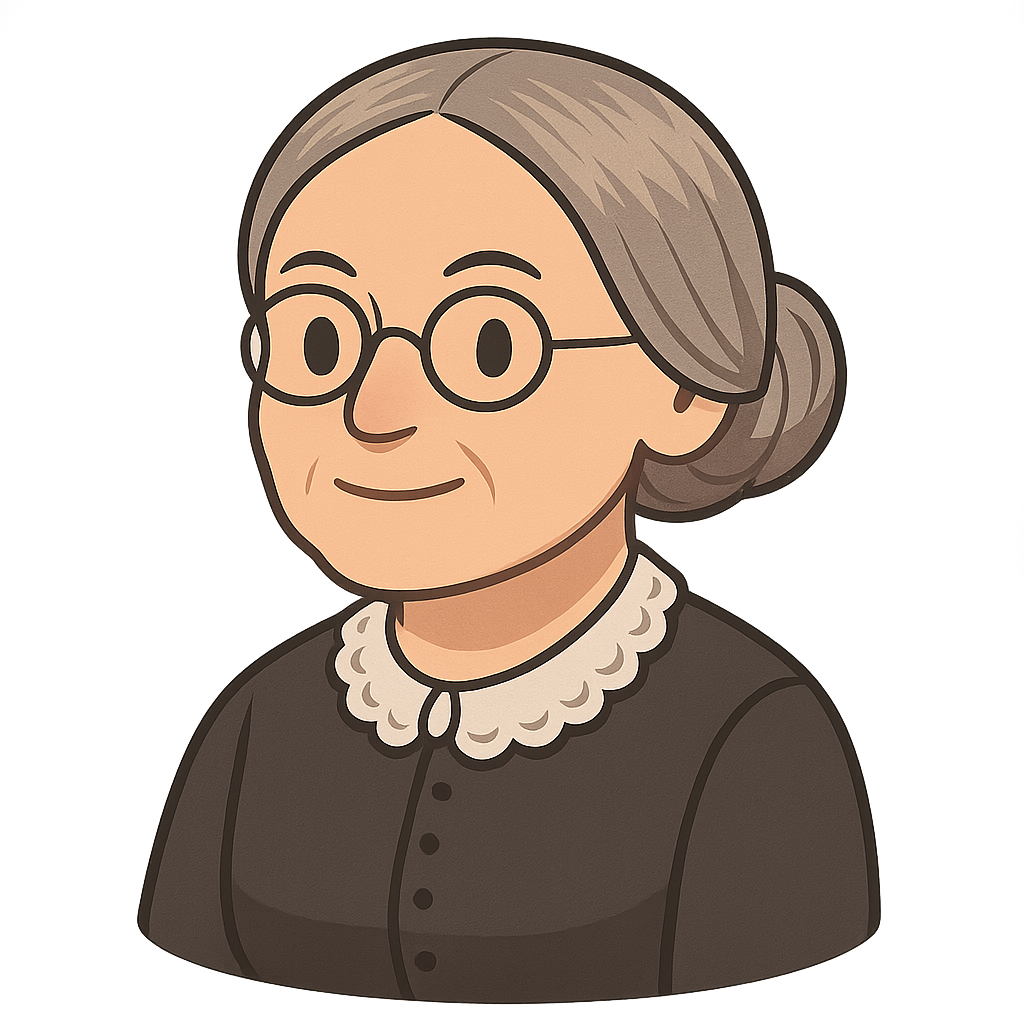
Susan B. Anthony: A Voice for Equality
Hello there. My name is Susan B. Anthony, and I spent my life fighting for a simple idea: that everyone deserves to be treated fairly. My story begins on a chilly day, February 15th, 1820, in a small town called Adams, in Massachusetts. I was born into a Quaker family, and this was perhaps the greatest gift of my childhood. Quakers believe that every single person, man or woman, Black or white, has a special light inside them and is equal in the eyes of God. We didn’t have fancy decorations in our meeting houses, and we believed in simple, honest living. This upbringing taught me from a very young age that my voice mattered just as much as any man’s. My father, Daniel, owned a cotton mill, but he was a man of strong principles. He refused to buy cotton from farmers who used the labor of enslaved people. He and my mother, Lucy, taught my siblings and me to value justice and to stand up for what is right, even when it’s difficult.
When I grew older, I became a teacher, a profession I truly enjoyed. However, it was as a teacher that I first felt the sting of injustice personally. It was the 1840s, and I was working hard, dedicating myself to my students. One day, I discovered a shocking fact: I was being paid only $2.50 a week, while the male teachers in the very same school, doing the very same job, were earning $10.00 a week. It was four times as much. A fire was lit inside me that day. How could this be fair? I knew in my heart that my work was just as valuable as theirs. This wasn't just about money; it was about respect. It was about being seen as an equal. That experience, combined with my family's passionate work in the abolitionist movement to end slavery, convinced me that I could not stand by while such unfairness existed. I had to do something. I knew my life’s path would be to fight for equality for all.
My journey into activism began with the movements against slavery and alcohol, but my world changed forever in 1851. That year, I traveled to an anti-slavery meeting in Seneca Falls, New York, where I was introduced to a woman named Elizabeth Cady Stanton. Meeting Elizabeth was like finding a missing piece of my own soul. She was a brilliant thinker and a powerful writer, but as a wife and mother of many children, she was often tied to her home. I, on the other hand, was unmarried and free to travel. We quickly realized we made a perfect team. She would often say, “I forged the thunderbolts, and she fired them.” Elizabeth would craft the passionate speeches and articles from her desk, and I would take to the road, delivering those powerful words to audiences all across the country. We wanted to change the world, and we knew we could do it together.
Our work was not easy. We faced angry mobs and people who shouted insults at us. Men threw rotten eggs and vegetables at me while I spoke on stage. Newspapers drew cruel cartoons of us, calling us unfeminine and radical. But we refused to be silenced. After the Civil War ended, we were heartbroken when the 14th and 15th Amendments were passed. These new laws gave voting rights to African American men, which was a great step forward for justice, but women—both Black and white—were still left out. We felt betrayed. So, in 1869, Elizabeth and I founded our own organization, the National Woman Suffrage Association. Our goal was clear and unwavering: to fight for an amendment to the U.S. Constitution that would grant all women the right to vote. We even started our own newspaper, which we called The Revolution. Its motto perfectly captured our mission: “Men, their rights, and nothing more; women, their rights, and nothing less.”
I believed that the only way to prove we deserved the right to vote was to take it. On November 5th, 1872, I decided to put the 14th Amendment to the test. It stated that all persons born in the United States were citizens, and I firmly believed that as a citizen, I had the right to vote. Along with my sisters and a dozen other brave women, I walked into a polling station in my hometown of Rochester, New York, and cast my ballot in the presidential election. It was a thrilling moment of defiance, but it did not last long. Two weeks later, a U.S. Marshal knocked on my door and arrested me. My trial, held in 1873, was a spectacle. The judge had made up his mind before it even began. He refused to let me speak in my own defense and ordered the all-male jury to find me guilty. When he sentenced me to pay a $100 fine, I looked him in the eye and declared, “I shall never pay a dollar of your unjust penalty.” And I never did.
That trial, meant to silence me, only made my voice louder. I traveled across the country, sharing the story of my arrest and trial, and arguing passionately for the rights of women. For decades, I gave hundreds of speeches, organized petitions, and met with politicians, never once giving up on our goal. I worked with Elizabeth and others to write the massive History of Woman Suffrage so that the story of our struggle would never be forgotten. I grew old in this fight, dedicating every ounce of my energy to the cause. On March 13th, 1906, at the age of 86, my life came to an end. I did not live to see the day when women could legally vote across the nation. But I never lost hope. In my final public speech, I told my fellow suffragists that with such a dedicated and spirited force, “Failure is impossible.” I was right. Fourteen years after my death, in 1920, the 19th Amendment to the Constitution was finally ratified. It is often called the Susan B. Anthony Amendment, a legacy proving that one person’s unwavering belief in fairness can indeed change the world.
Activities
Take a Quiz
Test what you learned with a fun quiz!
Get creative with colors!
Print a coloring book page of this topic.











 Free for Educators