

 English

The Story of the Carbon Cycle
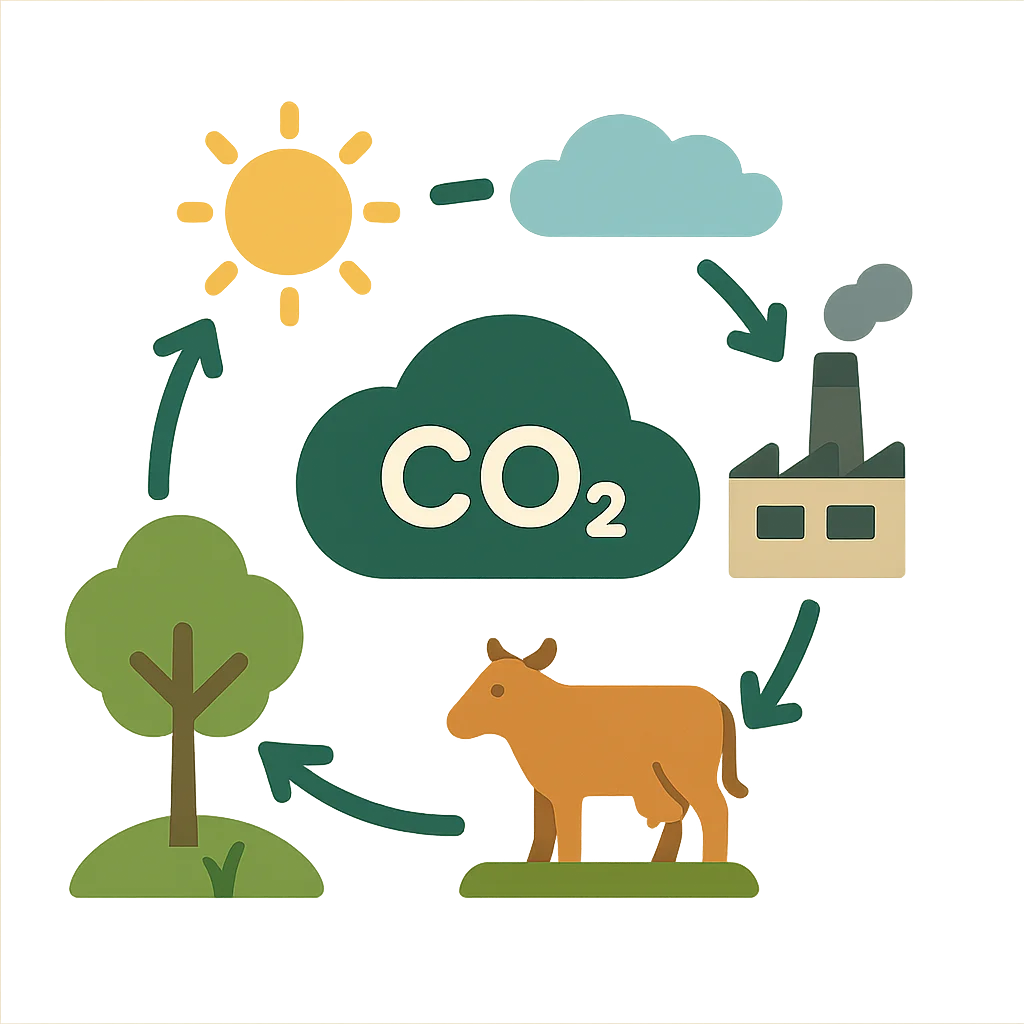
Have you ever felt the tiny bubbles of a fizzy drink tickle your nose. That’s me. Have you ever seen your breath as a misty cloud on a cold day. That’s me, too. I am in the strong, silent wood of the oldest trees and the delicate petals of a brand-new flower. I am a traveler on a journey that never ends. I drift through the atmosphere, a ghost in the air, before plunging deep into the swirling, dark waters of the ocean. There, tiny creatures use me to build their beautiful, intricate shells, which eventually sink to the seafloor, locking me away in stone for millions of years. I am a shapeshifter. Under immense pressure deep within the Earth, I can become the hardest, most brilliant diamond. With less heat and pressure, I am the soft, gray graphite in your pencil that lets you write your own stories. I am a builder, the fundamental block for every living thing you have ever seen. I am a recycler, moving constantly between the living and the nonliving, ensuring that nothing is ever truly wasted. My journey connects the sky, the land, the sea, and every creature within them. I am the Carbon Cycle, and I connect everything.
For most of history, humans knew I was everywhere, but they couldn’t see my paths. My grand, looping journey was a complete mystery. That began to change in the 1770s because of curious people with clever minds. One of them was a man named Joseph Priestley, an English chemist who loved to experiment with air. He noticed something fascinating. If he lit a candle in a sealed glass jar, the flame would eventually go out. If he put a mouse in that same jar, it would quickly struggle to breathe. The air was spoiled. But then, on August 17th, 1771, he placed a living mint plant inside the jar with the spoiled air, and after a few days, he discovered the air was fresh again. A new candle could burn, and a new mouse could breathe. He didn’t know it, but he had discovered one of my most important pathways. He had seen a plant breathing me in. Around the same time, a brilliant French scientist named Antoine Lavoisier was making his own breakthroughs. He was obsessed with precise measurements. Lavoisier figured out that breathing wasn't just moving air in and out, it was a chemical reaction. He demonstrated that animals take in a gas he called oxygen and release a different gas, which he proved was a combination of me and oxygen. He called it carbon dioxide. He realized that respiration was like a very slow, controlled fire, releasing energy to keep bodies warm and active. It was Lavoisier who gave my element its name, carbon, from the Latin word 'carbo' for charcoal. These two discoveries were like finding two sides of the same coin. Later, scientists put all the pieces together. They understood that the green leaves of plants used the energy from sunlight to pull me from the air, combine me with water, and build themselves into leaves, stems, and roots. This incredible process was named photosynthesis. And they confirmed that when animals ate those plants, or when plants and animals decomposed, I was released back into the air through respiration. My secret loop was finally being revealed.
My endless dance is what keeps our world in a delicate, life-sustaining balance. I act like a giant, invisible blanket around the Earth. I trap just enough of the sun’s heat to keep the planet warm and cozy, not too hot and not too cold. For thousands of years, this blanket was the perfect thickness. But then, during a period called the Industrial Revolution, humans discovered that some of my oldest forms, carbon that had been locked away underground for hundreds of millions of years as coal, oil, and natural gas, could be burned for energy. This unlocked incredible new possibilities, powering factories, cars, and entire cities. However, it also meant that huge amounts of my carbon were being released into the atmosphere very, very quickly. It was like pulling the stuffing out of an ancient mattress and adding it to the planet’s blanket. Now, that blanket is getting a little too thick, trapping more heat and causing the world’s climate to change. But the story isn’t over, and it doesn't have to be a scary one. Because humans have understood my journey, they also have the power to help me restore the balance. Every time you plant a tree, you are giving me a new home to live in. Every time we use clean energy from the sun or the wind, we are choosing to leave my ancient stores resting peacefully underground. By being creative and working together, people are writing the next chapter of my story. It is a chapter of balance, of understanding, and of taking care of our amazing shared home.
Activities
Take a Quiz
Test what you learned with a fun quiz!
Get creative with colors!
Print a coloring book page of this topic.














 Free for Educators