

 English

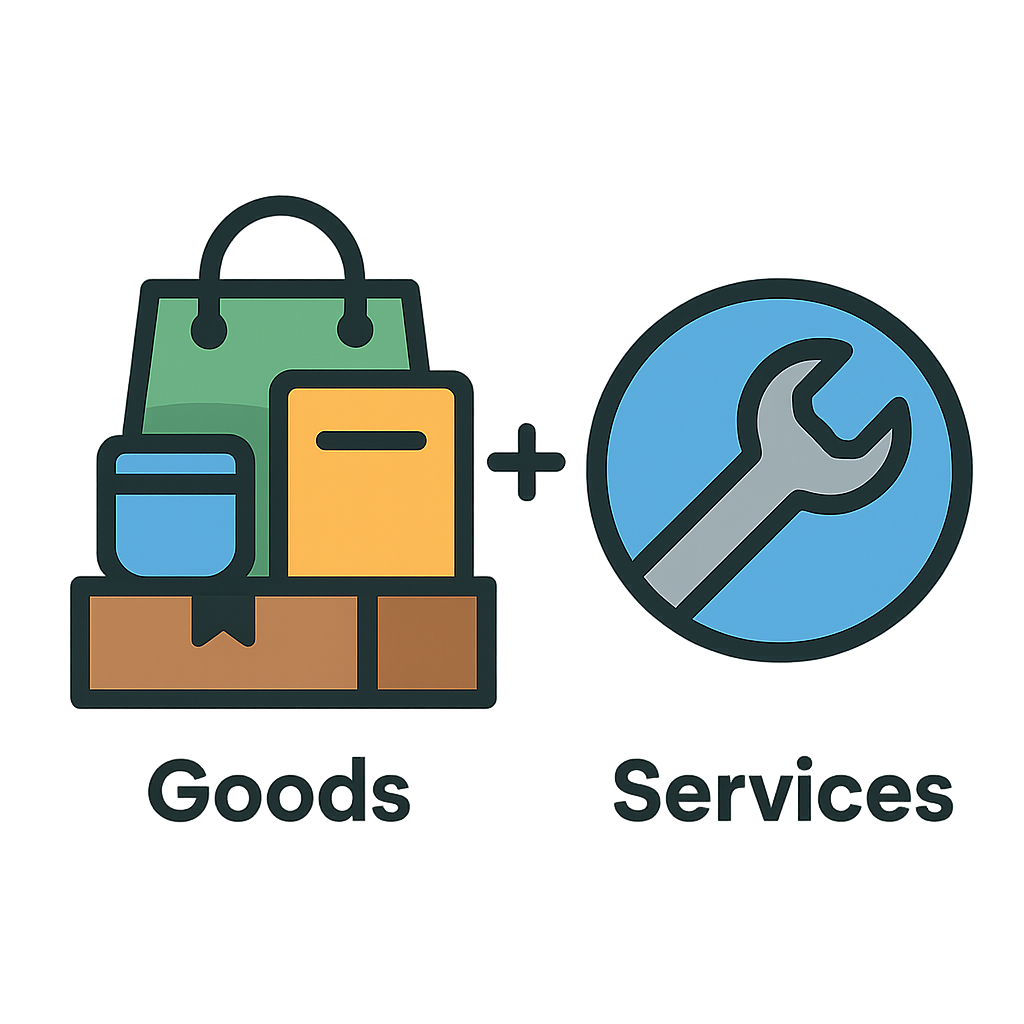
The Story of Goods and Services
Imagine the solid weight of a brand-new soccer ball, its perfectly stitched panels smooth under your fingertips, just waiting for that first powerful kick across a grassy field. Think about the warm, cheesy stretch of a perfect slice of pizza, the savory tomato sauce and delicious toppings making your mouth water as you lift it from the box. Picture the glowing screen of a new video game, its vibrant, pixelated world pulling you into an epic adventure filled with challenges and triumphs. You can hold these things, touch them, and use them. They are solid and real, filling your world with fun, comfort, and excitement. They are the 'stuff' of life, the objects you can point to and say, 'That's mine.' These are the things you can drop on your foot or place on a shelf.
But there’s another part of your world, just as important, but you can’t hold it in your hands. It’s the feeling of a lightbulb switching on in your brain when a teacher patiently explains a tricky math problem, making the numbers finally click into place. It’s the steady rumble of the school bus as the driver expertly navigates busy streets, getting you to school safely and on time every single day. It’s the calm, reassuring voice of a doctor when you’re sick, and the knowledge they use to diagnose your illness and help you feel better. You can't put a haircut in your pocket or store a dentist's check-up in your closet. These are actions, help, skills, and expertise. You can only experience them, but they make your life easier, safer, and so much better.
Have you ever stopped to think about how all of it fits together? The shiny new bicycle and the mechanic who fixed its flat tire. The colorful comic book and the writer who imagined the fantastic story inside. The tangible and the intangible, the objects and the actions, are all part of a massive, interconnected web that you live in every day. They are two sides of the same coin, constantly flowing between people, shaping your experiences from the moment your alarm clock buzzes to the time you drift off to sleep. I am that giant, invisible network that brings all these things together. I am Goods and Services.
My story began a very long time ago, long before there were stores or price tags. In those ancient days, if you wanted something, you had to trade for it. Imagine a skilled potter who could shape clay into beautiful, strong pots—that’s a good. Now, imagine a farmer who had a field full of sweet, juicy berries—another good. If the farmer needed a pot to store water, they might go to the potter and offer a large basket of berries in exchange. If the potter was hungry for berries, it was a perfect deal. This system was called bartering. It was me in my simplest, most direct form. People also bartered services. If you needed help building a sturdy hut to protect you from the rain, you might offer to hunt for the builder’s family for a week in return for their labor. It worked, but it could also be very tricky. What if the potter didn’t want berries that day? What if she needed a new pair of shoes, but the farmer didn't know how to make them? This problem, called the 'double coincidence of wants,' made life complicated. To solve it, people came up with a brilliant idea: money. They agreed on something everyone valued, like shiny shells, salt, or later, metal coins, to use as a medium of exchange. Now, the farmer could sell his berries to anyone for coins and then use those coins to buy a pot from the potter. It made trading much smoother and allowed me to grow.
For centuries, I continued to evolve, but people didn't always stop to think about how I worked. Then, a very thoughtful man in Scotland named Adam Smith spent years observing me. He was fascinated by how nations became wealthy and how people worked together, sometimes without even knowing it, to produce everything they needed. On March 9th, 1776, he published his revolutionary book, The Wealth of Nations. In it, he described me in a way no one had before. He introduced a powerful idea he called the 'division of labor.' It sounds complicated, but it's actually quite simple, and it changed everything.
Adam Smith used the example of a pin factory, but let’s think about something you use every day: a simple pencil. Imagine one person trying to make a pencil all by themselves. They would have to go out and chop down a tree for the wood. Then, they’d have to mine for graphite, mix it with clay, and bake it to make the lead. They would need to cut the wood into perfect little slats, carve a groove for the lead, glue it all together, shape it, sand it, paint it, and finally, attach the metal ferrule and the rubber eraser. It would take them ages just to make one single pencil, and it probably wouldn't be a very good one.
Now, picture Adam Smith’s idea in action. In a factory, one worker operates a machine that cuts the wood into slats. Another worker focuses only on mixing and shaping the graphite cores. A third person’s entire job is to place the graphite into the grooved wood. Another glues and presses the two halves together. Down the line, someone else paints the pencils yellow, another stamps the brand name on them, and a final worker attaches the eraser. Each person becomes an expert at their one small task. By dividing the labor, this team of specialists could produce thousands of high-quality pencils in a single day. This teamwork, Adam Smith explained, was the secret. It made goods cheaper and more plentiful, allowing more people to have the things they needed and wanted. He showed the world that I wasn't just random trading; I was a system that could be organized to make life better for everyone.
Today, I am bigger, faster, and more connected than Adam Smith could have ever dreamed. The simple pencil factory he described has grown into a worldwide network that links billions of people every second. Think about the smartphone in your parents' pocket. That single device is a masterpiece of global cooperation. The idea for its software might have been born in a shiny office in California. The powerful microchips inside were likely engineered in South Korea or Taiwan. The brilliant, touch-sensitive screen could have been manufactured in Japan, and all those intricate parts were probably assembled by skilled workers in a factory in China. That one good is the result of a planet-spanning team.
And it’s not just the things you can hold. Consider the last movie you streamed. That was a service, delivered to you instantly through the internet. But think of the people involved. A writer in London might have crafted the script. Actors in Hollywood brought the characters to life. Animators in Canada may have created the stunning visual effects, and composers in Germany wrote the thrilling musical score. Hundreds, even thousands, of people from different countries collaborated to create that two-hour experience for you. That is the modern me in action: a complex, beautiful dance of goods and services that crosses oceans and continents.
Every single job in the world is a part of my story. The farmer who grows your food is providing a good. The chef who cooks it in a restaurant is providing a service. The engineer who designs a bridge is providing a service; the bridge itself is a good. When you grow up, whatever you choose to do, you will be adding your own unique part to this story. Understanding me helps you see the world not just as a collection of objects, but as a place full of possibilities and connections. You could invent a new gadget that changes how people live, write a book that inspires millions, or create an app that helps people learn. Every time you create, build, or help, you are weaving your own thread into my vast and wonderful tapestry, making the world more interesting, innovative, and connected for everyone.
Activities
Take a Quiz
Test what you learned with a fun quiz!
Get creative with colors!
Print a coloring book page of this topic.













 Free for Educators