
 English
 For Schools
 For Homeschool

The Story of Me, Life
Feel that little flutter in your chest. That’s me. I am the steady thrum of energy in a silent forest, the deep warmth of a cat purring on your lap, and the invisible beat that pulses through your own veins. I am the slow, deliberate unfurling of a fern frond, the secret, silent stretch of a mushroom’s network underground, and the eerie glow of a fish that makes its own light in the crushing darkness of the deep sea. I am there in the dizzying height of the tallest redwood tree, and I am also there in the tiniest germ, a creature so small you could never see it with your eyes alone. For a very long time, humans simply saw me as the difference between a deer leaping through a field and a still, silent stone. They knew I was special, a kind of magic that animated the world, but they couldn’t explain how I worked or what powerful, invisible thread connected a buzzing bee to a blooming flower, or a swimming whale to a soaring eagle. They didn't yet understand that they were part of it, too. I am the great, sprawling, complicated family you belong to. I am Life. I am all Living Things.
For thousands of years, humans have tried to understand and organize me. A brilliant thinker in ancient Greece named Aristotle dedicated his life to observing me, carefully grouping what he saw into two main families: plants and animals. It was a wonderful start, but the biggest secrets I held were hidden in a world he could not see. That all began to change in the 1600s, when a Dutch cloth merchant named Antonie van Leeuwenhoek, driven by intense curiosity, crafted some of the most powerful microscopes of his time. He wanted to see the threads in his cloth more clearly, but he soon turned his lenses to everything else. One day in 1676, he peered into a single drop of pond water and was stunned. He saw a bustling, wriggling, microscopic world filled with creatures he called 'animalcules.' He had discovered my tiniest members, proving that I existed in places no one had ever imagined. It was like finding out your house was secretly home to an entire, invisible city. Nearly two hundred years later, a thoughtful and adventurous young man named Charles Darwin boarded a ship, the HMS Beagle, for a voyage that would change the world. For five long years, he traveled, collected, and observed me in all my glorious forms. In the Galápagos Islands, he was fascinated by the finches, noticing how birds on different islands had uniquely shaped beaks, perfectly suited for the local food source. This and countless other observations planted a revolutionary idea in his mind. On November 24th, 1859, he bravely shared this idea in his book, 'On the Origin of Species.' He proposed that I am not fixed, but am always changing and adapting over millions of years through a process he called natural selection. This grand theory, which we now call evolution, explained how I could branch out into so many different, beautiful forms, all related and connected on one gigantic family tree.
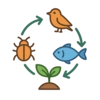
Even with these incredible breakthroughs, the deepest mystery remained: what was the instruction manual? What was the secret code that told a seed how to become a tree, or a single cell how to become a person? The answer was locked deep inside my smallest working parts—my cells. The final key was uncovered in 1953 by a team of brilliant scientists. A chemist named Rosalind Franklin produced a stunningly clear X-ray image of a mysterious molecule. Her image allowed two other scientists, James Watson and Francis Crick, to finally solve the puzzle. They built a model of my secret code, a beautiful, twisting ladder they called a double helix. This molecule was DNA. They had found my blueprint. DNA holds all the instructions for building and operating everything alive, from the color of your eyes to the way a flower creates its petals. Discovering this code transformed human understanding. It allows doctors to fight genetic diseases, helps conservationists protect endangered species by studying their unique DNA, and helps farmers grow stronger crops to feed a hungry world. I am not just a collection of separate things; I am a vast, connected network. The very oxygen you are breathing right now is a gift from me—from the plants and algae that fill the forests and oceans. The food that gives you energy is also me. I am a constant, unfolding story of cooperation, competition, and incredible change. When you watch an ant carry a crumb, walk through a park, or simply feel your own steady pulse, you are connecting with me. You are a precious, unique, and vital part of my story, and your curiosity helps everyone understand me better. So keep asking questions, keep exploring, and remember to help take care of our amazing, living world.
Activities
Take a Quiz
Test what you learned with a fun quiz!
Get creative with colors!
Print a coloring book page of this topic.