

 English

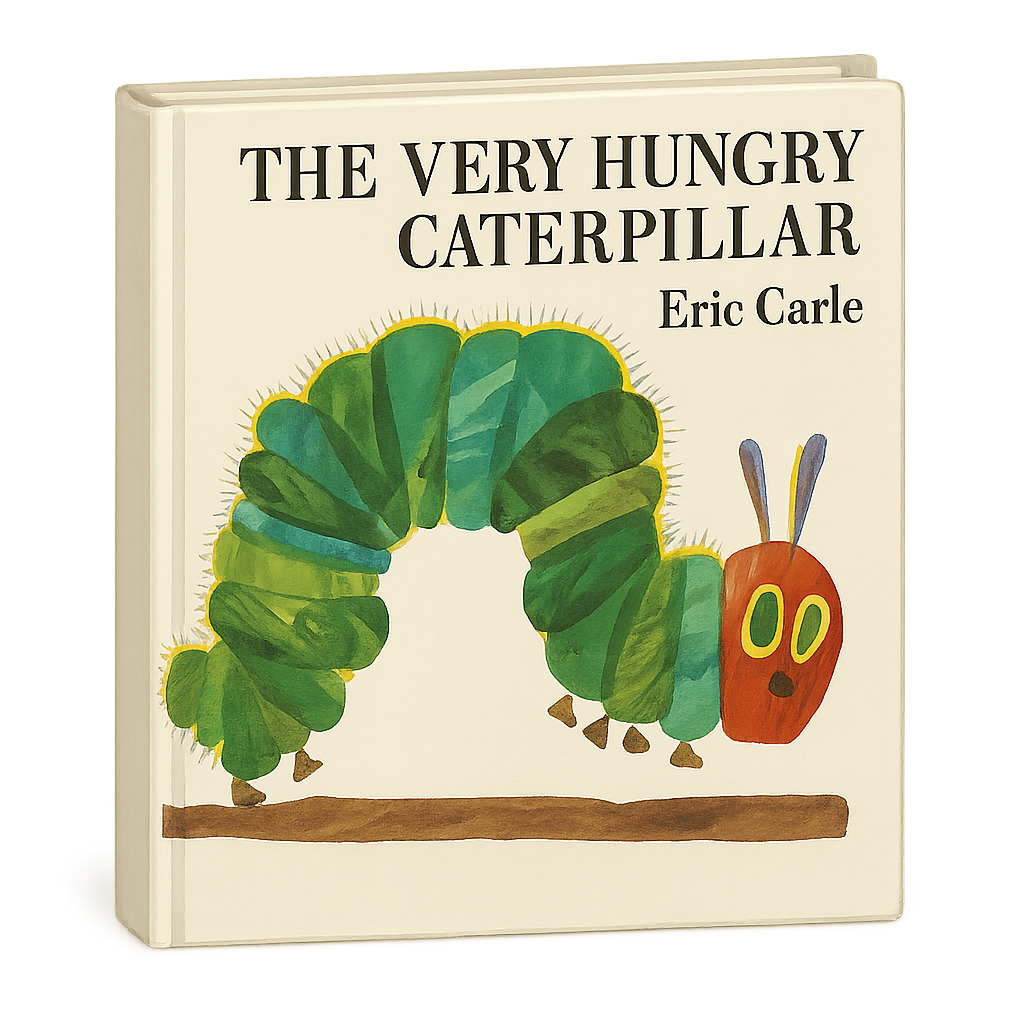
The Very Hungry Caterpillar
Imagine the feeling of being held gently in a pair of small hands. That’s where my life truly begins. I am not large or heavy, but sturdy, made for curious fingers and countless readings. My cover is a vibrant, hopeful green, the color of a fresh leaf in the sun. On it, a big, friendly, red face with curious green eyes greets you, a promise of the colorful journey that waits inside. I hold a wonderful secret between my pages, a story that whispers of hunger, of growth, and of a magnificent transformation. It's a journey of taste and color, from a crisp red apple to a juicy purple plum. But the most peculiar thing about me, the detail that makes children gasp with delight, are the tiny, perfectly round holes that travel through my pages. They are not a mistake. They are part of my story, a trail left behind by a very determined traveler. It looks as if a tiny creature has nibbled its way through, page after page. What, you might wonder, could be so hungry? The answer is the hero of my tale. I am the story of a tiny creature with a giant appetite. I am The Very Hungry Caterpillar.
My story was not written with a pen, but painted with paper. My creator was a brilliant artist named Eric Carle, who saw the world in layers of color and texture. His studio was a wonderland of painted tissue papers. He would take thin, delicate sheets and cover them with swirls of acrylic paint, creating speckles, stripes, and brilliant strokes of every color imaginable. He was a painter who used paper as his canvas and scissors as his brush. To bring me to life, he didn't just draw me. He carefully cut my plump, green body from these painted papers and layered the pieces together, giving me a texture you can almost feel. He did the same for the juicy red apple I ate on Monday, the two sweet pears I nibbled on Tuesday, and all the other delicious foods that mark my journey. My entire world was built from this beautiful, handmade paper collage. The most clever idea, my famous holes, came to him one day while he was playing with a hole puncher. He imagined a bookworm eating its way through the pages and thought, “Why not a caterpillar?” And so, my unique design was born. On June 3rd, 1969, I was officially published, ready to be shared with the world. My story is simple but profound. I hatch from a tiny egg on a Sunday and begin my quest for food. Each day of the week, I eat through a growing number of fruits, helping little readers learn to count and name the days. But my hunger is insatiable. On Saturday, I feast on a wild assortment of foods—chocolate cake, a pickle, a lollipop, and more—which, of course, gives me a terrible tummy ache. A single, big green leaf on Sunday makes me feel much better. Finally, no longer small or hungry, I build a cozy chrysalis around myself and, after a patient wait, emerge as a beautiful, magnificent butterfly.
From that single idea sparked by a hole puncher, I began a giant journey. My simple story of growth and hope seemed to speak a universal language. Soon, I was translated into over 60 different languages, from Spanish to Japanese, allowing me to travel far beyond my home in America. I have nestled on bookshelves in almost every country on Earth, my pages turned by millions of children. Why do so many people love my story? I think it’s because everyone understands what it feels like to grow. My tale is not just about a caterpillar turning into a butterfly; it’s about the universal experience of childhood. It’s about feeling small and sometimes awkward, about the unstoppable need to grow and change, and about the hopeful promise that this change, even when it feels strange, can lead to something wonderful and beautiful. I see the joy on children's faces as they poke their curious fingers through my holes, tracing my path and counting along with my meals. They connect with my journey because, in a way, it is also their own. I am more than just a book with colorful pictures and fun holes. I am a quiet reminder that every one of us, no matter how small we start, is on a journey of transformation. I am proof that even the smallest among us has the potential to grow wings and fly.
Activities
Take a Quiz
Test what you learned with a fun quiz!
Get creative with colors!
Print a coloring book page of this topic.















 Free for Educators