

 English

The Key to a Lost World
My name is Jean-François Champollion, and my life's great adventure began not on a battlefield or a throne, but in a dusty library in my home of Figeac, France. Even as a boy in the late 1790s, I was utterly captivated by languages. While other children played outside, I spent hours with my older brother, Jacques-Joseph, poring over ancient texts in Latin, Greek, and Hebrew. But one land, one ancient people, held a special magic for me: Egypt. At that time, our country was buzzing with news from Napoleon Bonaparte’s expeditions there. Soldiers and scholars were returning with incredible artifacts—statues of pharaohs, detailed papyrus scrolls, and trinkets covered in a form of picture-writing that no one in the world could read. They were called hieroglyphs, and to me, they were the most beautiful and frustrating mystery imaginable. I remember seeing drawings of these artifacts and feeling a deep pull, a sense of connection to the people who had carved them thousands of years before. Who were they? What were their stories? The silence of their lost language was a challenge I could not ignore. One day, looking at a copy of an inscription with my brother, I felt a surge of determination. I made a promise, both to him and to myself. I declared, “I will be the one to read this. I will give Egypt its voice back.” It was a bold claim for a young boy, but it became the guiding star of my entire life.
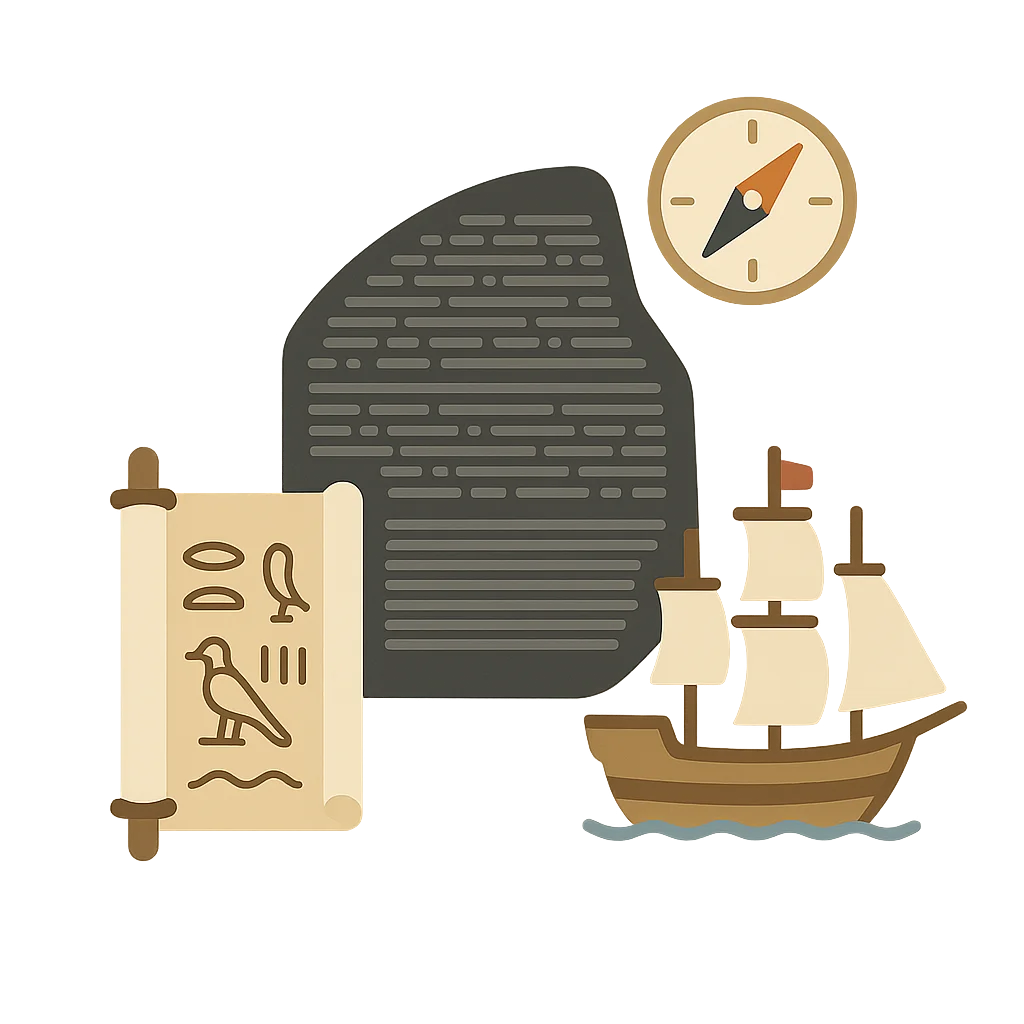
That promise echoed in my mind for years. I devoted myself to studying, learning not only ancient languages but also Coptic, the language of the Egyptian Christians, which I suspected was a direct descendant of the tongue spoken by the pharaohs. Then, news arrived that would change everything. On July 15th, 1799, while strengthening the foundations of a fort near a town the French called Rosetta, a soldier named Pierre-François Bouchard uncovered something extraordinary. It wasn't gold or a pharaoh's tomb, but a broken slab of dark, heavy stone. At first, it might not have seemed like much, but when cleaned, it revealed something astonishing. The stone was covered in three distinct bands of writing. The top portion was inscribed with the elegant, pictorial hieroglyphs I so longed to understand. Below that was a second script, a flowing, cursive writing that scholars called Demotic, the common script of later Egypt. And at the very bottom, there was a third inscription in a language we could read: Ancient Greek. The moment this was understood, a wave of excitement spread through the scholarly world. The Greek text stated that the decree on the stone was to be written in all three forms—the sacred, the common, and the Greek. This meant the stone was a key. The Greek text was the translation for the other two. The Rosetta Stone, as it came to be known, was the dictionary we had all been dreaming of. Even though I was still a boy when it was found, the news fueled my passion. I knew that stone held the answer to my promise.
Getting my hands on a copy of the inscriptions became my sole focus. The years that followed were a long and difficult journey—a great intellectual race against the brightest minds in Europe. My most notable rival was an English scholar named Thomas Young, a brilliant man who made important early discoveries. He correctly figured out that the oval shapes, which we call cartouches, contained royal names and that some of the hieroglyphs represented sounds, not just ideas. He was on the right path, but he believed the phonetic signs were only used for foreign rulers' names, like the Greek Ptolemy. I suspected the system was far more complex. I spent over a decade comparing the texts, cross-referencing symbols, and filling notebooks with my theories. My knowledge of Coptic proved to be my secret weapon, giving me clues to the sounds of the ancient Egyptian words. The breakthrough came from comparing the cartouches of 'Ptolemy' and 'Cleopatra'. I painstakingly matched the symbols to the sounds in their names. P, T, O, L—the sounds were there. This confirmed the phonetic principle. But the final piece of the puzzle clicked into place on September 14th, 1822. I was studying a cartouche with symbols I had not yet identified. I sounded them out using my new system and recognized the name 'Ramesses', a native Egyptian pharaoh. It proved that the phonetic system was used for all rulers, not just foreign ones. I realized in a flash that the hieroglyphic system was a magnificent, complex mixture of signs for sounds, ideas, and objects all working together. Overwhelmed with joy and exhaustion, I ran to my brother’s office, burst through the door, and exclaimed, “Je tiens l'affaire!”—“I've got it!” Then, after years of relentless work, I promptly fainted.
That moment changed not just my life, but our understanding of human history. When I awoke, I knew that the silence of ancient Egypt was finally broken. The Rosetta Stone was more than just a key to a code; it was the key to an entire civilization. For the first time in over 1,500 years, the people of ancient Egypt could speak to us in their own words. My discovery allowed us to read the grand inscriptions on temple walls, the spells for the afterlife in the Book of the Dead, and the everyday letters written on papyrus. We learned of their kings and queens, their gods and goddesses, their triumphs and their heartaches. A whole world, once lost to time, was reborn. My childhood promise had been fulfilled. The work was long and often felt impossible, but it taught me the profound importance of perseverance and curiosity. By unlocking the past, we do not simply learn about those who came before us; we learn more about ourselves and the incredible, continuous story of humanity. Understanding their world helps us build a wiser and more connected future.
Activities
Get creative with colors!
Print a coloring book page of this topic.













 Free for Educators