

 English

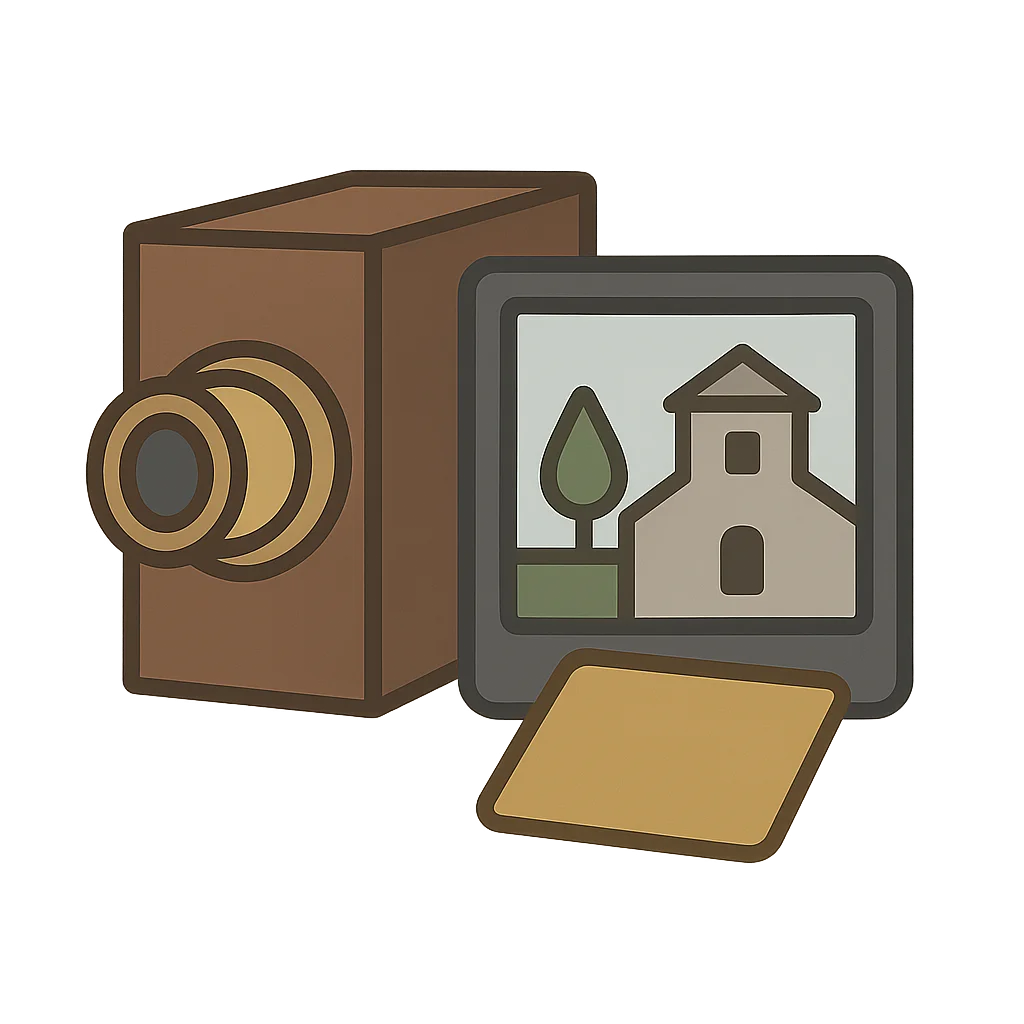
My Window to the World: The First Photograph
My name is Joseph Nicéphore Niépce, and my story begins not in a grand laboratory, but at my country estate, Le Gras, in the beautiful Burgundy region of France. The early 1800s were a time of great change and invention, and I, like many others, was filled with an insatiable curiosity. I spent my days inventing all sorts of things, from an early internal combustion engine for boats to a new method for making copies of engravings. But my greatest fascination, the one that truly captured my soul, was with light itself. I was captivated by a device called the camera obscura, which in Latin means ‘dark chamber.’ It was a simple box with a tiny hole, and through that hole, it could project a perfect, moving image of the world outside onto a surface inside. It was pure magic. I could see the leaves of the trees swaying in the breeze, the clouds drifting across the sky, all painted with light right before my eyes. But there was a deep frustration that came with this magic. The moment I moved the box or the light changed, the image was gone forever. It was as fleeting as a dream upon waking. This beautiful, living picture simply vanished. A powerful idea took root in my mind: what if I could find a way to make these images stay?. What if I could command the sun to be my artist and permanently capture a single moment of reality?. This question became my obsession, my life’s great challenge. I was determined to 'fix' these sun-drawn pictures, to seize a sliver of time and hold it forever.
My quest was not a short one. It was a long and often discouraging journey filled with countless failures. For more than a decade, I toiled away in my workshop. I experimented with silver salts, which I knew darkened in the sunlight, but the images they produced were negatives and faded away far too quickly. I tried coating stone, glass, and metal with different chemicals, hoping one would hold the light. Many days ended with nothing but stained fingers and a heavy heart. My friends and family must have thought I was chasing a phantom. But my belief in the idea never wavered. Around 1822, I began working with a peculiar substance called bitumen of Judea. It was a type of natural asphalt, and I discovered something remarkable about it: when this bitumen was exposed to bright light for a long time, it hardened and became insoluble, meaning it wouldn't wash away. This was the key I had been searching for. So, on a bright summer day in 1826, I decided to attempt my most ambitious experiment yet. I took a polished pewter plate and coated it with a thin layer of the bitumen dissolved in lavender oil. With the sticky, light-sensitive plate ready, I carried it to the attic workshop of my home. I placed it carefully inside my camera obscura and aimed the lens out the open window, toward the view of my estate—the barn, the pear tree, and the distant bakehouse. Then, I opened the aperture and let the sunlight begin its slow, silent work. There was nothing to do now but wait. For the next eight hours, perhaps even longer, the plate sat there, bathing in the sunlight. I watched the sun crawl across the sky, its light shifting through the window, painting the scene onto my plate. It was a test of supreme patience. Was this another failure?. Or was I, at last, on the brink of capturing a ghost?. I could only hope.
As dusk began to settle, I knew the moment had come. My heart hammered in my chest as I carefully retrieved the pewter plate from the dark box. At first glance, it looked like nothing special, just a dark, coated piece of metal. There was no image to see. I carried it with trembling hands to my workshop, a place that had witnessed so many of my failed attempts. The next step was the most delicate of all. I had to wash the plate in a mixture of lavender oil and white petroleum. The theory was simple: the solvent would wash away the parts of the bitumen that had been in shadow and remained soft, while leaving behind the light-hardened parts that formed the image. I poured the mixture over the plate and began to gently wash its surface. Slowly, miraculously, something began to appear. Faint lines and shapes emerged from the dark coating, like a secret being whispered from the metal. My breath caught in my throat. As the last of the soft bitumen dissolved away, the image became clear. There it was. A ghostly, ethereal impression of the view from my window. The slanted roof of the pigeon-house, the gentle slope of the barn's roof, the bakehouse in the distance, and the sky above. It was not sharp or detailed like a painting. It was blurry and abstract. But it was real. It was a moment of light and time, snatched from the world and held fast on a piece of metal. I stared at it in profound awe. After so many years of struggle, I had done it. I had made the world's first permanent photograph.
I named my creation 'Heliography,' which means 'sun-writing,' for it was the sun itself that had been my artist. That single, blurry image from my window was more than just a scientific success; it was a window to the future. It was the very first step on a long and incredible road. A few years later, in 1829, I began a partnership with a man named Louis Daguerre, who was also fascinated with capturing images. Though I passed away before our work could truly flourish, he would go on to build upon my discoveries, creating a much faster and clearer photographic process. My Heliograph was just the beginning. It was a quiet, lonely invention born from patience and curiosity. But that single image proved that it was possible to preserve a moment in time. It opened a new way for humanity to see itself and the world. Because of that eight-hour-long exposure, we can now see photographs of distant galaxies, pictures of our own families, and images from moments in history that happened long ago. My story is a reminder that sometimes the most important ideas take a very long time to come into focus. So, I encourage you to stay curious, to be patient with your own dreams, and to never stop trying, because you never know when your window will open up to a view that changes the world.
Activities
Take a Quiz
Test what you learned with a fun quiz!
Get creative with colors!
Print a coloring book page of this topic.











 Free for Educators