

 English

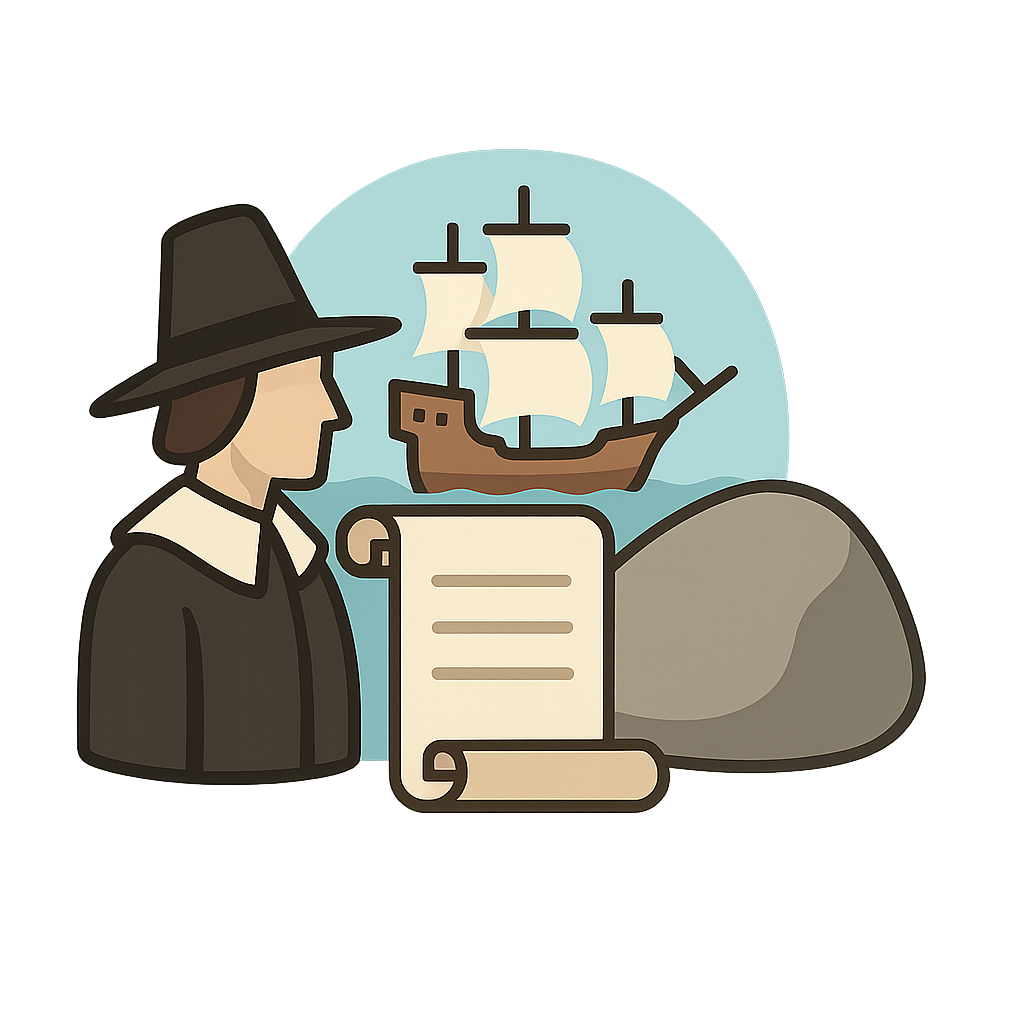
A Pilgrim's Journey: My Story of the Mayflower
A Farewell to the Old World
My name is William Bradford, and I was once the governor of a small colony called Plymouth. But long before that, I was just a man with a deep faith and a powerful hope for a different kind of life. In the early 1600s, my friends and I in England were known as Separatists. This was a dangerous thing to be. We believed that the Church of England had become corrupt and that we needed to separate from it to worship God in a pure and simple way. This belief was not welcome. We were hunted, watched, and even imprisoned for our faith. So, in 1608, we first sought refuge in Holland, a land known for its tolerance. Holland was kind to us, but after a decade, we saw our children growing up more Dutch than English, and we still longed for a place to build a community truly our own, under our own governance and grounded in our own faith. The idea of a New World, a vast and unsettled land across the great Atlantic Ocean, began to take root in our hearts. It was a terrifying prospect, filled with unknown dangers, but it was also a chance to build a new life from scratch. We spent months preparing, gathering supplies, and securing investors for our perilous journey. Our plan involved two ships, the Speedwell to carry our friends from Holland and the Mayflower to meet us from London. But our plans went awry from the start. The Speedwell proved unseaworthy, leaking so badly that it had to be abandoned. All of us, more than one hundred souls, had to crowd onto the Mayflower. It was a difficult beginning, a mixture of profound hope for the future and deep trepidation for the immense challenges that lay ahead.
A World of Water and Wind
The journey across the Atlantic began on September 6th, 1620, and it was more grueling than any of us could have imagined. For sixty-six days, the Mayflower was our entire world, and what a small, miserable world it was. We were packed below deck in cramped, dark quarters where the air was stale and damp. There was no room to stand upright, and the constant rocking of the ship made nearly everyone sick. We survived on a diet of salted beef, hard biscuits called tack, and beer, as the water was often unsafe to drink. But the worst part was the storms. The Atlantic in autumn is a ferocious beast. We encountered fierce gales that tossed our little ship like a piece of driftwood. The wind howled through the rigging, and massive waves crashed over the deck, sending cold seawater cascading down into our living space, soaking our clothes and bedding. There was a moment of sheer terror when, during one violent storm, a massive wave struck the ship with such force that it cracked one of the main support beams. The sound was like a great beast groaning in pain, and we all believed we were doomed. Water began to pour in, and the ship started to list dangerously. But through providence and ingenuity, one of the passengers remembered a great iron screw he had brought from Holland, part of a printing press. Working together in the swaying, dark hold, the men managed to hoist the massive beam back into place and secure it with the screw. It was a miracle that saved us all from a watery grave. Amidst all this hardship, a small sign of hope appeared. A young woman named Elizabeth Hopkins gave birth to a baby boy. They named him Oceanus, a fitting name for a child born in the middle of that vast, wild sea. His small cries were a reminder that even in the darkest of times, life continues.
A New Shore and a New Promise
On November 9th, 1620, after what felt like an eternity at sea, a lookout shouted the words we had all been praying to hear: 'Land, ho.'. The sense of relief that washed over us was indescribable. We wept, we prayed, and we embraced one another. We had made it. But our challenges were far from over. As we neared the coast, we realized we were at Cape Cod, far north of our intended destination near the Hudson River in Virginia. This was a serious problem. Our legal patent was for Virginia, which meant that here, in this new land, we were outside the authority of any English law. Some of the passengers who were not part of our Separatist group—we called them the 'Strangers'—began to mutter that they owed no obedience to anyone, that they would use their own liberty when they came ashore. I saw the danger immediately. If we did not unite under a common set of rules, our community would splinter into chaos before it even began. So, before we set foot on land, the leaders gathered in the great cabin of the Mayflower. On November 11th, 1620, we drafted an agreement, a simple but powerful document we now call the Mayflower Compact. In it, we all promised to combine ourselves into a 'civil body politic,' to create just and equal laws for the general good of the colony, and to obey the leaders we ourselves would choose. Forty-one men, including myself, signed it. It was a foundational promise, a commitment to govern ourselves and work together for our mutual survival. It was the first seed of self-government planted in this new soil.
The Great Sickness and a Glimmer of Hope
Our first winter in Plymouth was the cruelest time I have ever known. We were weak from the voyage, our supplies were low, and we had to build shelters in the biting cold of a New England winter. The work was slow and exhausting. Soon, a terrible illness swept through our small settlement. It was a combination of scurvy, pneumonia, and the general hardship we faced. We called it the 'Great Sickness.' At its peak, only six or seven of us were well enough to care for the sick and bury the dead. We lost so many. Scarcely a day went by when we did not have to dig a grave in the frozen ground. By the end of that winter, nearly half of our original one hundred and two passengers were gone, including my own beloved wife. It was a time of immense sorrow, and I confess that our faith was tested to its very limits. But just as our hope was dwindling, a miracle occurred. In the middle of March 1621, a tall Native man walked boldly into our settlement and, to our utter astonishment, greeted us in broken English. His name was Samoset. He told us of another man named Squanto, or Tisquantum, whose English was perfect. Squanto’s story was incredible; he had been kidnapped years before, taken to Europe, and had only recently returned to find his entire Patuxet tribe wiped out by disease. He was the last of his people. Squanto became our guide and teacher, a special instrument sent of God. He taught us how to plant corn in the native way, using fish for fertilizer. He showed us the best places to fish and hunt and acted as our interpreter and diplomat with the local Wampanoag people and their great leader, Chief Massasoit. Without Squanto’s help, I do not believe any of us would have survived.
A Harvest of Gratitude
Thanks to Squanto’s guidance and our own hard work, the summer of 1621 brought a bountiful harvest. Our cornfields flourished, and our storehouses began to fill with food for the coming winter. After surviving the harrowing voyage and the devastating sickness, our hearts were filled with profound gratitude. We felt we had finally found our footing in this new world. To celebrate and give thanks to God for His mercy, we decided to hold a special harvest feast in the autumn of 1621. I sent men out to hunt for fowl, and we prepared what food we had. In a gesture of friendship and diplomacy, we invited our Wampanoag allies. Chief Massasoit arrived with about ninety of his men, and for three days, we shared food, played games, and celebrated together. That feast, a simple gathering of two very different peoples sharing a moment of peace and thankfulness, is now remembered as the first Thanksgiving. It was a testament to our perseverance and a symbol of the hope that, through cooperation and faith, a new and better world could be built even after the most difficult of beginnings.
Activities
Take a Quiz
Test what you learned with a fun quiz!
Get creative with colors!
Print a coloring book page of this topic.










 Free for Educators