

 English

A President's Promise: The Story of Yellowstone
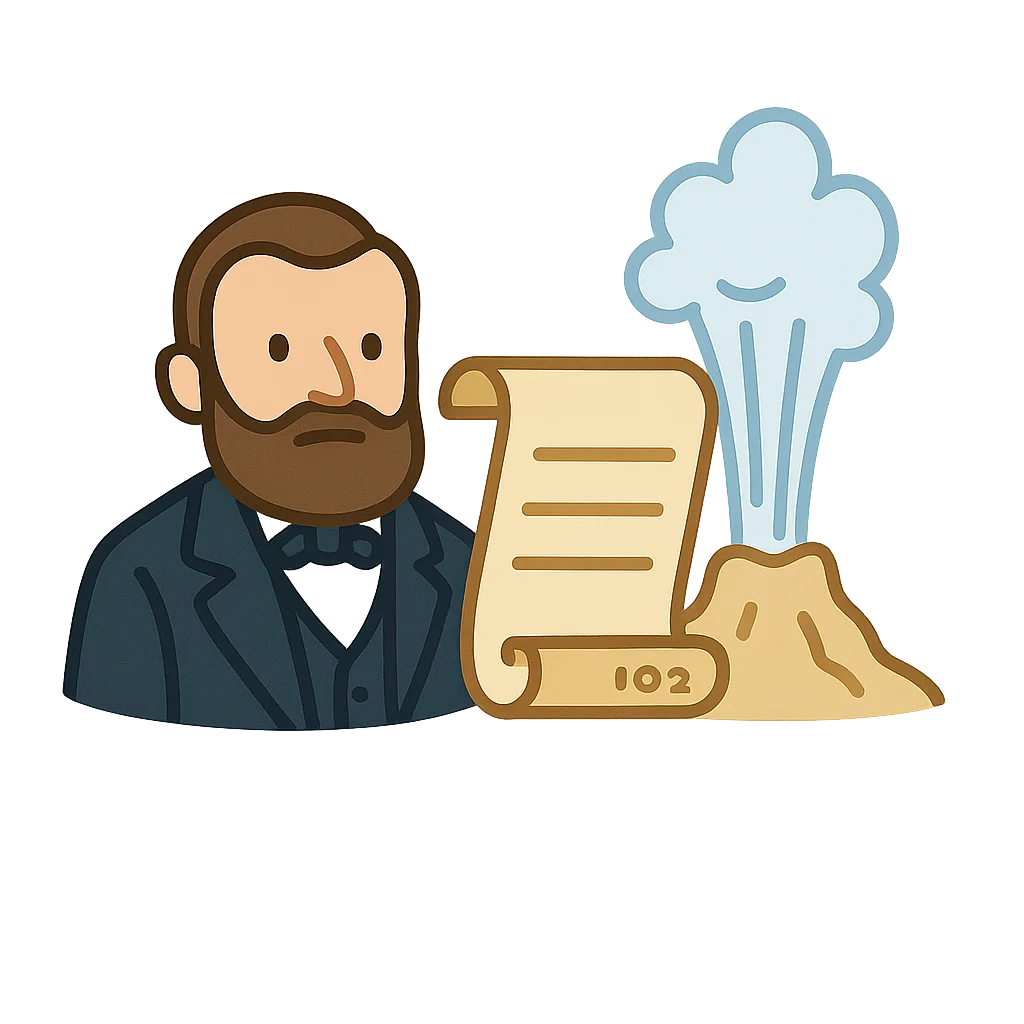
Hello there. My name is Ulysses S. Grant, and I had the great honor of serving as the 18th President of the United States. I am speaking to you now from a time long past, looking back on a moment that fills me with pride. The years after the Civil War, during the 1870s, were a time of healing and rebuilding for our nation. The country was piecing itself back together, and many people were looking westward, toward the vast, unexplored territories, with a sense of adventure and hope. It was during this time that I began to hear the most incredible stories coming from the lands we then called the Wyoming and Montana territories. Trappers and explorers who returned to the East spoke of a place that sounded like something from a fantasy book. They described rivers that were boiling hot, ground that hissed with steam, and mighty fountains of water, which they called geysers, that erupted high into the sky with a thunderous roar. They spoke of mud that bubbled like a witch’s cauldron and canyons so deep and colorful they seemed to be painted by a giant’s hand. For generations, Native American tribes like the Crow, Shoshone, and Bannock had known of this powerful and sacred land, but to us in Washington D.C., it all sounded too fantastic to be true. I must admit, even I was skeptical. But the stories were so persistent, so vivid, that I knew we had to learn more.
Mere stories, no matter how exciting, were not enough to convince the serious men of Congress to act. They needed proof. That proof arrived thanks to an important government-funded expedition in 1871, led by a geologist named Ferdinand V. Hayden. His team of scientists set out to map the region and document its wonders. When they returned, they brought back more than just scientific reports filled with facts and figures. They brought back the magic of the place itself. For the first time, we had undeniable evidence. With the expedition was a photographer named William Henry Jackson. He had hauled his heavy, clumsy camera equipment over mountains and across rivers to capture images of this unbelievable landscape. When his photographs were displayed in the Capitol building, people were speechless. There, in black and white, was a geyser we would later call 'Old Faithful', captured mid-eruption, soaring toward the clouds. There were the cascading waterfalls and the strange, terraced hot springs. These pictures proved the stories were real. Accompanying the photographs were the magnificent paintings of an artist named Thomas Moran. While Jackson’s photos gave us the truth of the land, Moran’s paintings gave us its soul. He used brilliant colors to show the fiery oranges and deep blues of the hot springs and the breathtaking, golden walls of the Grand Canyon of the Yellowstone. Seeing his work was like looking through a window into this enchanted world. Together, the photographs and paintings silenced the doubters and ignited the imagination of our nation’s leaders.
With this stunning proof before us, a new and very serious conversation began in the halls of Congress. What should be done with this remarkable land? In those days, the standard practice was simple: the government would survey the land and sell it off in parcels to homesteaders, railroad companies, or mining corporations. The idea was to encourage settlement and make use of the land’s resources. Many people argued we should do the same with this strange place of geysers and canyons. They saw timber to be logged, minerals to be mined, and land for ranches and towns. But a few forward-thinking individuals, including Dr. Hayden himself, proposed something completely different, something truly unprecedented. They argued that a place so unique, so wondrous, should not belong to any one person or company. It was a natural treasure that was too precious to be developed or fenced off. They put forth a radical idea: that the government should set this land aside and protect it forever, not for profit, but as a 'public park or pleasuring-ground for the benefit and enjoyment of the people'. This was a concept no nation had ever tried on such a grand scale. It would mean taking over two million acres of land and declaring that its value was not in what could be taken from it, but in what it offered to the human spirit. It was a debate about the future, a choice between short-term profit and a long-term legacy for all Americans.
After much discussion, a bill was written: The Yellowstone National Park Protection Act. It passed through Congress, and soon it arrived at my desk in the White House. I remember that day clearly. It was March 1st, 1872. The document lay before me, its formal language holding within it a truly revolutionary idea. I picked up my pen and looked at the words. I thought about the incredible photographs and the vibrant paintings. I thought about the future of our country, a nation still young and full of potential. I realized that we had a rare opportunity to do something not just for our own generation, but for every generation that would follow. By signing my name, I would be making a promise that this piece of the American wilderness would remain wild and accessible to everyone, rich or poor, for all time. It felt like a profound responsibility. With a steady hand, I signed the act into law. In that quiet moment, with the simple stroke of a pen, we created the world's very first national park.
That decision on March 1st, 1872, echoed far beyond the borders of Yellowstone. The creation of Yellowstone National Park became a model, an idea that spread across the country and then around the globe. It was the beginning of a movement to preserve our planet's most special places. Because of that act, we later established other great parks like Yosemite, Sequoia, and the Grand Canyon. Today, you can visit these places and see the same wonders that amazed those early explorers. My hope is that when you stand before a thundering waterfall or watch a geyser reach for the sky, you remember that it is a gift. It is a gift from the past to the future—to you. It is a reminder that we have a duty to protect the wild and beautiful parts of our world, and proof that one good idea, acted upon with courage, can truly change the world for the better.
Activities
Take a Quiz
Test what you learned with a fun quiz!
Get creative with colors!
Print a coloring book page of this topic.














 Free for Educators