English

The First Transcontinental Railroad Completed (1869)
The completion of the First Transcontinental Railroad in 1869 connected the eastern and western United States…
Reads at Grades 3–5 Listens at Grades 1–5
Print & create
Answer keys·No prep·Free with an account
28 worksheets · answer keys · full story · quiz · Ages 8-10 · CEFR B1
Plus adds 280,000+ more stories in 27 languages, audio for every one, and printables for all of them.
Just want The First Transcontinental Railroad Completed (1869)?
Hello there. My name is Leland Stanford, and I want to tell you about a dream I once had. It was a dream of a steel ribbon stretching all the way across America. Back in the 1860s, our country was a very big place with a lot of empty space in the middle. If you wanted to get from the East Coast, where cities like New York were, to the West Coast, where I lived in California, it was a long and dangerous journey. You could spend six long months in a bumpy wagon pulled by oxen, crossing dusty plains and giant mountains. Or, you could take a boat all the way around the tip of South America. It was slow, difficult, and kept our country feeling like two separate pieces. My friends and I had a bold idea. What if we could connect the coasts with an 'Iron Horse,' a steam-powered locomotive running on iron tracks? We formed the Central Pacific Railroad company to begin building eastward from California. At the very same time, another company, the Union Pacific Railroad, would start building westward from Nebraska. It was a race. The government promised land and money to the company that could lay the most track. Our goal was to meet somewhere in the middle and unite the country once and for all.
Our race began, and it was one of the hardest things anyone had ever tried to do. For my Central Pacific Railroad, the biggest challenge was right in our backyard: the Sierra Nevada mountains. These were enormous walls of solid rock. To get through them, we needed thousands of hardworking men. Many of them came all the way from China, leaving their homes to find work in America. They were amazing workers, brave and clever. They hung from cliffs in baskets to chip away at the rock and carefully used dynamite to blast tunnels through the mountains. Inch by inch, they carved a path for our Iron Horse. Sometimes, the winter snows were so deep that the men had to live and work in tunnels dug right through the snow, just to keep going. Far away, on the Great Plains, the Union Pacific workers faced their own challenges. Many of them were immigrants from Ireland, and they had to lay track across a huge, flat, and empty land. They faced scorching summer heat, bitter winter blizzards, and vast rivers that needed bridges. Both crews worked from sunrise to sunset, swinging heavy hammers to drive spikes into wooden ties, laying down the heavy iron rails, and pushing the line forward, mile after mile. It was a slow, tough, and grueling race against nature, distance, and time itself.
The Golden Spike
Hello there. My name is Leland Stanford, and I want to tell you about a dream I once had. It was a dream of a steel ribbon stretching all the way across America. Back in the 1860s, our country was a very big place with a lot of empty space in the middle. If you wanted to get from the East Coast, where cities like New York were, to the West Coast, where I lived in California, it was a long and dangerous journey. You could spend six long months in a bumpy wagon pulled by oxen, crossing dusty plains and giant mountains. Or, you could take a boat all the way around the tip of South America. It was slow, difficult, and kept our country feeling like two separate pieces. My friends and I had a bold idea. What if we could connect the coasts with an 'Iron Horse,' a steam-powered locomotive running on iron tracks? We formed the Central Pacific Railroad company to begin building eastward from California. At the very same time, another company, the Union Pacific Railroad, would start building westward from Nebraska. It was a race. The government promised land and money to the company that could lay the most track. Our goal was to meet somewhere in the middle and unite the country once and for all.
Our race began, and it was one of the hardest things anyone had ever tried to do. For my Central Pacific Railroad, the biggest challenge was right in our backyard: the Sierra Nevada mountains. These were enormous walls of solid rock. To get through them, we needed thousands of hardworking men. Many of them came all the way from China, leaving their homes to find work in America. They were amazing workers, brave and clever. They hung from cliffs in baskets to chip away at the rock and carefully used dynamite to blast tunnels through the mountains. Inch by inch, they carved a path for our Iron Horse. Sometimes, the winter snows were so deep that the men had to live and work in tunnels dug right through the snow, just to keep going. Far away, on the Great Plains, the Union Pacific workers faced their own challenges. Many of them were immigrants from Ireland, and they had to lay track across a huge, flat, and empty land. They faced scorching summer heat, bitter winter blizzards, and vast rivers that needed bridges. Both crews worked from sunrise to sunset, swinging heavy hammers to drive spikes into wooden ties, laying down the heavy iron rails, and pushing the line forward, mile after mile. It was a slow, tough, and grueling race against nature, distance, and time itself.
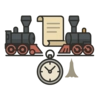
After six long years of sweat and struggle, the end of the race was in sight. The two railroads were getting closer and closer, and we decided they would meet at a place called Promontory Summit in Utah. On the morning of May 10th, 1869, everyone gathered for the big moment. It was a fantastic sight. The Central Pacific’s engine, the Jupiter, and the Union Pacific’s No. 119, steamed toward each other until they were just a few feet apart. Crowds of workers, soldiers, and officials cheered with all their might. To celebrate, we had a special final spike made of pure gold. This was the ceremonial 'Golden Spike'. Now, we wanted the whole country to share in our celebration. In those days, there was no radio or television, but we had the telegraph. A telegraph operator attached a wire to a regular iron spike and to my silver hammer. The idea was that when I tapped the spike, the electrical signal would travel across the country in an instant. I swung the hammer, and though I missed on the first try, the telegraph operator sent the message anyway. A single word flashed across the wires to cities from coast to coast: 'DONE.'. The crowd roared, the locomotive whistles shrieked, and we all knew we had just changed the world.
Looking back, that day was more than just the end of a race. It was the beginning of a new chapter for America. The Transcontinental Railroad stitched our country together like a needle and thread. That six-month wagon journey I told you about? It could now be done in just one week, safely and comfortably in a train car. The railroad helped people settle in new places, share goods and ideas, and feel like one single nation. It proved that when people from different backgrounds work together with courage and a big idea, they can overcome any obstacle and connect the world in amazing new ways.
Wow facts
About
The completion of the First Transcontinental Railroad in 1869 connected the eastern and western United States, revolutionizing transportation and commerce across the country.
Take a Quiz
Question 1 of 5
Why do you think Leland Stanford and the others were so determined to build the railroad, even though it was very difficult?
Explore next




Want to do even more?
Go beyond exploring. Unlock tools that turn every story into real learning.

Storypie Plus for families
Full stories, quizzes, and printables. Nights and car rides, sorted.
- Unlimited audio stories
- Create Mode: your child stars in the story
- Offline downloads
- Printable worksheets & coloring pages

Why Storypie for Schools
Students engaged. Prep in seconds. Evenings back to you.
- Worksheets & Quizzes
- Classroom Management
- Formative Assessment
- Custom Curriculum & Lesson Plans
- 27 Languages

Why Storypie for Homeschool
Curriculum done. They'll ask for more. Hours back in your day.
- Worksheet Generator
- First-Person Audio Stories
- Built-in Comprehension Quizzes
- Custom Curriculum & Lesson Plans
- Print & Go Activities