

 English

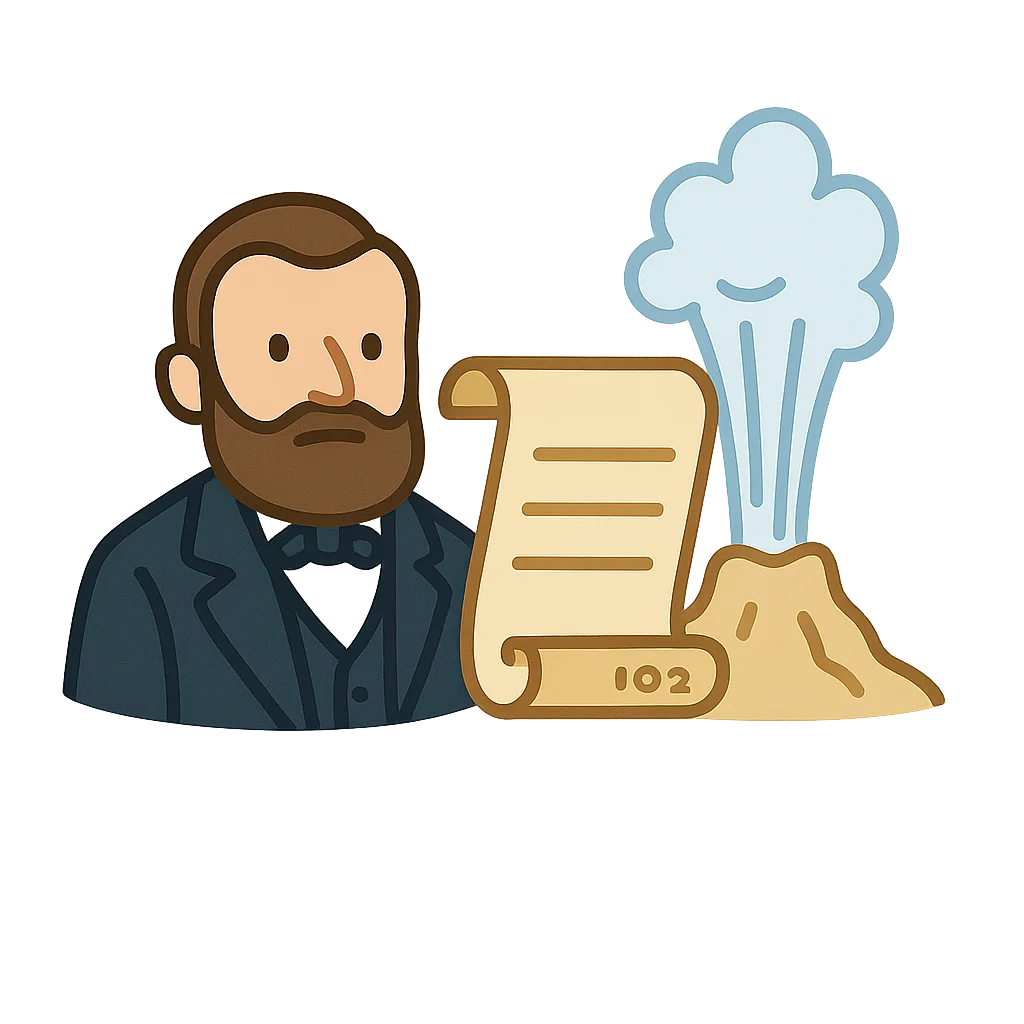
A Geologist's Tale: The Birth of Yellowstone
Hello there. My name is Ferdinand V. Hayden, and I am a geologist, which is a scientist who studies the Earth, its rocks, and its history. I want to tell you about a grand adventure I took long ago, back in a time when much of the American West was still a great mystery. For years, explorers and trappers had returned from the wild lands of what is now Wyoming and Montana with unbelievable stories. They spoke of a place where the ground hissed with steam, where fountains of boiling water shot high into the sky, and where mud bubbled like a giant's cooking pot. Most people back East thought these were just tall tales, the kinds of wild stories people tell around a campfire. But I had a feeling there was truth to them. So, in the summer of 1871, the United States government gave me a very important job. I was to lead an expedition of over thirty men—scientists, map-makers, and artists—into this strange land. Our mission was to explore this region, which they called Yellowstone, to map it carefully, and to find out if these incredible stories were real. We packed our mules with scientific instruments, food, and supplies, and set off into the unknown, ready to discover the truth.
Our journey was long and difficult, traveling for weeks across rugged plains and over steep mountains. The air was crisp and clean, and every day brought a new landscape to explore. I brought along two men whose jobs were just as important as any scientist's. One was a brilliant painter named Thomas Moran, and the other was a talented photographer named William Henry Jackson. I knew that my scientific reports filled with facts and figures might not be enough to convince people of what we would find. But a picture. or a painting. that could show them the truth. I will never forget the moment we first saw the wonders of Yellowstone. We heard a deep, rumbling sound, and then a mighty roar as a geyser we named 'Old Faithful' shot a tower of steaming water over one hundred feet into the air. It was more amazing than any story. We found hot springs that glowed with the colors of the rainbow, like the Grand Prismatic Spring, which looked like a giant artist’s palette on the ground. We stood at the edge of the Grand Canyon of the Yellowstone, a massive canyon with walls of bright yellow rock and a powerful waterfall crashing into the river below. I watched as Thomas Moran quickly took out his watercolors, trying to capture the brilliant yellow of the canyon walls and the deep green of the pine trees. William Henry Jackson set up his heavy, complicated camera, and with a flash of light, he captured images that would prove we weren't just telling stories. Their work was our proof. It was our way of taking this magical place back with us to show the world.
When we returned to Washington, D.C. that autumn, we were filled with excitement. We had maps, scientific notes, and most importantly, we had Mr. Jackson's photographs and Mr. Moran's stunning paintings. We laid them all out for the members of Congress to see. At first, they were speechless. They could not believe that such a place existed in our own country. But as we explained our findings, a new problem arose. Some businessmen saw our pictures and wanted to buy the land. They wanted to build hotels and fences and charge people money to see the geysers and waterfalls. The idea that this natural treasure could be owned by just a few people felt wrong to me. I argued that Yellowstone was too special, too magnificent, for any one person to own. It was a treasure that belonged to all Americans, and to people all over the world, for all time. It was a revolutionary idea. We proposed that the government should protect this land forever, keeping it open for everyone to visit and enjoy. After much discussion, Congress agreed. On March 1st, 1872, President Ulysses S. Grant signed a special law, The Yellowstone National Park Protection Act. With the stroke of his pen, he created the world's very first national park. Looking back, I am proud that our journey did more than just map a new territory. it helped create an idea that has spread across the globe—the idea that some places are so precious they must be protected for everyone, forever.
Activities
Take a Quiz
Test what you learned with a fun quiz!
Get creative with colors!
Print a coloring book page of this topic.










 Free for Educators