English
 For Schools
 For Homeschool

The Voice of Generations: My Story as the Electric Guitar
Before I could roar, my family only knew how to whisper. I am the Electric Guitar, but my story begins with my ancestors, the acoustic guitars. They were beautiful, crafted from resonant woods like spruce and rosewood, with round, hollow bodies that cradled sound like a secret. Their voices were warm and intimate, perfect for a quiet room or a gentle folk song. But the world was getting louder. By the 1920s, music was a party. Big bands and jazz orchestras exploded with sound. Drums crashed, saxophones wailed, and trumpets blared with dazzling force. In the middle of it all, my poor acoustic cousins strummed with all their might, but their delicate voices were swallowed by the glorious noise. Imagine trying to share a secret in the middle of a parade. That’s what it was like for them. They were the heart of the rhythm, but no one could hear their heartbeat. This was the problem I was born to solve. A need was growing for a guitar that could not only join the party but lead it.
That quiet frustration sparked an incredible idea. It wasn't about making a bigger, louder wooden box; it was about reimagining my voice entirely. The breakthrough came from the minds of ingenious people who saw a connection between sound and electricity. In the late 1920s, a musician and inventor named George Beauchamp was determined to make a guitar that could cut through the sound of an orchestra. He teamed up with an engineer named Adolph Rickenbacker, and together they experimented. Their revolutionary idea was the 'pickup.' They discovered that by wrapping a coil of wire around a magnet and placing it under my strings, they could transform the vibration of a plucked note into a tiny electrical signal. That signal wasn't just sound anymore; it was information that could be sent down a wire to an amplifier and a speaker, which would turn it back into sound—as quiet or as loud as you wanted. Their first successful creation, born on a summer day in 1931, was a strange-looking thing. Made of cast aluminum, it had a long neck and a small, circular body that earned it the nickname the 'Frying Pan.' I was barely recognizable, but I was alive. For the first time, a guitar's voice was not limited by its own body. I had been given the potential to be heard by everyone.
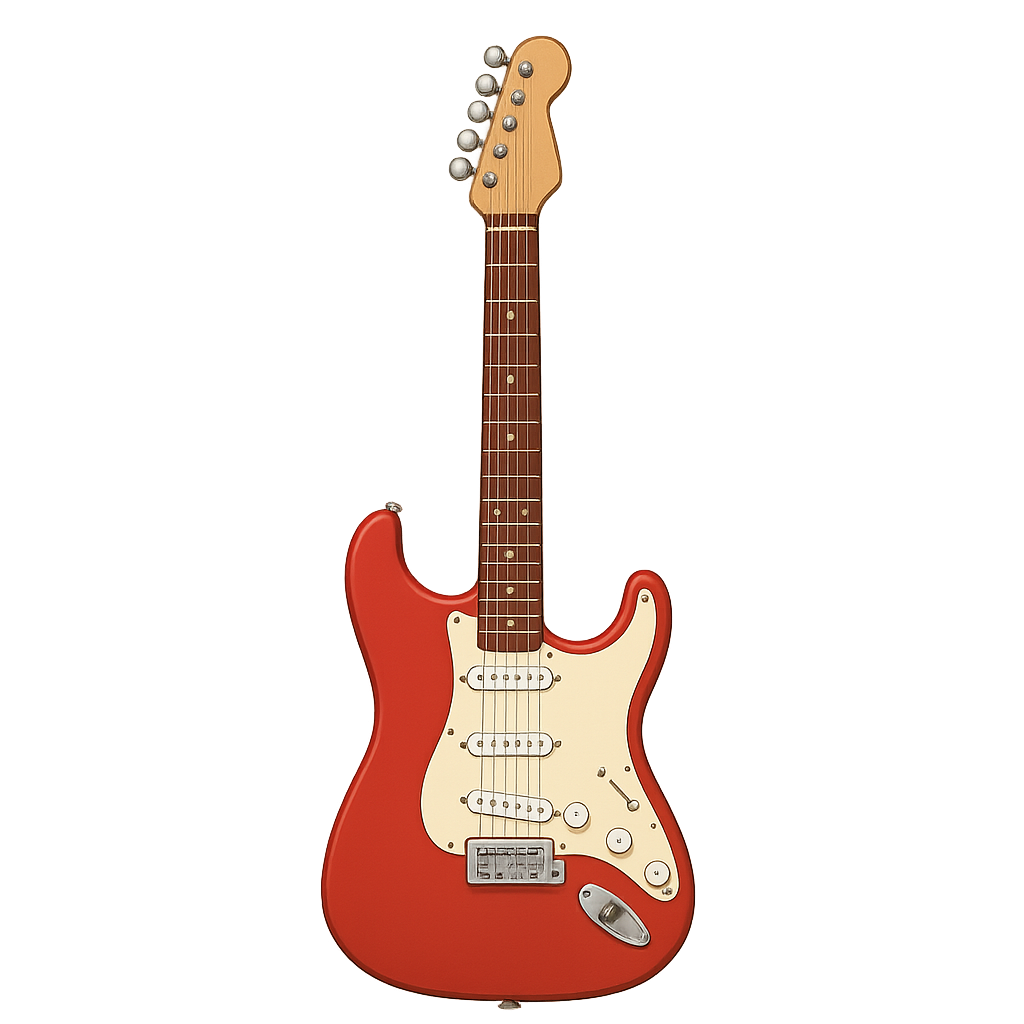
My new electric voice was powerful, but my body was still catching up. My early forms often had hollow bodies, like my acoustic cousins, which caused a terrible problem called 'feedback.' When my sound came out of the amplifier, it would make my own hollow body vibrate, creating a new sound that the pickup would catch and amplify again. It created a loop that would spiral into a piercing, uncontrollable shriek. I was trying to sing, but I couldn't stop screaming. The solution required a radical change. A brilliant musician and inventor named Les Paul had an idea. In 1941, he took a solid 4-by-4 block of pine wood—a piece of a fence post—and attached a guitar neck, strings, and his own homemade pickups to it. He called his creation 'The Log.' It wasn't pretty, but because it was solid, it didn't have a hollow chamber to vibrate and cause feedback. It proved that a solid body was the key to a pure, controllable electric tone. A few years later, another genius, Leo Fender, perfected this concept. He was a radio repairman, not a musician, so he designed me to be simple, durable, and easy to mass-produce. In 1950, he introduced the Fender Telecaster, the first commercially successful solid-body electric guitar. Then, on April 15th, 1954, he unveiled the Stratocaster, with its comfortable, contoured body and three pickups. I finally had a form that was as revolutionary as my voice. I was ready for the world stage.
With a solid body and a clear, powerful voice, I was no longer just an instrument; I was a force of nature. I landed in the hands of trailblazers who would use me to change the sound of the world. A gospel singer with incredible energy, Sister Rosetta Tharpe, played me with a fire and passion that blurred the lines between sacred music and the raw energy of what would become rock and roll. Then came Chuck Berry, who made me duck-walk across stages, my notes bending and soaring as he told stories of teenage life. My voice became the sound of rebellion, of joy, and of a new generation finding its rhythm. I powered the blues, gave birth to rock and roll, and shaped countless other genres. From the quiet whisper of my ancestors, I had learned to sing, to shout, and to scream with emotion. My journey from a quiet idea to a global icon is a reminder that even the biggest changes can start with a small spark of creativity. And today, I continue to be a tool for anyone with a story to tell or a song to share, a voice for generations past, present, and future.
Activities
Take a Quiz
Test what you learned with a fun quiz!
Get creative with colors!
Print a coloring book page of this topic.