

 English

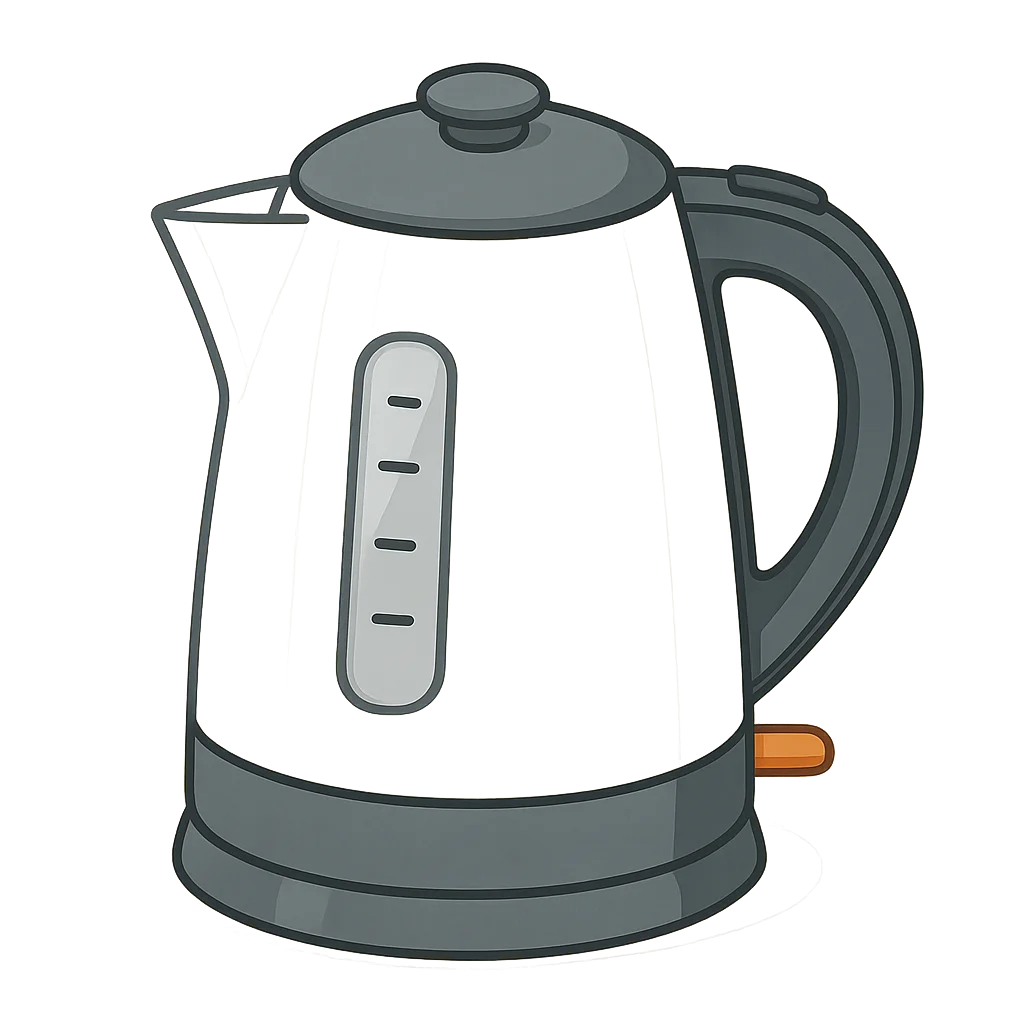
The Story of the Electric Kettle
Hello there. You probably see me sitting on your kitchen counter every day, sleek and ready. I am the electric kettle. But before I could offer you a quick cup of tea with a simple flick of a switch, the world was a very different place. Imagine a kitchen filled with the faint smell of coal smoke or the hiss of a gas flame. In that world, my ancestors were heavy, cast-iron kettles. They sat patiently, but stubbornly, on top of hot stoves, taking what felt like an eternity to heat up. People had to wait and wait, their mornings moving at a much slower pace. There was no quiet click to tell them the water was ready. Instead, a piercing whistle would eventually shriek through the house, a demanding sound that meant you had to rush to the stove. It was a world of constant watching and listening, a world of whistles and waiting. It was a world that was ready for a new, faster, and quieter way to get a warm drink, and that’s where my story begins.
My story doesn’t begin in a cozy kitchen, but in a workshop buzzing with a new kind of magic: electricity. It was in Chicago, on September 15th, 1891, that my very first ancestor was born. A clever group of people at the Carpenter Electric Company looked at the glowing electric lightbulbs and wondered what else this invisible power could do. Their big idea was me. They thought, if electricity can create light, why can’t it create heat for water? So they built the first version of me. I must admit, I wasn’t very impressive to look at. I was a bit clunky, and my heating element—the part that did all the work—was hidden away in a separate compartment underneath my main body. This meant the heat had to travel through a layer of metal just to reach the water. Honestly, I was slow. Sometimes, I was even slower than my old-fashioned cousins sitting on the stove. But even though I was inefficient, I represented a revolutionary concept. I was a glimmer of a new future, a promise that the power of electricity could make everyday life a little bit easier. I was the first spark of an idea that would soon warm the world.
For my next big step, my story travels across the Atlantic Ocean to Great Britain, a country that loves its tea. It was there, in 1922, that an ingenious engineer named Arthur Leslie Large had a truly brilliant thought. He looked at my slow, inefficient design and realized the problem wasn't the electricity, but how it was being used. He thought, "Why are we heating the kettle from the outside when we really just want to heat the water on the inside?". It was a game-changing question. His solution was to take the heating element and plunge it directly into the water. Imagine trying to warm up a swimming pool by building a fire underneath it. It would take forever. But if you could put a powerful, safe heater right in the water, it would warm up much faster. That’s exactly what Arthur Leslie Large did for me. This innovation, created for the Bulpitt & Sons company, was a massive leap forward. Suddenly, I could boil water faster than almost any kettle on a gas stove. I was no longer just a novelty; I was becoming a true time-saver. This was the moment I transformed from a curious experiment into the fast, efficient, and bold helper that people recognize today.
Becoming fast was wonderful, but it also introduced a new danger. If someone filled me up, switched me on, and then forgot about me, I would keep boiling and boiling until all the water turned to steam. Then I would just keep getting hotter and hotter, which could damage me and even cause a fire. I needed a brain. I needed a way to know when to stop. That crucial piece of my identity arrived in 1955, thanks to two brilliant inventors named William Russell and Peter Hobbs. They gave me my 'click.' They designed a special switch using something called a bimetallic strip. It sounds complicated, but it’s actually quite simple. It’s a small strip made of two different metals fused together, one that expands more than the other when it gets hot. They placed this strip near the top of my spout. As the water boiled, hot steam would rush out and hit the strip. The heat from the steam caused the strip to bend, and as it bent, it would push a lever that switched off my power with a satisfying 'click!'. This single, clever invention made me safe. It meant people could turn me on and walk away, knowing I would turn myself off at the perfect moment. I was no longer just fast; I was trustworthy.
From that first slow, clunky box in 1891 to the safe, automatic helper of 1955, my journey was one of constant improvement. Today, I’ve continued to evolve in ways my first creators could never have imagined. I’ve shed my cord, so you can lift me right off my base and carry me to your cup. I have settings that can heat water to the perfect temperature for delicate green tea or strong coffee. I come in all sorts of beautiful colors and shapes, a stylish companion in the modern kitchen. My journey shows how a simple idea—using electricity to heat water—can be refined and perfected over decades through the creativity and perseverance of many different people. Every time you hear my quiet click, it’s the echo of over a century of innovation. I am more than just an appliance. I am a small source of comfort, a quick start to a busy morning, a warm welcome for a friend. I am proof that a bright idea, when nurtured with care and ingenuity, can grow to bring a little bit of warmth to the entire world.
Activities
Take a Quiz
Test what you learned with a fun quiz!
Get creative with colors!
Print a coloring book page of this topic.










 Free for Educators