

 English

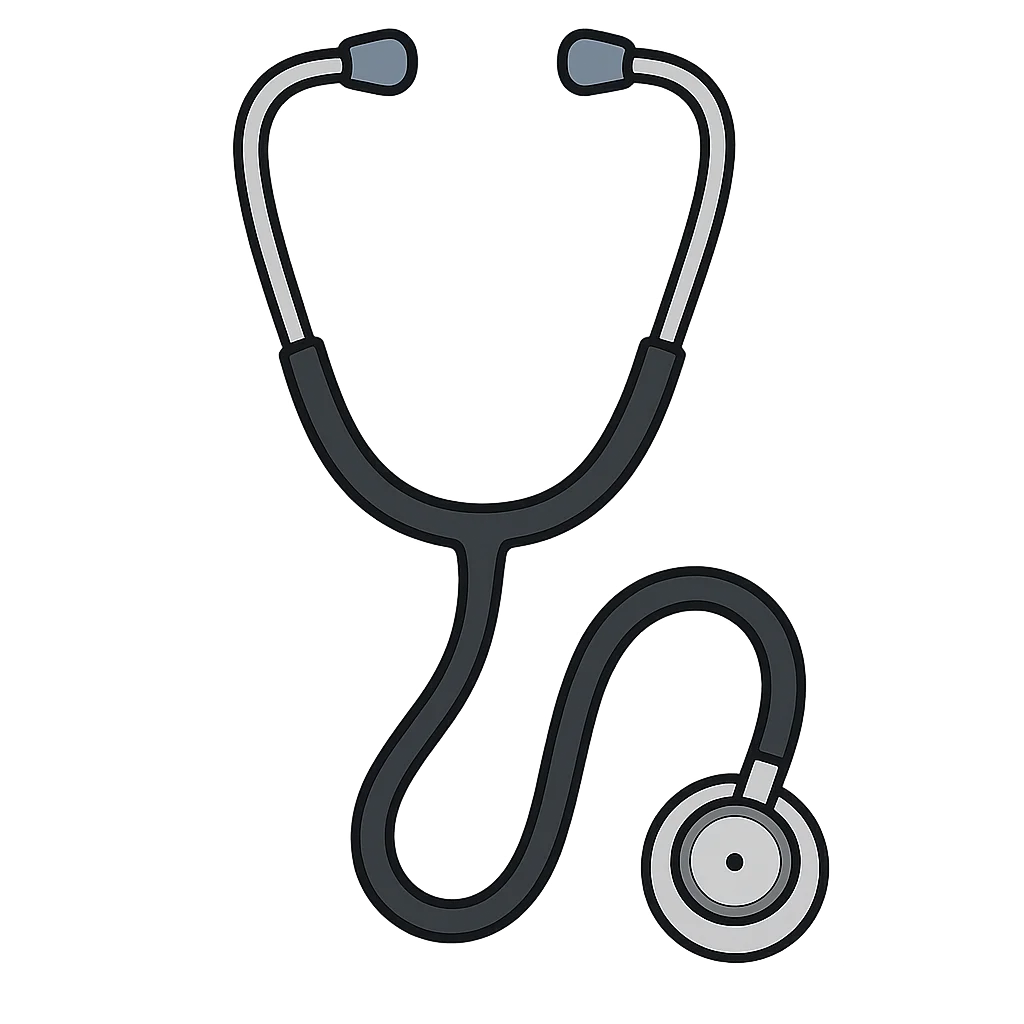
The Listener: A Stethoscope's Story
Hello there. You’ve probably seen me draped around a doctor’s neck, with my two earpieces and my cool, round chest piece. I am a stethoscope, but I like to think of myself as a secret sound catcher. My job is to listen to the incredible orchestra playing inside your body. I can hear the powerful thump-thump-thump of your heart as it works hard to send blood everywhere it needs to go. I can also hear the gentle whoosh of air as your lungs breathe in and out, like a quiet ocean tide. For a very long time, before I was invented, doctors had a difficult job. Imagine trying to hear a tiny mouse scurrying behind a thick wall. That's what it was like for doctors when they had to press their ear directly against a person’s chest to try and hear these sounds. It was often uncomfortable for the patient and not very clear for the doctor. The sounds were muffled and distant, like trying to hear a whisper from across a busy room. They needed a bridge, something that could carry those secret sounds from the patient's chest directly to their ears, and that’s where my story begins.
My life began in Paris, France, in the year 1816. I wasn't made of metal and rubber back then. I was just an idea in the mind of a very thoughtful doctor named René Laënnec. One day, Dr. Laënnec was examining a young girl. He needed to listen to her heart, but he felt it would be improper and awkward to place his ear directly on her chest. He stood there for a moment, wondering what to do. His mind drifted to a memory of watching children play in a park. He remembered seeing them at one end of a long wooden log, scratching it with a pin. Their friends at the other end would press their ears to the wood and giggle with delight, hearing the scratching sound perfectly loud and clear. The wood had carried the sound. Suddenly, an idea sparked. Dr. Laënnec grabbed a sheet of paper from his desk and rolled it into a tight tube. It was a simple thing, really, but it was my very first form. He gently placed one end of the paper tube on the young girl's chest and put his own ear to the other end. His eyes widened in amazement. The sound was astonishing. The girl’s heartbeat wasn’t a faint, muffled thump anymore. It was a loud, clear, rhythmic beat, traveling right up the tube and into his ear. He had found the bridge. He was so excited by his discovery that he soon created a more durable version of me out of wood. He gave me a special name, 'stethoscope,' which comes from two Greek words: 'stethos,' meaning chest, and 'skopein,' meaning to examine. I wasn't for seeing, of course, but for listening so well that it was like seeing inside the body.
From that first wooden tube, I began a long journey of change and improvement. For many years, I could only listen with one ear at a time, just like that first rolled-up paper. It worked, but doctors knew it could be even better. Then, in 1851, an Irish doctor named Arthur Leared had a brilliant idea. He designed a version of me with two earpieces, one for each ear. This was a huge step. Suddenly, the sounds were not just louder, but they had depth, like listening to music with two headphones instead of one. This change made it so much easier for doctors to hear even the faintest whispers and murmurs from the heart and lungs. This is why I am so important. I help doctors find out what's wrong inside a person's body without a single poke or prod. I am a painless detective, gathering clues through sound alone. I can tell a doctor if a heart is beating too fast or too slow, or if a person’s breathing is wheezy or clear. Looking back, I am so proud of my journey. I started as a simple, rolled-up piece of paper, born from a moment of clever thinking. Today, I am a trusted friend to doctors and nurses all over the world, a symbol of care and listening. And I still help them hear the secret, life-saving music inside every one of us.
Activities
Take a Quiz
Test what you learned with a fun quiz!
Get creative with colors!
Print a coloring book page of this topic.








 Free for Educators