

 English

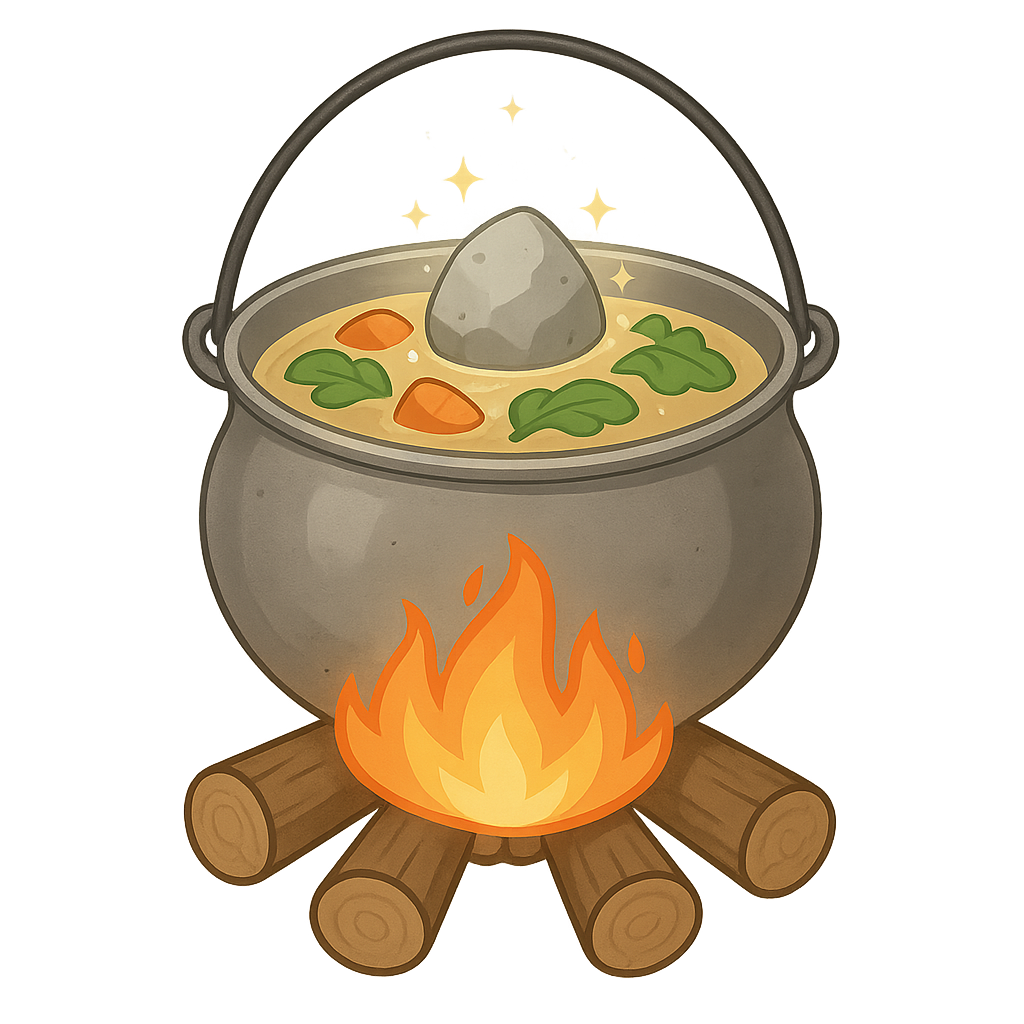
The Myth of Stone Soup
The dust of the road clung to my worn-out boots, and a hollow ache echoed in my stomach. My name is Jean-Luc, and alongside my fellow soldiers, I was returning from a long, wearying war, hoping only for a bit of kindness and a warm meal. We trudged, our uniforms frayed and our spirits nearly as thin, dreaming of hearths and hospitality. Instead, we found a village with its doors and hearts shut tight, which is how we came to perform the small miracle known as the myth of Stone Soup. We entered the town square, a place that should have been bustling but was eerily silent. Shutters were latched, and the only signs of life were the fleeting glimpses of faces in windows before curtains were swiftly drawn. Our captain, a man whose optimism had carried us through countless battles, approached the mayor's house, his back straight despite his fatigue. His request for provisions was met with a firm, unwelcoming refusal. 'There has been a poor harvest,' the mayor said, his voice as barren as his words. 'We have nothing to spare for strangers.' We heard the same discouraging story at every door, a chorus of scarcity that left us feeling colder than the autumn wind. It was clear the war had taken more than just soldiers from the battlefield; it had stolen the town's trust and generosity, leaving a chilling suspicion in its place. We stood in the empty square, the weight of our hunger matched only by the weight of their fear.
As dusk began to settle, casting long, lonely shadows across the square, our captain gathered us. A clever glint shone in his eyes, a familiar spark that always preceded an ingenious plan. 'If they will not give us food,' he announced quietly, his voice a low rumble of confidence, 'then we shall give them a feast.' We exchanged bewildered glances, but we trusted him implicitly. We built a small fire in the center of the square, its flames dancing against the twilight, and placed our largest cooking pot over it, filling it with water from the village well. As steam began to rise like a ghostly mist, the captain strode to the center of the square and held something aloft for all to see. 'My friends!' he boomed, his voice carrying through the quiet streets, a theatrical announcement designed to capture attention. 'We are weary, but we are not without resources. We shall make the most delicious soup you have ever tasted—from this very stone!' He dramatically pulled a smooth, grey, and utterly ordinary stone from his satchel, presenting it as if it were a precious gem. Whispers rippled through the village like wind through dry leaves. Doors creaked open. The villagers, their profound curiosity overpowering their suspicion, began to emerge from their homes, drawn by this strange spectacle. They watched, arms crossed and faces skeptical, as the captain ceremoniously dropped the stone into the bubbling pot with a satisfying 'plunk'. He then began to stir the water with a large ladle, humming a cheerful tune as if he were preparing the most magnificent meal in the world.
After a few minutes of theatrical stirring, the captain dipped a ladle into the pot and tasted the water with a thoughtful expression. 'Magnificent!' he declared loudly. 'A soup fit for a king! Though, a pinch of salt and perhaps some pepper would truly unlock the stone's magnificent flavor.' A woman on the edge of the crowd, perhaps emboldened by the sheer absurdity of it all, scurried back to her home. She returned moments later with a small pouch of salt and a pepper grinder, which she hesitantly offered to the captain. He thanked her graciously and stirred them in. A little while later, he tasted it again. 'Ah, it is improving! This is very good, but I had a stone soup once, back on October 5th of last year, that had carrots. It was divine, the sweetness of the carrots perfectly complemented the earthy tones of the stone.' A farmer, who had been watching from his doorway, suddenly remembered a few small carrots left in his cellar. He disappeared and returned to hesitantly offer them to the pot. This single act of contribution broke the spell of suspicion. Soon, another villager mused aloud, 'A good soup is always better with potatoes.' Before long, he was back with a sack. A woman brought a handful of pungent onions and a few cloves of garlic. Someone else contributed a cabbage, another a bit of barley. I watched in amazement as the pot, which had started with only water and a stone, began to fill with a rainbow of vegetables and grains. The air, once thick with mistrust, now carried the rich, comforting aroma of a real stew. The villagers were no longer just spectators; they were co-creators, each one adding their small but valuable part to the communal meal, their faces slowly transforming from skepticism to pride.
When the soup was finally ready, it was a thick, fragrant, and wonderful stew, bubbling with generosity. The villagers, now fully invested in the magical meal they had helped create, brought out tables and benches from their homes, setting up a long banquet in the square. Bowls and spoons appeared as if from nowhere. We all sat together—soldiers and villagers, strangers who had become neighbors—and shared the meal under the stars. Laughter and lively conversation filled the square, chasing away the last vestiges of the earlier silence and fear. The mayor himself took a large bowl, and after his first spoonful, he declared it the finest soup he had ever tasted. Our captain simply smiled and, with a flourish, lifted the clean, warm stone from the bottom of the pot with his ladle. 'You see,' he said to the captivated crowd, 'the magic was not in the stone. The magic was in all of you.' A wave of understanding passed through the villagers. They hadn't been poor in food, but in spirit and community. They had possessed everything they needed all along; they just needed a reason to share it. We didn't just fill our stomachs that night; we helped rekindle the warmth in a whole village's heart.
This story, which people started telling hundreds of years ago in Europe, has traveled the world and taken many forms. Sometimes it's a 'nail soup' or a 'button soup,' but the core message, the essential ingredient, is always the same. It teaches us that our greatest strength is found not in what we keep for ourselves, but in collaboration. The myth shows that even when we feel we have very little to give, our small, individual contributions, when joined with those of others, can create something extraordinary and abundant. Today, the idea of 'stone soup' is a powerful metaphor that inspires community gardens, potluck dinners, and even modern crowd-funded projects where people pool their resources to achieve a common goal. The story reminds us to look past the illusion of scarcity and see the potential for prosperity that exists when we open our hearts and our pantries to one another. It's a timeless recipe for how to build a community, proving that the most magical and powerful ingredient of all is, and always will be, the simple act of sharing.
Activities
Take a Quiz
Test what you learned with a fun quiz!
Get creative with colors!
Print a coloring book page of this topic.
















 Free for Educators