

 English

The City That Never Sleeps
Listen closely. Can you hear that? It’s a deep rumble from under the ground, the sound of my subway trains humming like giant metal dragons. If you breathe in, you might smell roasting chestnuts, sweet donuts, and savory pizza all at once. Look around you, and you’ll see a river of bright yellow taxi cabs flowing down streets canyoned by buildings so tall they tickle the clouds. Music spills from open doorways, and people from every corner of the world rush past, each with a dream in their heart. I am a place of endless energy, a giant, sparkling island full of stories. I am New York City.
My story didn’t begin with skyscrapers and bright lights. Long ago, I was a green and peaceful island called Manahatta. My lands were covered in thick forests, and clear streams crisscrossed my earth. The Lenape people lived here, paddling their canoes in my waters and hunting in my woods. Their lives were connected to the seasons and the land. But one day in 1609, everything began to change. A huge ship with tall masts, called the Half Moon, sailed into my harbor. Its captain was an English explorer named Henry Hudson, who was sailing for a country called the Netherlands. Not long after, people from that country, the Dutch, arrived. They saw my harbor as a perfect place for trading furs and goods, so they built a bustling little town right at my southern tip. They called it New Amsterdam.
For many years, I was New Amsterdam, a busy Dutch trading post with a windmill and wooden houses. But other countries also saw how special I was. On August 27th, 1664, a fleet of English warships sailed into my harbor. The Dutch governor, Peter Stuyvesant, knew he could not win a fight, so he surrendered the town without a single shot being fired. The English king gave me to his brother, the Duke of York, and that is how I got my new name: New York. I grew and grew, and I became very important. When a new country called the United States of America was born, I was chosen to be its very first capital. I felt so proud when George Washington stood on a balcony here and took his oath to become the first president.
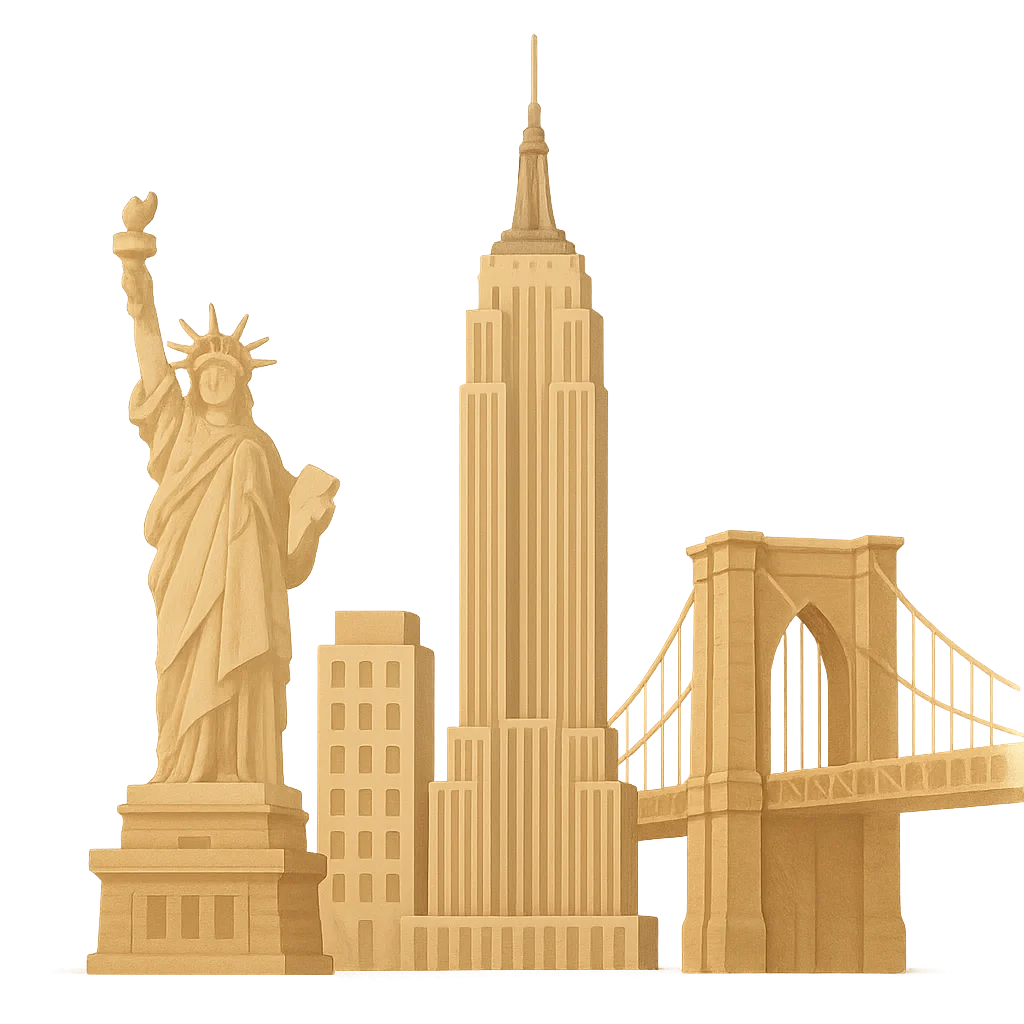
My role as a capital was short, but my next job was even more important. I became a beacon of hope for people all over the world. From Ireland, Italy, Germany, China, and so many other places, families packed their few belongings and boarded crowded ships, all dreaming of a better life. As their ships sailed into my harbor, the first thing they saw was a giant green lady holding a torch high in the sky. I am, of course, talking about the Statue of Liberty, my promise of freedom and welcome. They would then go to a small island next to her, Ellis Island, where doctors and officials would check their papers before they could start their new lives. These immigrants brought their languages, their music, their holidays, and their delicious food, turning me into a wonderful, noisy, and exciting 'melting pot' where all cultures mixed together.
As more people arrived, I had to grow—not just outwards, but upwards. Brilliant engineers and brave workers built incredible things. On May 24th, 1883, the amazing Brooklyn Bridge opened, its strong steel cables stitching my islands together like giant threads. It was a miracle of its time. Then, a race began to see who could build the tallest building. Steel skeletons rose into the air, wrapped in stone and glass, creating my world-famous skyline of skyscrapers. But my clever planners knew that people needed more than just buildings. They saved a huge rectangle of green land right in my middle and called it Central Park, a place where everyone could escape the concrete and connect with nature.
Today, my heart beats on, stronger than ever. My streets are alive with the bright lights of Broadway shows, the quiet wonder of museums filled with art, and the energy of millions of people chasing their dreams. I am a city built by dreamers from long ago and a home for the dreamers of today. My story is written in every brick and every bridge, and a new page is turned every single day. I will always be a place of hope, a reminder that with courage and creativity, anything is possible. And there is always room for one more dream.
Activities
Take a Quiz
Test what you learned with a fun quiz!
Get creative with colors!
Print a coloring book page of this topic.















 Free for Educators