Ancient Egypt for kids dances with sunlight, river reeds, and living stones. I tell bedtime stories and design quick learning moments. So, I love sharing this place with families.
Ancient Egypt for kids: Simple timeline
First, people settled along the Nile. The river flows north to the Mediterranean and floods each year. The flood leaves rich black silt. As a result, farms grow where desert once stood. These changes let towns and cities grow. The civilization of ancient Egypt began around 3100 BCE and lasted until its conquest by the Macedonians in 332 BCE.
Next, eras unfold across thousands of years. Begin with the Predynastic before 3100 BCE. Then come the Early Dynastic years. After that the Old Kingdom rises and pyramids appear. There are approximately 118 known Egyptian pyramids still standing today, with at least eight smaller pyramids accompanying the three main Pyramids of Giza. Later the Middle Kingdom rules. Then the New Kingdom brings powerful pharaohs. The New Kingdom period (circa 1539–1075 BCE) is known for the construction of monumental architecture, including the temples at Karnak and Luxor. Finally, later periods and the Ptolemaic dynasty follow.
Pharaohs, power and people
The pharaoh served as king and priest. He guarded Maat, the idea of order and balance. Famous rulers include Narmer, Khufu, Hatshepsut, Akhenaten, Tutankhamun, and Ramses II. Temples and officials kept daily life running. Scribes recorded laws, taxes, and stories. Estimates of Ancient Egypt’s population range from approximately 1.0–1.5 million people in the 3rd millennium BC, increasing to around 2–3 million by the 1st millennium BC.
Monuments and mystery
Pyramids served as royal tombs to protect a pharaoh for the afterlife. The Great Pyramid of Giza, constructed during the Fourth Dynasty (circa 2589–2566 BCE), consists of approximately 2.3 million stone blocks, each weighing up to 9 tons, and stands as a huge, honest marvel. The Sphinx watches the plateau. Visit Luxor and Karnak to see long temple rows. Abu Simbel shows how rulers announced power. Temples honored the gods. Tombs cared for the dead.
Beliefs, mummies and respect
Egyptians believed in many gods. Ra, Osiris, Isis, Anubis, and Maat guide life and death. Mummification protects the body. Organs go into canopic jars. Spells from the Book of the Dead help the journey. When you speak about mummies, do so with care and respect.
Writing, trade and daily work
Hieroglyphs are picture words on stone and papyrus. Papyrus grows from river reeds. Boats move goods along the Nile. Fields feed cities. Craftspeople, farmers, and traders build the economy. For example, potters, metalworkers, and carpenters work in busy towns.
Science, art and building
Engineers use ropes, sledges, ramps, cubits, and geometry to build big projects. Medicine appears in ancient papyri. Art follows rules and strong colors. Green often means life. Blue often means sky. Teams of skilled workers and seasonal laborers make it all happen.
Try a tiny activity in 10 minutes
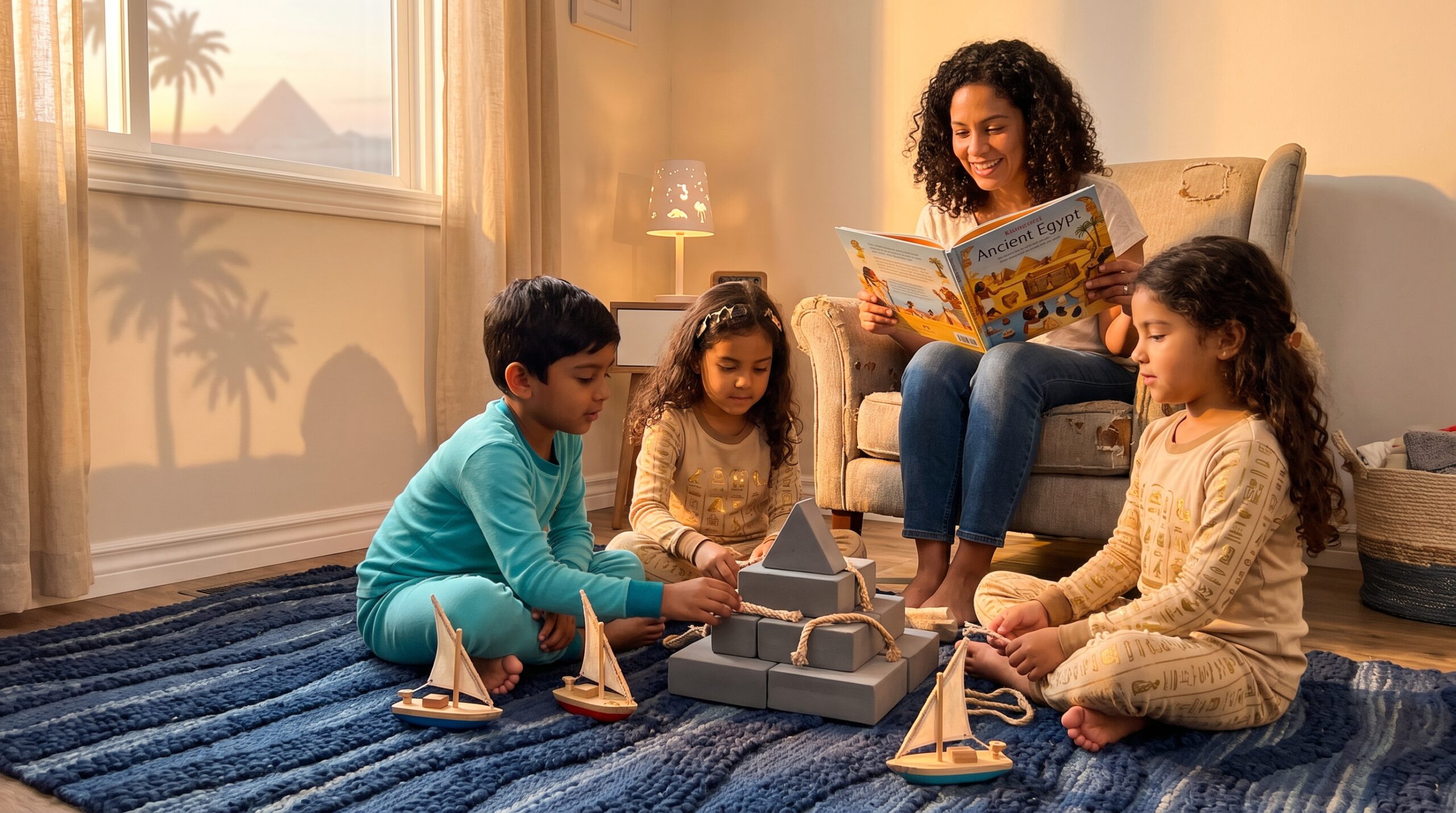
Build a small paper pyramid to learn shapes. Also, float paper boats to show Nile travel. Draw a hieroglyph name. Make a sticker timeline for the Old, Middle, and New Kingdoms. I did this at my kitchen table and we laughed at our shaky ramps. It stuck with us and felt joyful.
Read or listen to a story about Ancient Egypt now: For 3-5 year olds, For 3-5 year olds, For 6-8 year olds, For 8-10 year olds, and For 10-12 year olds.
Museums and gentle wonder
Museums hold treasures and tell stories. I remember pointing at Tutankhamun’s mask and whispering wow. If you plan a visit, look for family friendly exhibits. Also, talk about respect for ancient objects and for people today. Ancient Egypt sparks wonder. Try one small activity tonight.
For more stories and family activities, visit Storypie. It offers gentle, age-based tales that bring Ancient Egypt to life for children.