
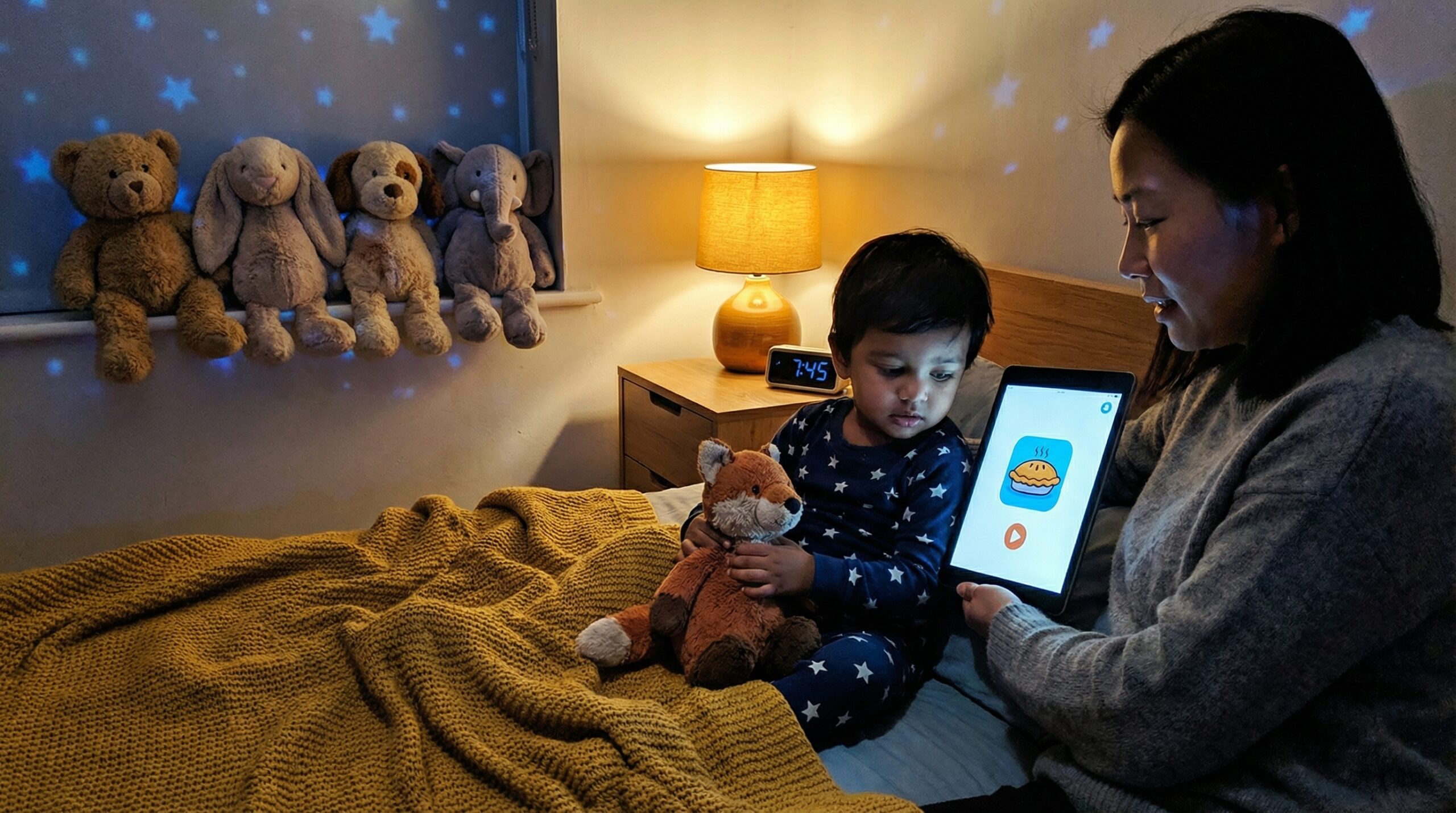
Start small. A bedtime wind-down mini story ritual gives children a short, repeatable habit that helps them settle. Use low light, the same soothing words or audio, and a predictable ending. The ritual promises calm, connection, and a gentle cue for sleep.
Why the bedtime wind-down mini story ritual works
Predictability matters. Repetition signals the brain that rest follows. Routine lowers arousal and helps cortisol fall. Night after night, the same short story becomes a cue for sleep. Research shows that consistent bedtime routines, including storytelling started as early as 3 months, are associated with fewer night-time awakenings, reduced sleep problems, and longer sleep durations by age 3, according to a 2025 study. Also, shared reading builds vocabulary and narrative sense. A tiny nightly tale can stick in a child’s mind and comfort them like a soft blanket.
What makes a good mini story ritual
Keep it tiny and steady. Aim for about five minutes. Three to ten minutes fits most toddlers and early elementary kids. Five minutes works well on tired nights.
- Keep it brief: short is better when kids are sleepy.
- Keep it consistent: use the same story or a small set of favorites.
- Keep it gentle: slow pace, soft voice, minimal excitement.
- Keep it shared: caregiver voice or shared audio strengthens attachment.
Simple habits that help
Use the same starting cue each night. Try three slow breaths, a hush, or a tiny chant. Close with a familiar line that says bedtime is near. These small moves make the ritual a trusted bedtime bridge.
Set up that invites sleep
Design matters. Choose low, warm light and a cozy spot. A cushion or lap works wonders. Keep a small basket with a bookmark or a soft toy. Face one “hero” story card on the shelf.
Curation beats clutter. Rotate three to ten trusted mini stories slowly. That beats fifty half-read titles. When a child drifts without asking, the ritual is working.
Digital options and cautions
Apps make short stories handy when caregivers are tired or traveling. Prefer audio-only playback. Keep screens dim and volume low. Choose narration that soothes. Avoid bright visuals near sleep time. A randomized clinical trial published on Oct 21, 2024, found that removal of all screen time in the hour before bed, replaced with a ‘bedtime box’ of non-screen activities such as reading, produced small-to-medium improvements in sleep efficiency.
Storypie offers 5-minute mini story options to try. If you use the app, pick offline, ad-free tracks and test the voice for fit. For a gentle start, try one story five nights in a row.
Adaptations and inclusivity
Short stories work across languages and needs. In bilingual homes, rotate short tales in both tongues to build each language. For sensory-sensitive or neurodivergent children, tweak pacing, volume, and repetition. Test and adjust. When sleep problems persist, ask your pediatrician; this ritual is not a replacement for medical advice.
Quick transportable ritual
Traveling? Pack a small pillow, a favorite plush, and a playlist of two mini stories. Dim a lamp. Do the same three breaths. Play the story and end with the same closing phrase. The ritual travels well.
Try a tiny test
Try five nights of the same short story. Watch how bedtime resistance softens. A little ritual, repeated, becomes the very best kind of habit.
Want a simple place to try short, soothing stories? Visit the Storypie app to explore 5-minute mini stories and gentle narration. A nationally representative C.S. Mott Children’s Hospital National Poll reported that 90% of parents with children aged 1–6 years say their child has a bedtime routine, and 67% of parents report reading bedtime stories as part of that routine, emphasizing the importance of storytelling in these rituals.
Moreover, the American Academy of Sleep Medicine reported that 63% of parents link insufficient sleep to worse mood outcomes in children, highlighting the connection between bedtime routines and children’s emotional well-being.