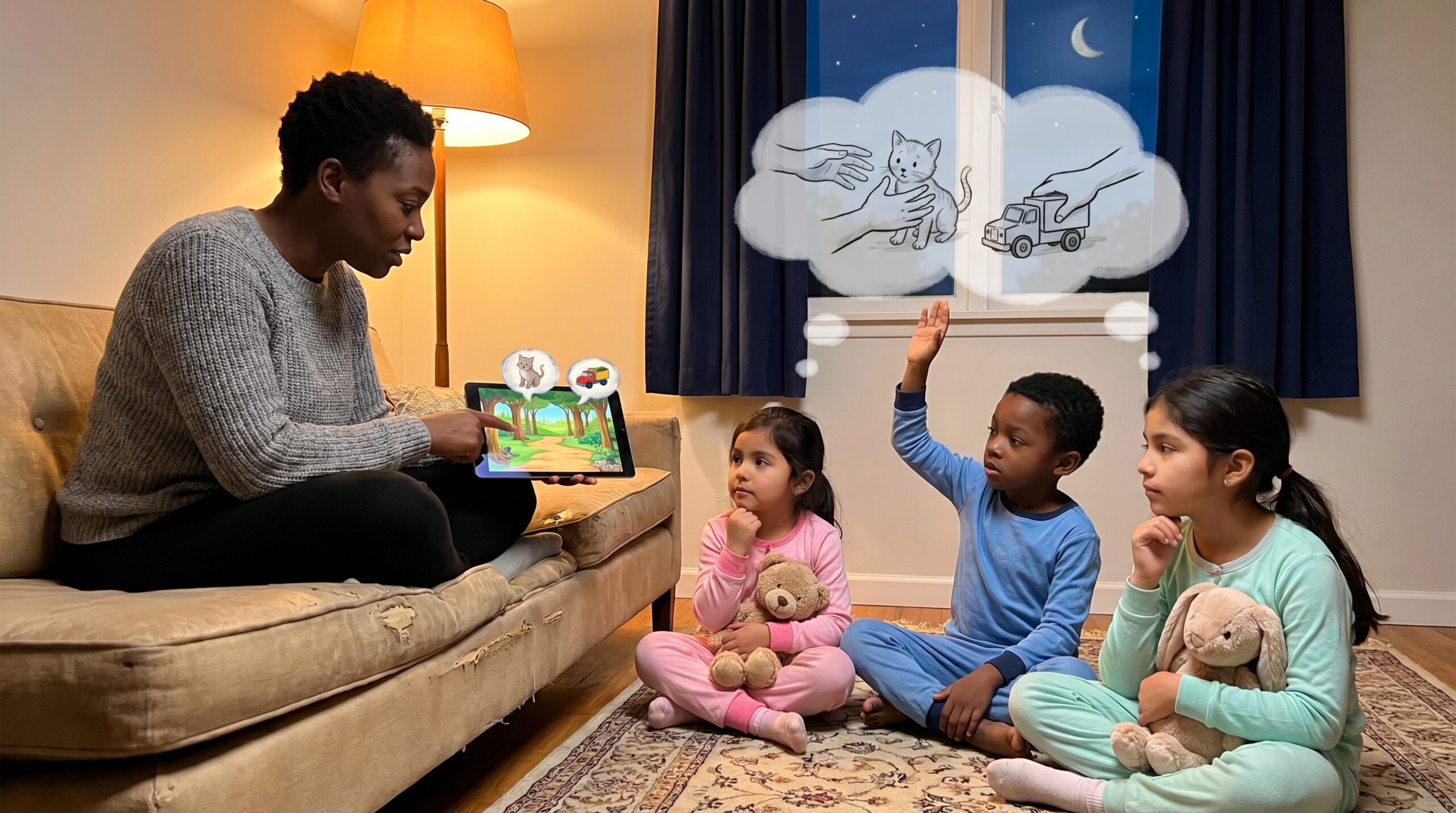
Education through storytelling for ages 3-12 connects memory, language, and feeling in one lively package. Stories create order, cause, and meaning. Children lean in. They remember. It really sticks.
Why education through storytelling for ages 3-12 helps memory
Stories impose a clear timeline. A beginning, middle, and end gives children something to hold. Causal links explain why events happen. As a result, details gain purpose and stay easier to recall. Research indicates that storytelling increases information retention by 65% compared to traditional verbal instruction methods, highlighting its effectiveness as an educational tool.
Decades of developmental research show ordered stories beat isolated facts for both immediate and delayed recall. Neuroscience adds more proof. Listening to a story lights language networks, sensory areas, and emotion centers at once. Even the listener and speaker can sync up. That neural coupling signals shared understanding and richer memories. A 2025 meta-analysis of 25 studies found that interactive reading produces a medium aggregate effect on young children’s narrative ability, with the strongest effects observed in children aged 4–5 years.
How stories match changing development
Children change fast between ages 3 and 12. Stories that fit a child’s stage work best. For example, preschoolers prefer repeated, concrete plots. They gain big vocabulary from strong images and rhythm. Early school children start to follow multi-step plots and infer motives. Later, older children handle complex themes and abstract ideas.
In short, well-shaped narrative meets the child where they are. The right story for the right age opens doors to thinking, feeling, and remembering. A longitudinal study published in May 2024 found that storytelling connectedness in children ages 5–8 predicted phonological awareness and reading comprehension measured 3–4 months later, reinforcing the importance of storytelling in developing literacy skills.
Language, thinking, and social growth
Storytelling drives language growth. Rich oral stories predict larger vocabularies later. Stories also scaffold episodic memory. They teach sequencing, cause and effect, and basic theory of mind. Moreover, a classroom proof-of-concept randomized study of 22 first-graders showed that an oral narrative intervention with embedded vocabulary instruction produced large effects: students in the treatment group outperformed controls on narrative retell (p = 0.0001; effect size d = 1.54) and on a vocabulary measure (p = 0.029; effect size d = 1.18), providing empirical evidence of the effectiveness of narrative interventions in improving both narrative and vocabulary skills in young children.
Moreover, narratives let children simulate dilemmas and practice empathy. Across cultures, elders used stories to pass on knowledge. Modern studies repeat that pattern. Contextualized facts transfer more easily than isolated facts. That transfer makes story-based learning powerful and practical.
History and characteristics of narrative education
Story-based teaching is both ancient and modern. From campfire tales to classroom read-alouds, people used narrative to share skills and values. Today, digital tools keep that tradition alive. They add portability, repeatability, and new ways to record family tales.
Key characteristics make narrative education effective. These include structure, emotion, vivid sensory detail, and meaningful cause-and-effect. Together, these traits boost attention, support memory, and deepen understanding.
A quick, real moment
Recently I told a six-line sock quest to my six-year-old. The next morning they retold the whole plot and said the word mysteriously. That tiny exchange showed how a small story can carry words and ideas into daily life.
Storypie and narrative learning
At Storypie, we build tools that celebrate stories as learning engines. We focus on short, age-friendly tales that match children’s changing minds. A large randomized controlled trial in Paris found that a shared-book reading intervention raised the share of families reading daily from a 41.2% baseline by +8 percentage points, with benefits persisting six months after the program ended, illustrating the impact of shared reading practices on family engagement in literacy, which is crucial for children’s educational success. Learn more about Storypie on our homepage or try the Storypie app to save family stories.
Ultimately, narrative remains a primary path for teaching. It engages attention, grows language, and builds empathy. Who would not remember a tiny quest about a lost sock? Stories are small rituals with huge results.