Australia bedtime stories feel wide and bright. They bring open skies, slow rhythms, and curious animals into a cozy bedtime. Parents and teachers will find calm and wonder in these tales.
Australia Bedtime Stories: land, sea, and culture
Start with Dreamtime. Aboriginal and Torres Strait Islander peoples hold the oldest living cultures on Earth. Their Dreamtime stories carry place, law, and care. Therefore, tell Dreamtime with respect. Use works made or approved by Indigenous authors. Also, acknowledge the traditional custodians of the land. Keep sacred stories for the people who hold them.
Soft scenes and friendly animals
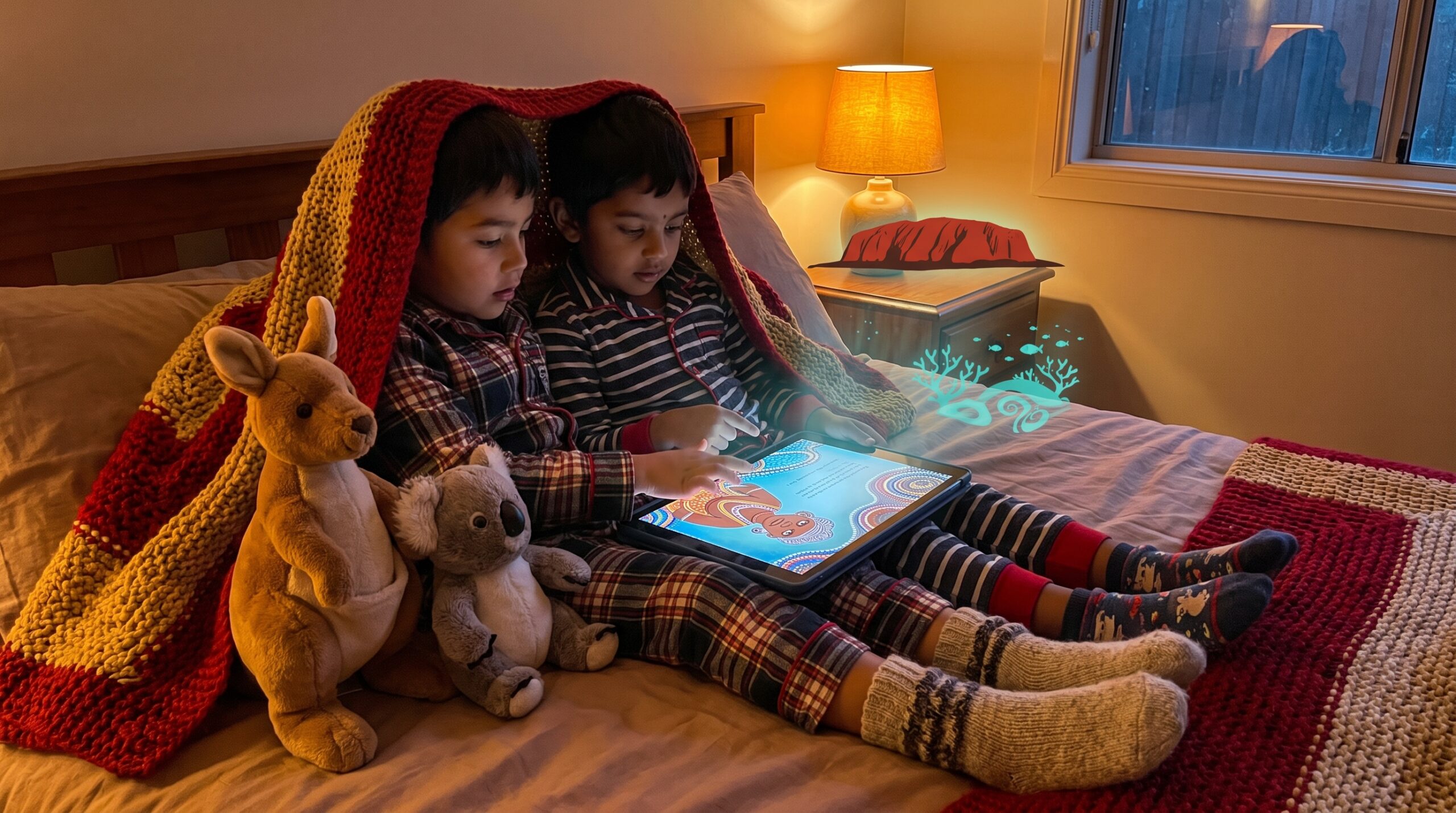
The land and sea offer gentle scenes and steady sounds. The Outback sits wide and still, with honey coloured rocks like Uluru. The coast holds the Great Barrier Reef, more than 2,300 kilometres of coral. Rainforests hum with birds. Cities glow with harbour lights and opera sails.
Wildlife feels playful and sleepy at once. Kangaroos hop in groups. Koalas nap like soft clouds. Kookaburras laugh. Bright cockatoos preen like tiny showoffs. Also, the platypus surprises with its odd, charming ways. As of 2023, Australia’s population grew by 2.5% to 26.97 million people, enriching the tapestry of stories and experiences shared within families and communities, according to the Australian Bureau of Statistics.
History and modern life in Australia
British colonisation began in 1788. The six colonies federated on 1 January 1901 to form the Commonwealth of Australia. Today the nation is a constitutional monarchy and a parliamentary democracy. The Prime Minister leads the government. The Governor General represents the monarch.
Australia is multicultural and multilingual. Many immigrant communities add food, music, and language. Indigenous languages still survive. Families and teachers can use this diversity to open warm, small conversations. In addition, Australia’s commitment to sustainability is reflected in its energy sector, where renewable sources contributed 35% of the total electricity generation in 2023, with solar accounting for 16%, wind for 12%, and hydro for 6%, as noted by the Department of Climate Change, Energy, the Environment and Water.
Bring Australia into bedtime
Keep stories short and steady. Ten minutes often feels just right. Use calming soundscapes such as a soft didgeridoo, gentle waves, or a hush of eucalyptus leaves. Let endings stay reassuring and peaceful.
Read or listen to a story about Australia now: Read or listen to a story about Australia now: For 3-5 year olds, For 6-8 year olds, For 8-10 year olds, and For 10-12 year olds.
Simple family activities
- Read a short Dreamtime tale and name the place it honours.
- Make a soft kangaroo puppet and act out a calm scene.
- Trace Australia on a map and point to Uluru, the reef, and a favourite city.
Safety and respect tips
Do not feed or approach wildlife. Follow beach lifeguard flags. Do not climb sacred sites such as Uluru. Sun safety matters. When sharing Indigenous art or stories, credit the creators. Choose materials made or approved by Indigenous authors.
Tip: Curl up tonight with a cozy Australian winter tale. Play a 10-minute Storypie Australia story to spark curiosity and calm. Get the Storypie app.
Final thought: Australia gives us bright colours and slow wonder. Pick a just-right, sleepy-time story. Listen, breathe, and let a small adventure carry you to sleep. However, it’s important to note that in 2023-24, Australia’s total net greenhouse gas emissions were 466.4 million tonnes of carbon dioxide equivalent, highlighting the environmental challenges the nation faces, as reported by the Department of Climate Change, Energy, the Environment and Water. This context can enrich our understanding of Indigenous stewardship narratives.