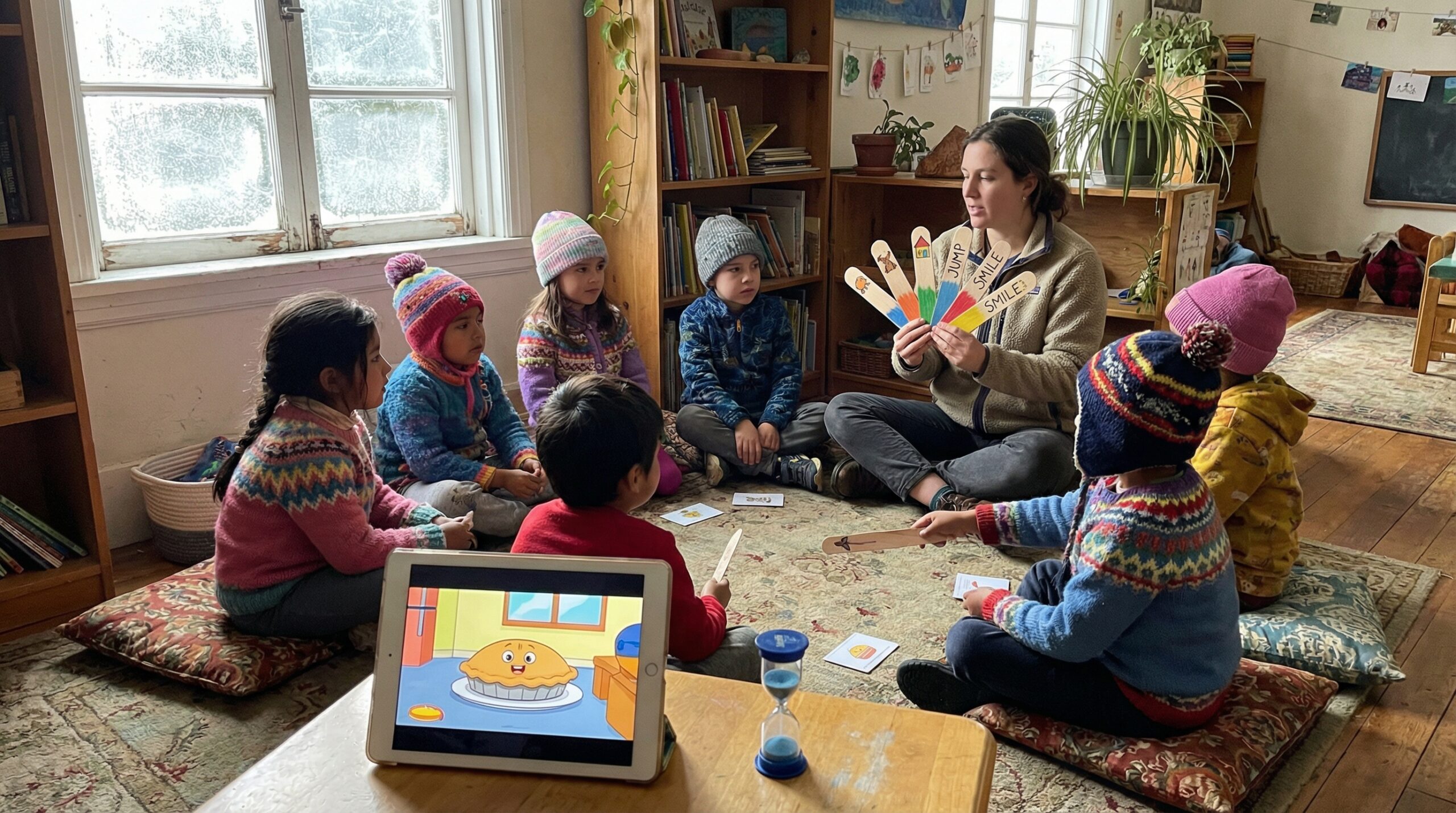
Education through storytelling ages 3-12 blends facts with feelings to make learning stick. In short, it ties vocabulary and ideas to scenes children can replay. For parents and teachers, that mix matters more than lists of facts. Research indicates that storytelling increases information retention by 65% compared to traditional verbal instruction methods, making it a compelling teaching tool.
What education through storytelling ages 3-12 is
This approach uses stories as the main carrier of knowledge. Stories provide sequence, context, and emotional hooks. As a result, children remember events, words, and concepts more easily. A 2025 meta-analysis of 25 studies found that interactive reading produces a medium aggregate effect on young children’s narrative ability, with the strongest effects observed in children aged 4–5 years.
Core characteristics
- Sequence: stories show cause then effect.
- Context: facts live inside scenes or episodes.
- Emotion: feelings increase memory consolidation.
- Repeatable structure: predictable patterns support recall.
Why narrative works
The brain prefers cause and effect. Therefore, narratives make facts retrievable. Also, episodic hooks let children replay scenes in their minds. Finally, emotional detail helps with long term storage. A longitudinal study published in May 2024 found that storytelling connectedness in children ages 5–8 predicted phonological awareness and reading comprehension measured 3–4 months later, demonstrating the long-term benefits of storytelling on literacy skills.
Cognitive basics
- Causal sequencing boosts retrieval.
- Episodic memory anchors facts as scenes.
- Emotion increases consolidation and recall.
- Dual coding links voice and images for stronger memory.
How it shows up by age
Education through storytelling ages 3-12 affects children differently. Below are common patterns by age group.
Ages 3 to 5
Stories here are simple and concrete. Children benefit from repetition and predictable structure. Picture and sound combinations help words attach to actions. A randomized study of augmented-reality storybooks found that AR-enhanced storytelling significantly improved retelling and comprehension compared to traditional printed books, showcasing the role of technology in modern storytelling methods.
Ages 6 to 8
Children begin to follow causal chains. Narratives that show mistakes and fixes build inference skills. Vocabulary grows faster when words sit in context. Research shows that storytelling contributes 68.2% to the improvement of early childhood empathy skills, especially at the age of 5–6 years, making it a valuable practice for social development.
Ages 9 to 12
Older children handle layered plots and abstract themes. Narratives support moral reasoning and transfer of knowledge. Background stories prepare them for classroom concepts.
Practical benefits
Education through storytelling ages 3-12 brings measurable gains. For example, you can expect better vocabulary and stronger sequence skills. Also, stories help children practice empathy in safe ways. Improved vocabulary through repeated words in context, stronger listening and retelling abilities, and more perspective taking and smoother school transitions are all positive outcomes.
Equity and cultural relevance
Stories that reflect a child’s culture increase background knowledge. Therefore, they reduce classroom mismatch and make facts land more reliably. Diverse narratives matter for access and belonging.
Learn more with Storypie
Storypie turns short, child-friendly episodes into learning moments. If you want a gentle start, try Storypie episodes for age-focused stories. Visit the Storypie app to explore episodes and series for different ages.
In short, education through storytelling ages 3-12 ties facts to feelings. That combination creates the stickiness children need to remember and grow.