Europe for kids is a bright, compact world with mountains, islands, great cities and long stories. It sits in the Northern Hemisphere. Oceans and seas frame it: the Arctic to the north and the Atlantic to the west.
Quick facts about Europe for kids
Europe covers about 10 million square kilometres. It holds roughly 700 to 750 million people. That means many languages, foods and festivals. To the east, the Ural Mountains, the Ural River and the Caucasus form common borders. As of January 1, 2025, the EU’s population was estimated at 450.4 million, an increase of over a million from the previous year, marking the fourth consecutive year of population growth.
Read or listen
Read or listen to a story about Europe now: For 3-5 year olds, For 6-8 year olds, For 8-10 year olds, and For 10-12 year olds.
Where to look first
Maps divide Europe into regions. Northern Europe has fjords and boreal forests. Western Europe shows rolling hills and big cities. Central Europe holds the Alps and river valleys. Eastern Europe has wide plains and the Carpathians. Southern Europe links sunlit Mediterranean coasts and islands.
Major rivers help us picture the land. Think Volga, Danube, Rhine and Dnieper. Also picture the British Isles, Sicily and Crete when you think of islands.
A tiny timeline kids can carry
Ancient Greece taught philosophy and gave us early ideas of democracy. Roman builders made roads, cities and law. The Middle Ages brought castles and knights. The Renaissance revived art and ideas. Later, the Age of Exploration launched long voyages. The Industrial Revolution reshaped towns and work. Finally, two world wars led nations to cooperate and form the European Union. The EU stands today as a friendly experiment in working together across borders. In 2023, the EU’s gross domestic product (GDP) was valued at €17.2 trillion, equivalent to an average of €38,100 per inhabitant.
Culture and curious bites
Europe for kids means many languages and lively music. You will find Mozart and modern pop. Artists such as Michelangelo and Van Gogh changed how people see art. Scientists from Europe shaped astronomy and physics. Food is a parade: pasta, tapas, pastries and fish. Traditions appear as festivals, markets and family meals. There are thousands of castles and a forest of myths to explore. Research shows that in 2023, renewable sources supplied 24.5% of the European Union’s gross final energy consumption, reflecting a significant shift towards sustainability.
Three quick ways to bring Europe alive
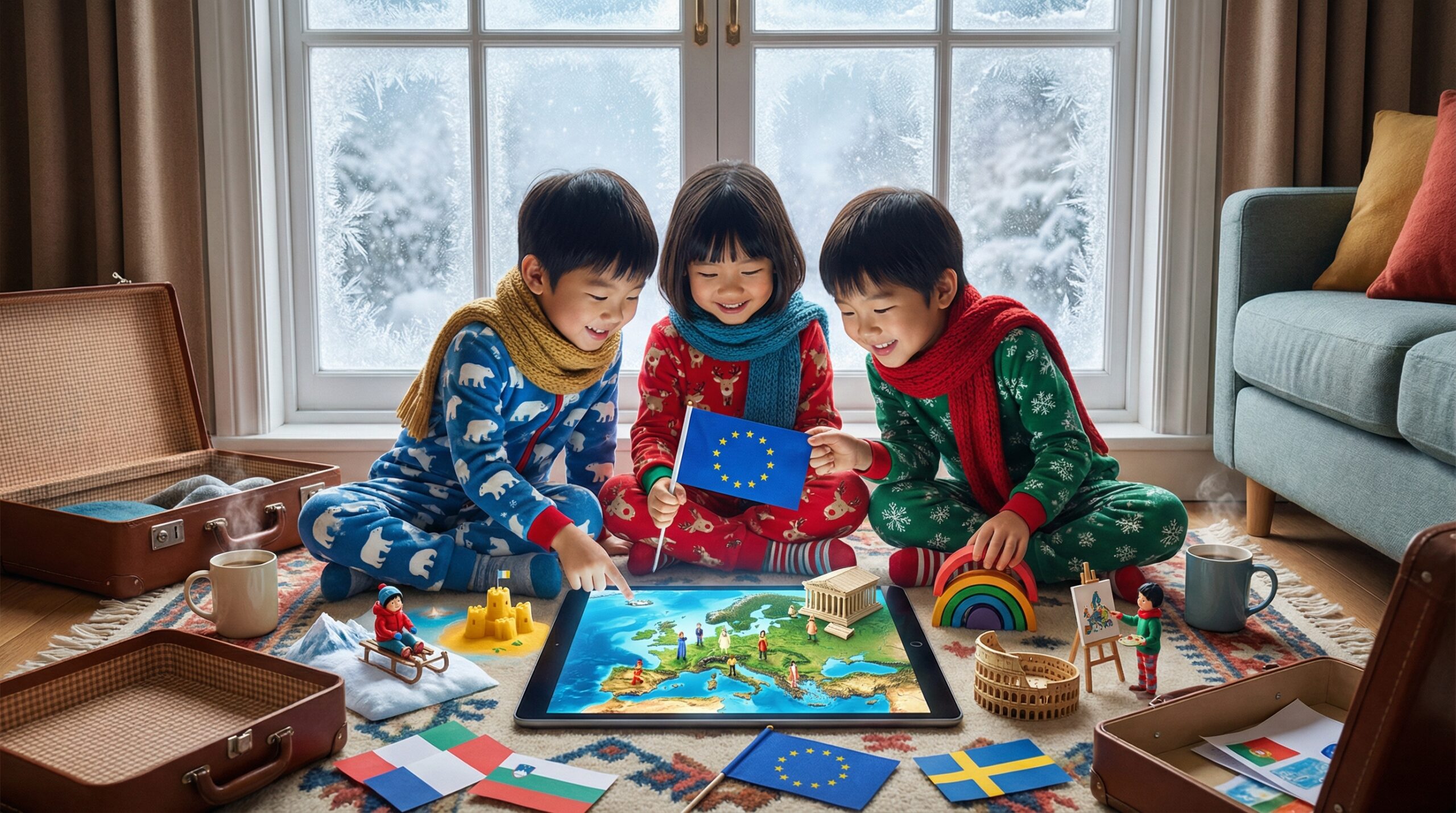
- Map game. Print a simple map and color the Alps, the Mediterranean and the British Isles. Label two rivers.
- Snack stop. Make a Mediterranean plate with bread, cheese and olives. Say the country name out loud.
- Read and listen. Play a 15-minute Europe story on Storypie before a trip or a snowy morning. It sparks curiosity and makes places feel magical.
Famous touchpoints to name-drop
Try these names to spark wonder: Eiffel Tower, Colosseum, Acropolis, Big Ben, Sagrada Família and the Northern Lights. Add the Alps for mountains and fjords for drama. Mention Greek thinkers, Roman builders and Renaissance artists to show how ideas and beauty spread across time.
Quick share
Snowy morning idea: Storypie brings Europe alive – Alps to beaches, Greek thinkers, Roman builders, Renaissance art, and a friendship that grew into the EU. Tip: Play a 15-minute Europe story before holiday prep to spark curiosity.
Parting note
Europe is delightfully diverse and absolutely magical. It is a feast for curious kids. Keep explanations short, add a map and a snack, and watch questions bloom. Start small and enjoy. Together. Every day. Notably, in 2024, Europe experienced its hottest year on record, impacting over 400,000 people due to extreme weather events, an important reminder of the challenges posed by climate change.
Find more stories and gentle learning on Storypie.