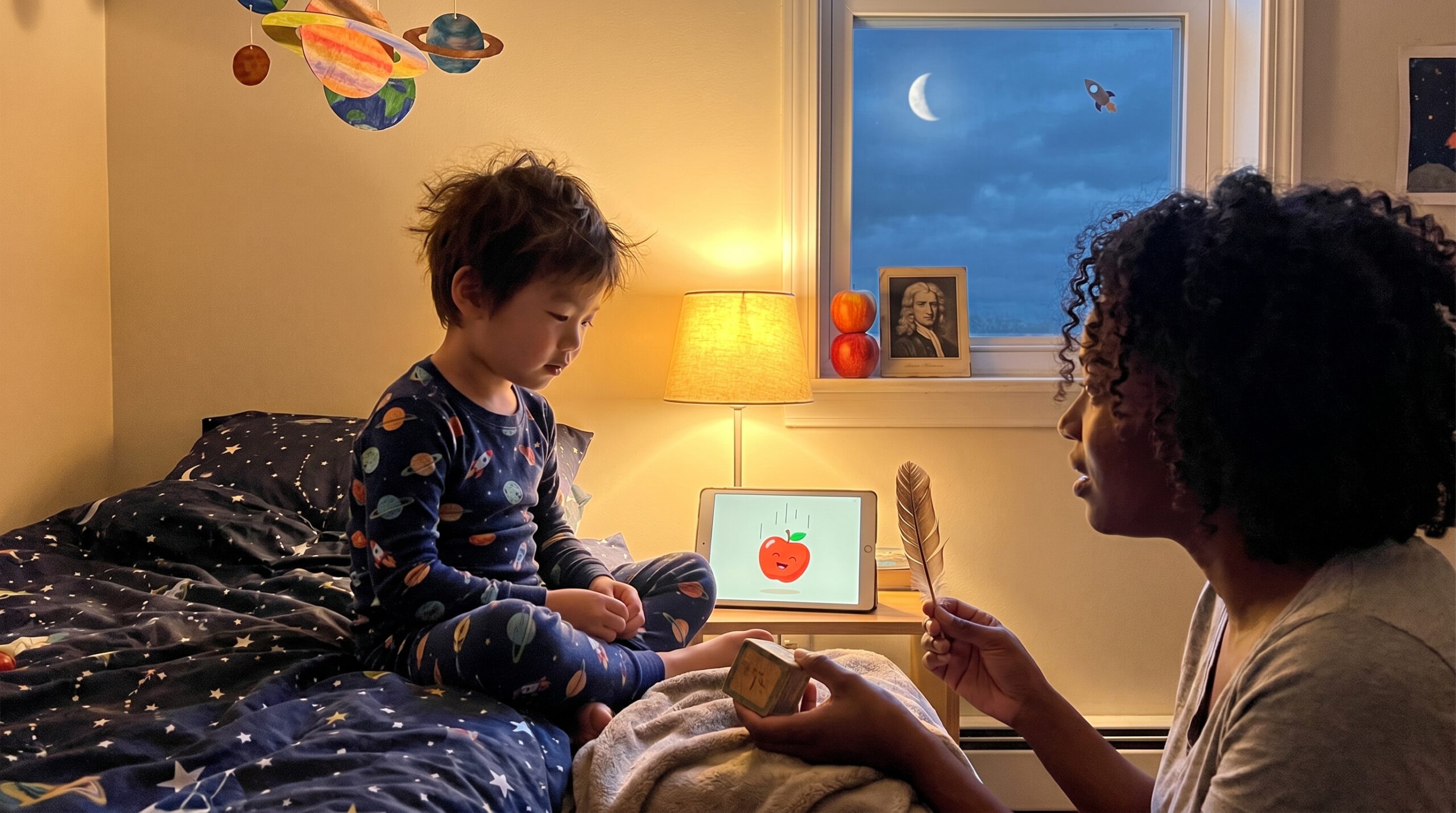
Gravity for kids can turn a small moment into a big wonder. So many parents see the spark when a toy drops. That gasp makes science feel alive.
At Storypie we turn big ideas into bedtime wonder. Meet gravity, the invisible pull that makes apples fall and keeps the Moon in orbit. In fact, the Moon’s mean surface gravitational acceleration is 1.62 m·s², which is about 16.5% of Earth’s surface gravity, helping to explain why we feel lighter there.
Read or listen to a story about Gravity now: For 3-5 year olds, For 3-5 year olds, For 6-8 year olds, For 8-10 year olds, and For 10-12 year olds.
What is Gravity for Kids?
Gravity is a pull between masses. The bigger the objects and the closer they are, the stronger the pull. On Earth we feel that pull as weight. The conventional standard acceleration due to Earth’s gravity is exactly 9.80665 m·s⁻², which scientists use as a reference for understanding weight and measurements.
Use simple examples. An apple falls. You stay on the ground. The Moon orbits because it keeps falling around Earth. Also, the same idea explains why planets move. Did you know that the acceleration due to gravity on Earth’s surface can vary between approximately 9.78 m/s² and 9.83 m/s², depending on latitude and altitude? This variability can make the concept of gravity feel even more relatable for kids.
A Short, Cozy History
Galileo showed that heavy and light objects fall together without air. Then Newton put the idea into a neat formula: F = G·m1·m2 / r^2. That formula links falling apples to planetary motion.
Later, Cavendish measured G so people could estimate Earth mass. In the 20th century Einstein reframed gravity as curved spacetime. Still, the heart of the idea stays familiar. Mass bends space and other things move along that bend.
How Gravity Acts at Home
Earth gives us g, about 9.81 m/s². That means speed increases by about 9.81 meters per second every second during free fall. For example, distance falls as s = 1/2 g t^2.
So, from one meter an object falls in about 0.45 seconds if we ignore air resistance. That quick fact makes for a perfect bedside moment.
Try Two Simple Tests Tonight
- Drop two safe toys of similar shape from low height. Most times they land together. Ask: who won? Let your child be the judge.
- Drop a flat paper and a coin to show air resistance. Then imagine no air and watch how fair the race becomes.
Also try a pendulum. Tie a small weight to string and time several swings. Use T = 2π sqrt(L/g) to estimate g. Keep it playful and fun.
Safety and Simple Notes
Do not drop heavy or sharp objects. Use cushions or a soft outdoor spot. Supervise every step. Safety keeps the experiment joyful.
Ask questions. Why do we not float away? Why does the Moon not crash into Earth? What changes on the Moon or Mars where gravity is weaker? For instance, the mean surface gravitational acceleration on Mars is 3.72076 m·s², about 38% of Earth’s gravity. These questions turn facts into little victories.
Wrap-Up and a Gentle Next Step
I like ending with a tiny victory. Try the drop test tonight. Let your child be the expert and enjoy the delight.
If you want more bedtime science, get the app: get the app. Tiny wonders lead to big curiosity.