
Isaac Newton biography for kids: Early life and breakthroughs
Isaac Newton biography for kids begins with a quiet farmhouse birth. He was born at Woolsthorpe Manor in Lincolnshire on 25 December 1642 (New Style calendar: January 4, 1643). First, he lived without his father. Then he attended the King’s School in Grantham. In 1661 he went to Trinity College, Cambridge. When the Great Plague closed the university in 1665, he returned home. That year became his annus mirabilis. In that quiet time, he worked on ideas that still shape how we view motion, light, and numbers.
Three clear laws you see every day
Next, Newton wrote three laws of motion that are tidy and surprising. First, objects keep doing what they do unless a force acts on them. For example, a toy car slows because friction acts on it. Second, force equals mass times acceleration, written F = ma. So a heavy shopping bag needs more push than a light one. Third, every action has an equal and opposite reaction. Thus a balloon gliding across a room shows action and reaction. Rockets also push exhaust one way and move the craft the other way. In 1687, he published “Philosophiæ Naturalis Principia Mathematica”, introducing these three laws of motion and the law of universal gravitation, which became foundational to classical mechanics.
Gravity: the same pull nearby and far away
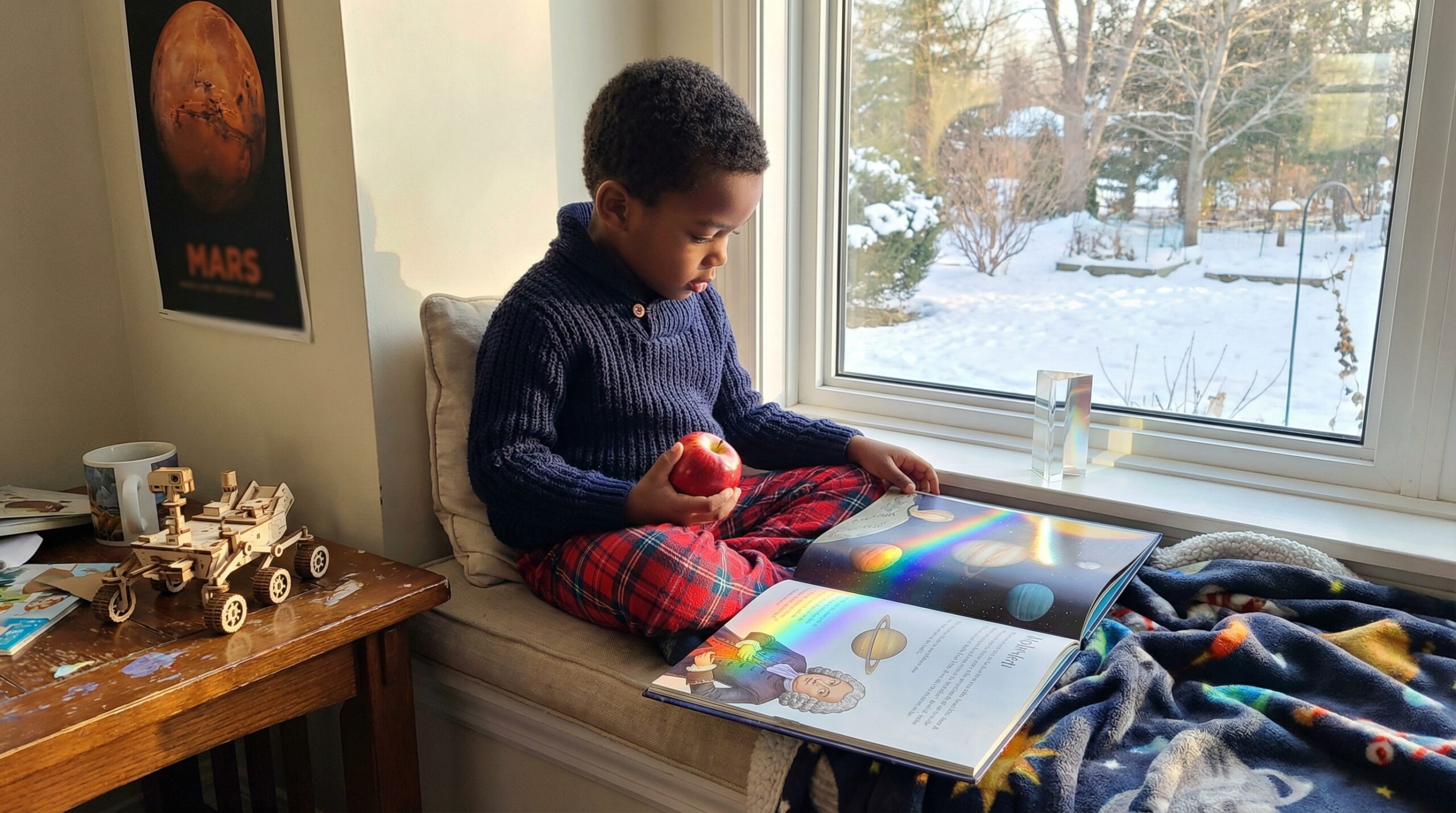
Then he proposed that every two masses attract each other. The attraction falls with the square of the distance between them. This idea links a falling apple to the Moon’s orbit. He set this out in Philosophiæ Naturalis Principia Mathematica, published in 1687. The apple image is simple and delightful. It shows how a small question led to a big answer.
Light, prisms, and tiny surprises
Also, Newton showed white light contains many colors. He shone light through a prism and spread a spectrum across a page. Then he recombined the colors and got white light back. He gathered these experiments in Opticks, published in 1704. For curious hands, a glass of water or a prism can make a tiny wow moment.
Calculus, disputes, and public life
Next, Newton developed fluxions, an early form of calculus, to solve changing motion. Gottfried Leibniz created a similar system at the same time. A sharp dispute followed. Today, history credits both men because they worked independently. Meanwhile, Newton also served as President of the Royal Society from 1703 until his death in 1727, overseeing the society for 24 years. He worked at the Royal Mint and helped reform coinage. In 1705, he was knighted by Queen Anne, becoming Sir Isaac Newton, and was buried in Westminster Abbey in 1727.
Private habits and lasting legacy
However, Newton could be private and combative. He spent long hours on alchemy and Biblical study. He rarely published much of that work. His disputes with Hooke and Leibniz show how heated science could become. Finally, the SI unit newton is named for him. Woolsthorpe Manor preserves his workspace and invites children to imagine experiments. For families who love apples, prisms, and big questions, his life remains a warm story.
Quick family activities to try today
- Drop two small objects of different mass to show gravity acts on both.
- Shine sunlight through a glass of water or a prism to make a rainbow.
- Ask one simple why question and then listen carefully.
Read or listen to a story about Isaac Newton now: Read or listen to a story about Isaac Newton now: For 3-5 year olds, For 6-8 year olds, For 8-10 year olds, and For 10-12 year olds.
Also visit Storypie for more child-friendly science biographies and gentle readings.