
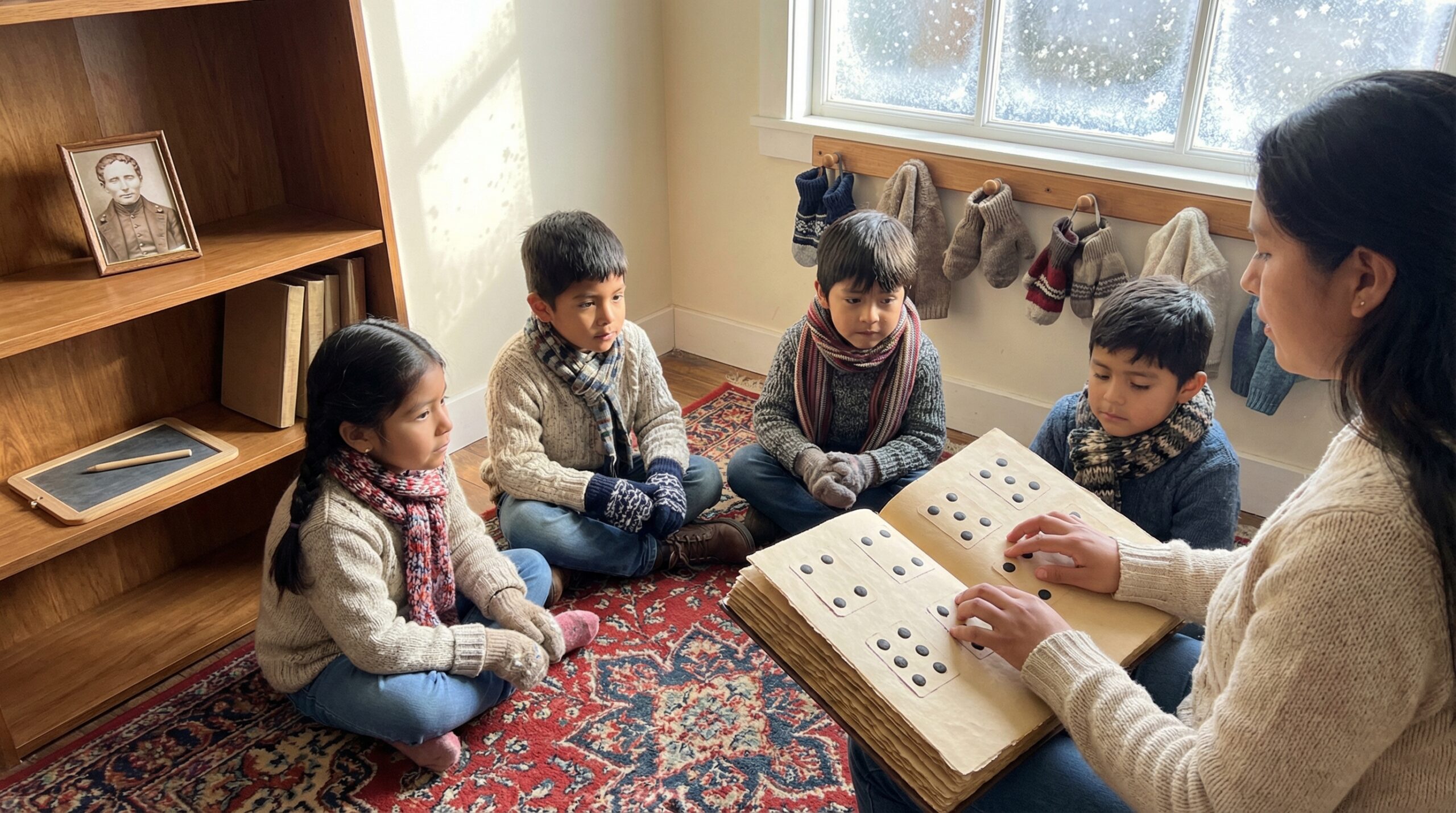
Louis Braille biography for kids begins with a curious boy in Coupvray, France. He was born on January 4, 1809, and loved to explore. At age three he had an accident in his father’s workshop. The injury led to infection and loss of sight. Still, he stayed lively and curious. Louis Braille passed away on January 6, 1852, at the age of 43, leaving behind a remarkable legacy.
Louis Braille biography for kids: early life
When he was ten, Louis moved to Paris. He joined the Royal Institute for Blind Youth. There he learned music and read by touch. He also studied with other blind students. Later, he became a teacher at the same school. The Institute shaped his talents and work.
A new system for touch reading
As a teen, Louis learned a system called night writing. It came from Charles Barbier and served the military. However, it proved bulky and hard to read by touch. At the age of 15, in 1824, Louis Braille developed his tactile reading and writing system, which consists of a six-dot code allowing for 64 possible combinations. He simplified it into a compact six-dot cell. The cell has two columns and three dots in each column.
The dots are numbered 1 to 6. Together they form 64 patterns. These patterns stand for letters, numbers, punctuation, music, and more. Louis published his system in 1829. Later, he added musical notation. He kept improving the code while he taught and played music.
Why Braille matters today
Braille opened doors. It gives blind readers direct access to spelling and punctuation. Therefore, readers learn grammar and layout from the page itself. Braille literacy links to higher education and better employment. In fact, as of 2025, the Braille system has been adapted for at least 133 languages worldwide, facilitating literacy and communication for the visually impaired across diverse linguistic groups, showcasing its global impact. UNESCO declared January 4 World Braille Day in 2019. This honors Louis Braille and his lasting legacy. The United Nations General Assembly proclaimed this day to raise awareness about the importance of Braille in the lives of visually impaired individuals.
Types of braille and tools
- Grade 1 braille spells every letter simply.
- Grade 2 braille uses contractions to save space.
- Eight-dot braille supports computing and extra symbols.
- Special codes cover music and mathematics.
Tools range from a slate and stylus to embossers and refreshable braille displays. For example, the Perkins Brailler makes neat braille pages. Today, refreshable displays link to phones and computers. Thus braille readers can browse the web and write using touch.
Small ways to feel braille
At home, you can make a simple braille cell. Glue six small beads onto a card. Or press playdough dots into cardboard. These hands-on projects make inclusion joyful and very doable. They also help children notice two columns and three dots per column.
Storypie remembers Louis Braille on a crisp winter morning. He turned a personal challenge into a way for the world to read by touch. His story still sparks curious fingertips everywhere. In 2009, to commemorate the 200th anniversary of Louis Braille’s birth, countries such as Belgium and Italy issued special 2-euro coins in his honor, reflecting the recognition and celebration of his legacy.
Read or listen to a story about Louis Braille now: Read or listen to a story about Louis Braille now: For 3-5 year olds, For 6-8 year olds, For 8-10 year olds, and For 10-12 year olds.