
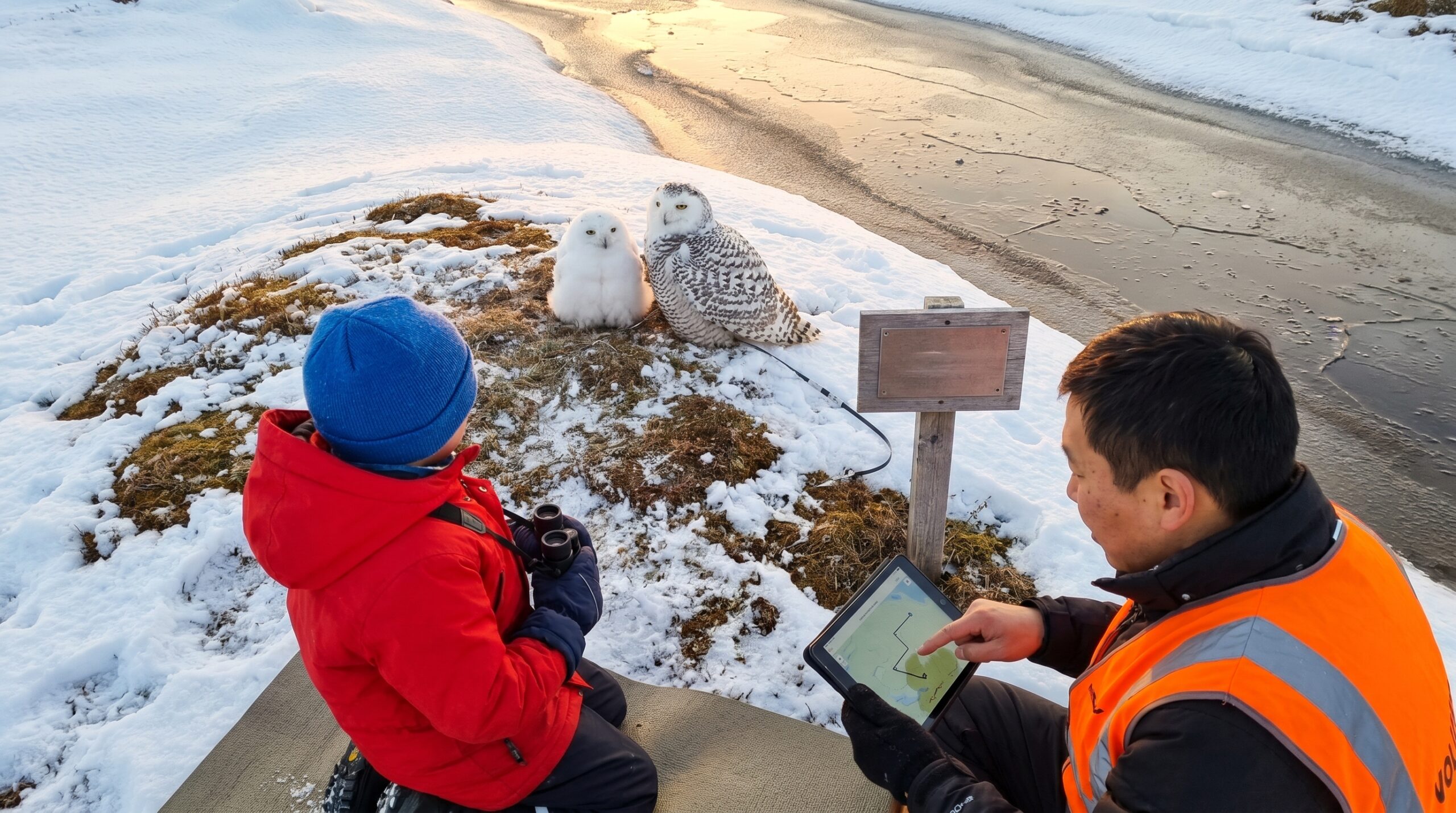
Snowy owl facts for kids introduce a magnificent Arctic bird. These bright white owls begin life as fluffy chicks on windswept tundra hummocks. Because they grow fast, young owls learn to hunt in long summer daylight. Also, they follow lemming cycles that shape breeding each year. In fact, Snowy Owls can lay up to 14-16 eggs in a single nest when lemmings are abundant, but may forego nesting or lay smaller clutches (4-7 eggs) when prey is scarce, illustrating their reproductive behavior closely tied to food availability according to Massachusetts Government.
Snowy Owl Facts for Kids: Appearance and Size
Adults are large and mostly white. Males often look almost pure white. Females and juveniles show darker bars and spots. Typically adults measure about 52 to 71 cm long. Their wingspan ranges roughly from 125 to 150 cm. Feathers cover legs and toes for extra insulation. As a result, they blend into snowy tundra very well.
Where They Live and Move
Snowy owls breed across Arctic tundra in North America and Eurasia. They nest on the ground and lay clutches that vary with food. For example clutches range from about three up to eleven eggs. Incubation lasts 32 to 34 days and chicks fledge at six to eight weeks. When lemmings are scarce, owls may lay fewer eggs or skip breeding. In winter some owls move south in irruptions and turn up across southern Canada and the northern United States. Notably, in the winter of 2025-2026, approximately 59 Snowy Owls were recorded in Wisconsin as of January 5, which is higher than the 18 recorded in 2023 and 34 in 2022, indicating potential population fluctuations according to the Wisconsin Department of Natural Resources.
Diet and Role as a Top Predator
Lemmings are the main prey, but snowy owls also take voles, Arctic hares and birds. They serve as top terrestrial predators and shape the tundra food web. Unlike many owls, snowy owls are often active during daylight in Arctic summer. Males give soft hoots during breeding, while females make harsher croaks.
Special Adaptations and Links to Climate
Thick plumage, feathered feet, sharp talons and keen senses make snowy owls perfect for cold life. Their fortunes closely track rodent cycles; fewer lemmings usually means lower breeding success. Research indicates that the global population of Snowy Owls is estimated to be between 14,000 and 28,000 breeding adults, with breeding populations in the Arctic having declined by over 30% over the past three generations according to the Committee on the Status of Endangered Wildlife in Canada (COSEWIC). Also, climate change alters vegetation and snow patterns. As a result, these shifts can reduce lemming stability and nesting habitat. Alarmingly, in December 2025, Sweden declared the Snowy Owl regionally extinct after a decade without any observed nesting as reported by Euronews.
How Families Can Observe and Help
Use binoculars or a spotting scope and stay on trails. Keep a safe distance from nests and keep pets leashed. Do not approach chicks. Reduce your carbon footprint and avoid second generation rodenticides. Next, support trusted conservation groups and report sightings to community science projects. For example add records to eBird to help researchers track irruptions.
Simple Activities to Try with Kids
- Binocular basics: practice scanning fields from a window.
- Map activity: mark Arctic breeding range and winter irruption spots.
- Tundra food web: draw lemmings to owls to plants.
- Coloring page: trace a snowy owl and add white and dark bars.
Quick Facts and Monitoring
Adults can live more than ten years in the wild. Males often appear pure white, and juveniles show heavier barring. Scientists use banding and GPS tags. They also rely on community sightings during irruption years. A 2024 multinational review concluded that Snowy Owls have experienced a long-term decline of 2.3% per year from 1966 to 2023, with a 3-generation decline estimate of -42.6% as noted in Bird Conservation International. Kid friendly tip: spot bright white shapes against winter fields from a safe distance.
Read or listen to a story about Snowy Owl now: For 3-5 year olds, For 3-5 year olds, For 6-8 year olds, For 8-10 year olds, and For 10-12 year olds.
Hear it on Storypie: Get the app.
If you could do one thing to help snowy owls and their Arctic home, what would you do?