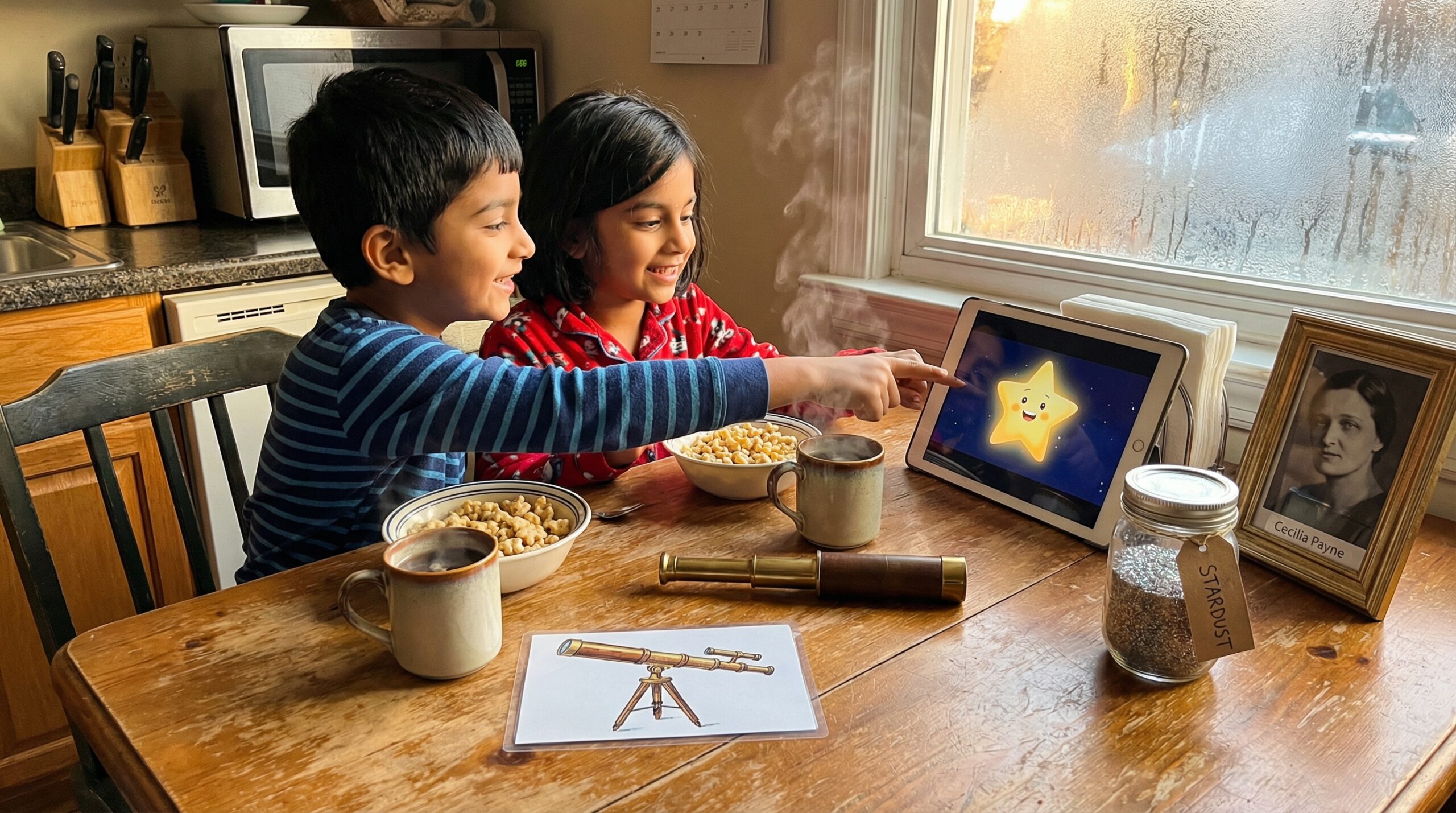
Stars for kids can spark big curiosity with one tiny idea. For example, you and your breakfast cereal contain stardust. Stars are glowing balls of gas held by gravity. Also, nuclear fusion in their cores powers their light and heat. Cecilia Payne showed that stars are mostly hydrogen and helium, a discovery that changed how we view the sky.
What stars are
Stars are giant spheres of hot gas. They glow because fusion fuses hydrogen into helium in the core. This process makes light and heat. The Sun is our nearest star. It gives Earth life, light, and warmth. As of May 2025, astronomers estimate that the universe contains up to one septillion stars (1 followed by 24 zeros), with our Milky Way galaxy alone housing more than 100 billion stars.
How stars are born and live
Stars form inside cold, dense clouds called molecular clouds. Under gravity, these clouds collapse into a protostar. Then the protostar heats up. When the core reaches millions of degrees, fusion begins. Most stars then spend most of their lives on the main sequence, quietly fusing hydrogen into helium.
Mass decides a star’s fate. Heavier stars burn hotter and faster. Lighter stars burn cooler and can live for trillions of years. For example, massive stars may explode as supernovae. In fact, as of December 2024, the Zwicky Transient Facility (ZTF) has identified over 10,000 supernovae since its inception in 2018, marking the largest number ever recorded by an astronomical survey. Meanwhile smaller stars end gently as white dwarfs. Some very massive stars leave neutron stars or black holes.
Colors and what they mean
Star color reveals temperature. Blue stars are scorching hot. Red stars are cool by comparison. The Sun sits in the middle as a yellow white star. Astronomers sort stars with the OBAFGKM sequence. A classic mnemonic is easy to remember on cold evenings.
Why we are stardust
Supernovae spread heavy elements into space. Then planets, rocks, and life form from those elements. So we are literally made of stardust. Modern telescopes read starlight to learn composition, distance, and motion. Spectroscopy and parallax give astronomers powerful tools. In January 2025, astronomers using NASA’s James Webb Space Telescope identified 44 individual stars in a galaxy located halfway across the observable universe, the largest number ever detected at such a distance.
A quick human moment
I once pointed out Polaris to my child. They asked if that star was our night light. That tiny question turned into a five minute adventure about direction and constellations. Small curiosities grow into big wonder. For teachers and parents, moments like this matter most.
Simple family activities and tiny wows
- Winter breakfast spark: say that stars made the atoms inside us. Then share Cecilia Payne as a bold scientist. Play the short Storypie episode at breakfast for a gentle start.
- Find a sky target: look for Orion, Polaris, or the Pleiades. Use binoculars to see more stars. Never look at the Sun directly; use a pinhole projector for safe viewing.
- Tiny model walk: lay objects in a hallway to map a scaled solar system. It is simple and fun.
Find the short episode inside the Storypie app if you want a quick listen. Read or listen to a story about Stars now: Read or listen to a story about Stars now, For 3-5 year olds, For 6-8 year olds, For 8-10 year olds, and For 10-12 year olds.
Quick science bites to say in one sentence
- The Sun is a star about 1.39 million km across and gives Earth light and heat.
- A light-year is the distance light travels in one year.
- Supernovae make heavy elements; that is why planets and people are made of stardust.
Glossary
- fusion – the core reaction that powers stars
- nebula – a stellar nursery where stars form
- supernova – an exploding star that spreads heavy elements
- light-year – the distance light travels in one year
Tonight pick one tiny fact and say it aloud with your child. Then draw it together. Tiny rituals like this build curiosity over time. For more short episodes and family-friendly science, visit the Storypie app.