
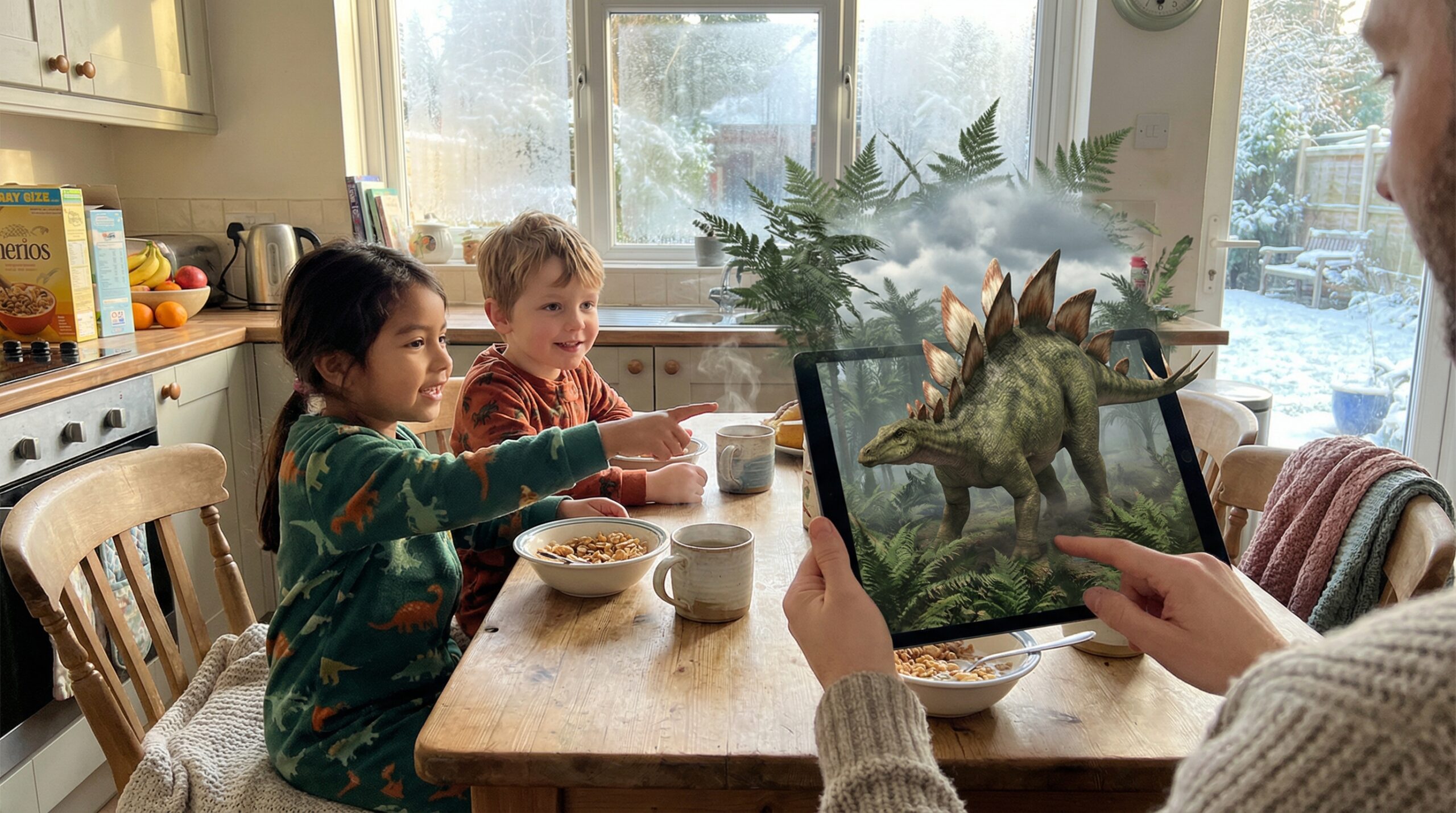
Stegosaurus for kids starts with a big, friendly name. Stegosaurus means roofed or covered lizard. It lived in the Late Jurassic, about 155 to 150 million years ago, as noted by the Natural History Museum. It is best known from the Morrison Formation of western North America.
Where Stegosaurus lived and how it looked
Fossils come from Colorado, Wyoming, and Utah. Therefore, stegosaurs roamed river plains and open woodlands. They walked among ferns and cycads, which made a leafy stage for their slow lives.
Adults reached about 20 to 30 feet long, with the largest known Stegosaurus skeleton, nicknamed “Apex,” measuring an impressive 8.2 meters (27 feet) in length. Also, the tallest plates could make them seem near 13 feet high. They weighed several tons, roughly the size of three or four cars, with recent estimates of body mass ranging from 1.7 to 3.7 tonnes, depending on the method used to calculate it.
Famous plates and the thagomizer
Stegosaurus had two staggered rows of bony plates on its back. Some fossils show 17 plates. In addition, stegosaurs often carried four strong spikes on the tail.
Those tail spikes form the thagomizer. The name began as a cartoon joke but it stuck. Fossils with bite marks support the idea that stegosaurs used the thagomizer against predators like Allosaurus.
What were the plates for?
Scientists still debate plate function. The plates were bone with many blood vessel channels. They grew as the animal matured, and juveniles had smaller, flatter plates.
Display and species recognition are leading ideas. Also, the plates might have helped with some heat exchange. Yet display seems the best explanation overall.
Diet, movement, and curious facts
Stegosaurus was a plant eater. It cropped low plants with a beak. Then it sliced food with small, leaf shaped teeth. Ferns, cycads, horsetails, and low conifers likely filled its plate.
The brain was small for the animal’s size, comparable to that of a plum, despite its large body size according to the Natural History Museum. Older ideas suggested a second brain near the hips. Modern research finds an enlarged spinal canal there, not a second brain.
Trackways show four legged walking. Sometimes those tracks hint at group movement. Therefore, stegosaurs may have had social behavior, but evidence stops short of proving large herds.
History and why kids love it
Othniel Charles Marsh named Stegosaurus in 1877. Since then, museums have mounted near complete skeletons, with one of the most notable selling for $44,600,000 at Sotheby’s on July 17, 2024. Kids usually find the plates and the thagomizer both funny and awe inspiring.
Stegosaurus makes a great teachable fossil. For parents and teachers, it sparks questions and hands on play. For example, you can mark 20 feet with blocks to show true size.
Read and listen on Storypie
Read or listen to a story about Stegosaurus now: For 3-5 year olds, For 6-8 year olds, For 8-10 year olds, and For 10-12 year olds.
Get the Storypie app to listen on the go: https://mystorypie.com/get-app.
Accuracy note
Paleontology changes with new fossils and methods. For example, exact plate counts, colors, and social lives remain uncertain. Still, that uncertainty is a teaching moment. It shows how science updates with new evidence.
Hands on ideas: Mark 20 feet with blocks to imagine a real Stegosaurus. Or pick a hero plate at breakfast and chat about its shape. Playful and curious learning works wonders.