Technology in early childhood education shapes how young children learn, play, and connect. It covers many tools, from audio stories to programmable toys. For parents and teachers, the term sums up both opportunity and responsibility.
What technology in early childhood education includes
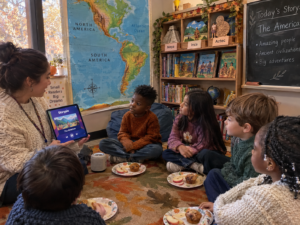
These tools form the backbone of modern early learning. For example, audio stories and podcasts bring voice and imagination into a child’s day. Tablets and apps deliver interactive games and reading experiences. Interactive e-books add sound and animation.
- Programmable toys that introduce early coding ideas.
- Digital cameras for creative documentation.
- Learning platforms used by preschools and families.
- Video chat that keeps distant relatives in a child’s life.
- Assessment tools and family communication apps.
Historically, mass media first showed that media can teach. Sesame Street proved educational television could boost knowledge. Later, mobile devices and apps exploded onto the scene. Also, the pandemic accelerated adoption in many homes and classrooms. A bibliometric/content-analysis study that reviewed research published between 2011 and 2020 using the Web of Science confirmed there is a measurable body of peer‑reviewed literature on technology in early childhood science education, underscoring that this is a recent and active research area (2011–2020 bibliometric study). In addition, summaries of educator surveys report that access to types of technology in early childhood programs increased compared with earlier surveys, citing a 2019 survey of early childhood teachers and programs (GAFCP summary).
History and characteristics
Early educational media focused on broadcast television. Then software and apps changed the pace. Today’s technology blends audio, touch, movement, and data. It responds to choices and often adapts to a child’s progress.
Key characteristics include interactivity, measurable feedback, and multimodal input. Many tools track progress quietly. Additionally, some platforms provide parent dashboards and educator reports. These features make technology both powerful and complex.
Benefits and risks
When used thoughtfully, technology can boost language, early literacy, numeracy, and social skills. Interactive tools often support thinking and attention. For instance, child-directed audio can grow vocabulary quickly. A review of the research also maps these potential effects across multiple developmental domains—including social–emotional, physical, cognitive, language, mathematics, and literacy—highlighting that technology’s impacts can be broad but domain-specific (review on the effects of technology).
However, not all uses are equal. Passive screen time and background TV can reduce parent-child play. Also, excessive or poorly designed apps may disrupt sleep or replace active play. Quality matters far more than sheer time spent.
Age guidance and practical notes
Age cues help people choose appropriate tools. For infants under about 18 to 24 months, live interaction remains best. For toddlers, co-engaged media and object naming are most effective. For preschoolers, high-quality programming often fits into short daily windows.
These are general guidelines and not hard rules. Moreover, research emphasizes adult involvement and interaction as key drivers of benefit. At the same time, a peer-reviewed review on incorporating technology into early childhood classrooms concludes that future research is needed to identify the critical components of effective technology-based interventions, so families and educators should watch for stronger evidence as it emerges (peer-reviewed review on classroom technology).
Privacy, equity, and the road ahead
Privacy and equity shape how technology affects readiness. Many apps collect data. Consequently, privacy safeguards and child accounts matter. Also, unequal access to devices and broadband can widen learning gaps.
Looking forward, AI and adaptive systems promise stronger personalization. Yet they also raise data and fairness questions. Therefore, educators and families should evaluate new tools carefully and watch for evidence.
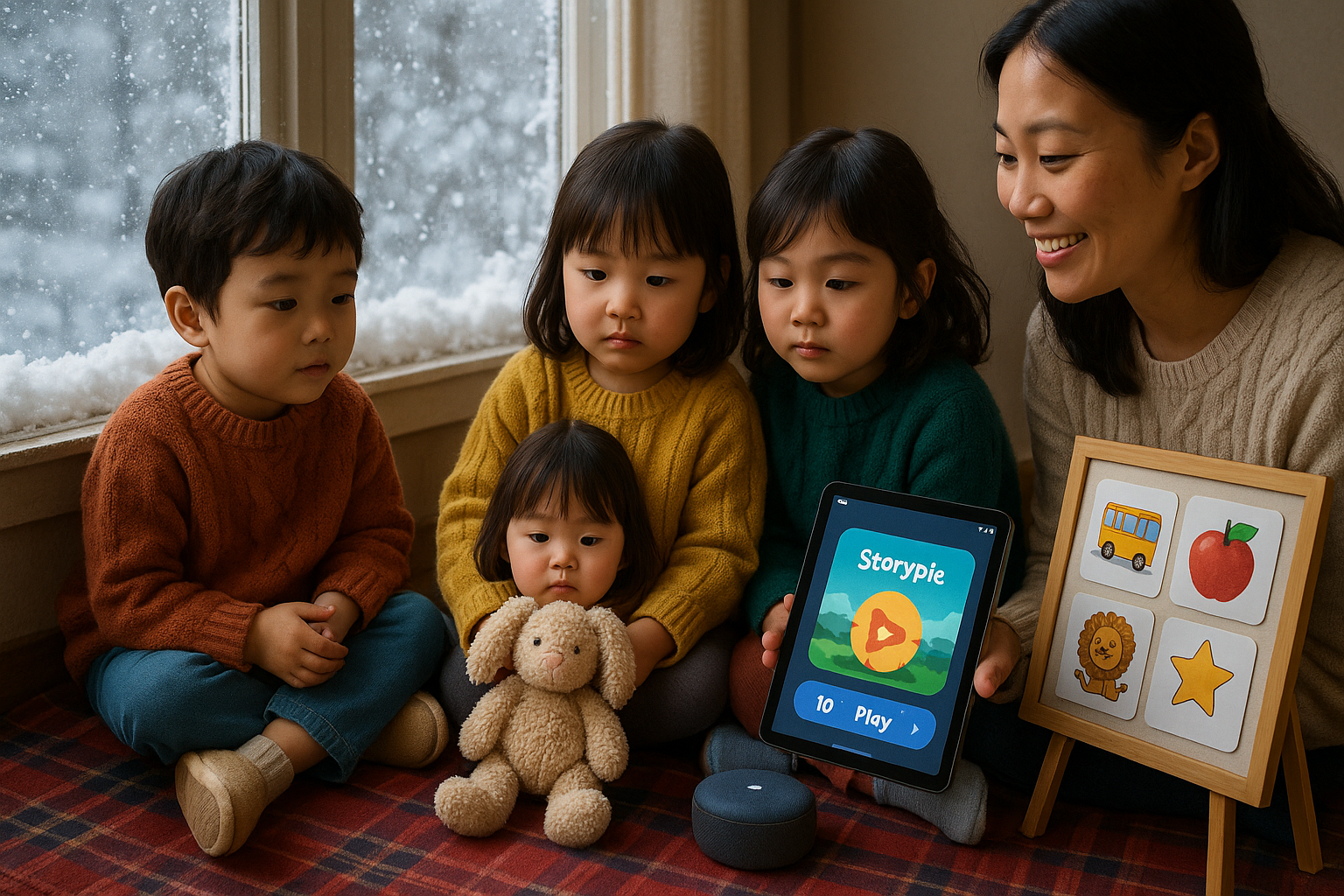
Finally, Storypie offers a curated audio collection that illustrates how voice-centered media can join early learning routines. Explore Storypie for age-appropriate audio and options to support family listening at Storypie and the Storypie audio collection at Storypie audio collection.
Technology in early childhood education is not a single thing. Rather, it is a lively mix of tools, research, benefits, and trade-offs. With good information, families and teachers can make wise, joyful choices.