
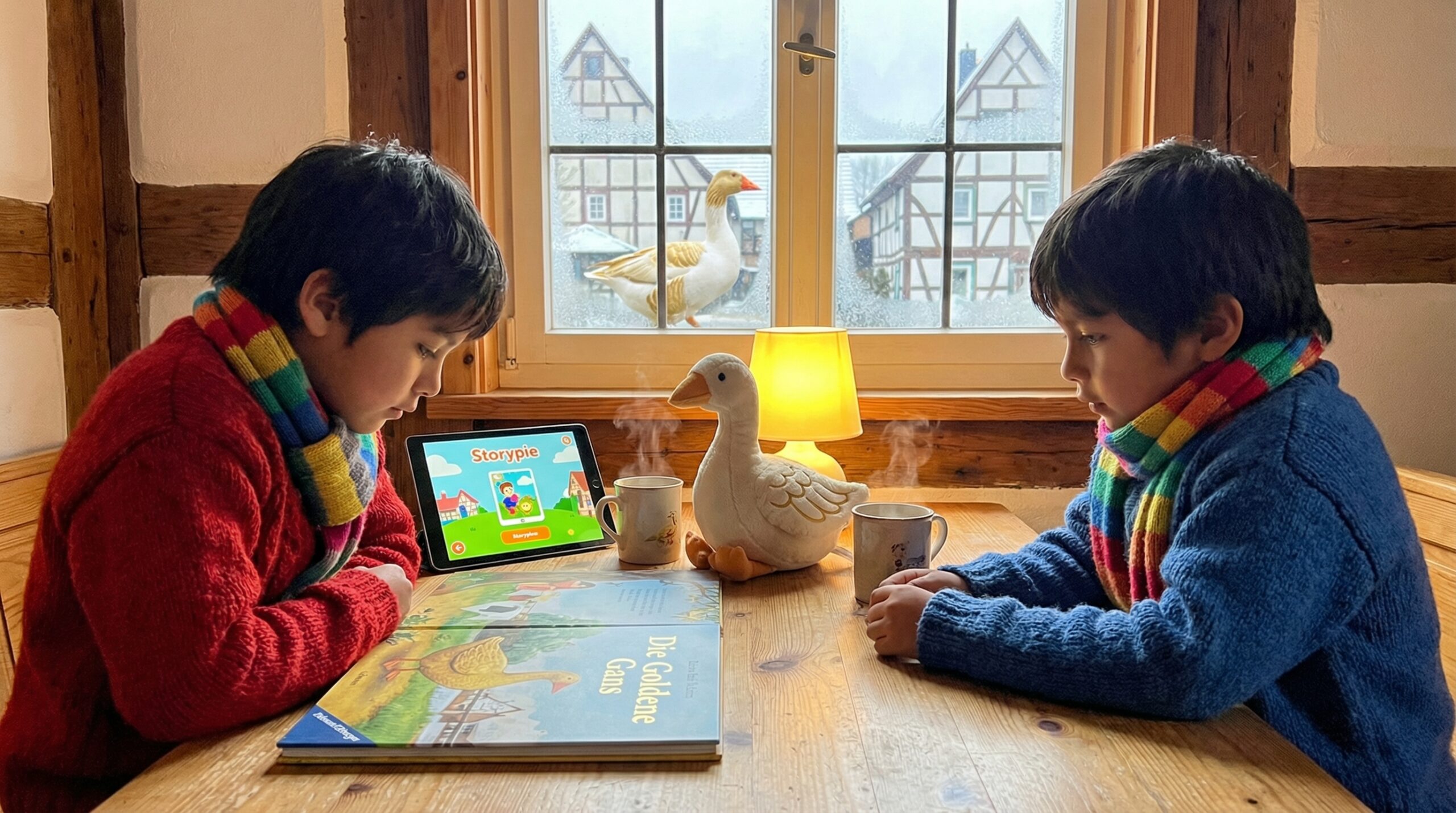
The Golden Goose – German is a short, comic Grimm tale that lands easily in a child’s lap. Today it reads like a sunny, silly parable. Parents and teachers love its bright humor and tidy lesson.
Origins and charm of The Golden Goose – German
The Grimms collected this tale in the 19th century. Also known in German as Die goldene Gans, it is listed as tale number 64 (KHM 64) in the Brothers Grimm collection Kinder- und Hausmärchen. This tale grew from oral storytelling and feels rural and practical. The story names clear characters and uses slapstick for laughs.
Meanwhile the plot stays simple. A humble youngest son shows kindness and receives a magical golden goose. When villagers try to steal a feather, they become stuck. Then they cling to the bird and to each other. Soon a ridiculous procession grows and winds toward the palace.
Key details and why it delights
However this tale is not the goose-that-laid-golden-eggs story. That is a different fable. The Grimms use a sticky procession as a comic device. Also, the princess laugh motif ends the spell. Finally, the hero wins a reward and a fresh start. The tale is classified in the Aarne–Thompson–Uther folktale index as type ATU 571 (‘All Stick Together’ / ‘Golden Goose’), which situates it within a broader folklore context.
Illustrators love the parade. They paint the growing chain in bright, absurd detail. Short stage pieces and small animations bring it to life. Children giggle at the absurd line of stuck villagers. The contrast between the humble hero and pompous townsfolk keeps the moral tidy and funny.
Modern editions and uses
Today modern editions feel playful and bold. Teachers and parents pick picture books and early readers. They use the tale to spark conversations about kindness and greed. Also the story proves durable. Variations change scenes but not the core message. The Grimms’ Kinder- und Hausmärchen, including “Die goldene Gans,” were first published on 20 December 1812, and by the 7th (final) edition in 1857, the corpus had expanded to 200 tales, highlighting the tale’s evolution over time. In 2005, this collection was inscribed on UNESCO’s Memory of the World Register and has been translated into more than 160 languages, underscoring its global cultural significance.
Read or listen to a story about The Golden Goose – German now: For 3-5 year olds, For 6-8 year olds, For 8-10 year olds, and For 10-12 year olds.
Short takeaways
In short The Golden Goose – German is small, quick, and endlessly giggly. It makes a perfect 10-minute read. Also, it leaves a warm, silly memory that kids love to retell.
For a cozy retelling on Storypie, try a quick storytime before bed or breakfast. Also explore more Grimm tales and related reads on Storypie for family listening.
Read or listen to a story about The Golden Goose – German now