
 English
 For Schools
 For Homeschool

The Ocean Singer's Journey
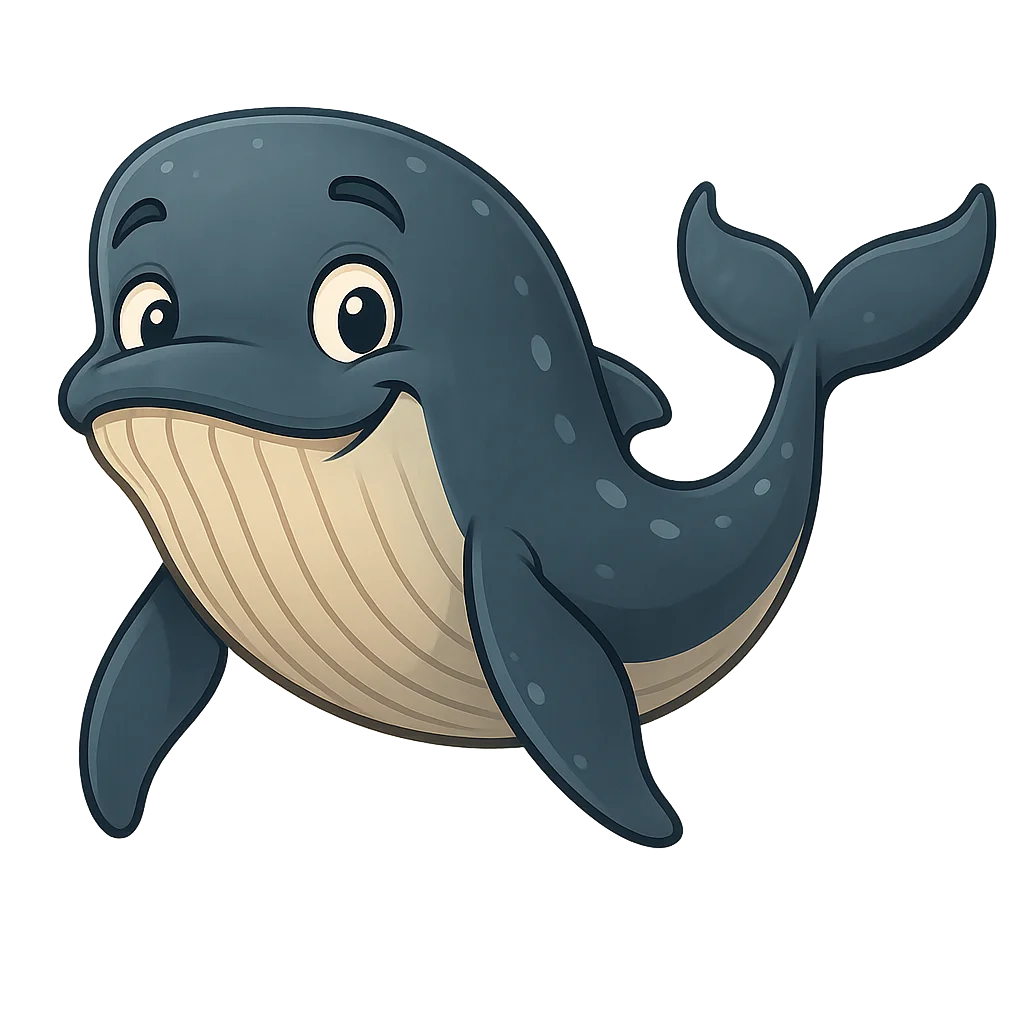
Hello. I am a Humpback Whale, one of the great travelers and singers of the deep blue sea. My story begins not in the vast, cold ocean you might imagine, but in the warm, crystal-clear tropical waters where I was born. I remember the moment my life began, a gentle nudge from my mother pushing me toward the shimmering surface for my very first breath of air. The bond between us was instant and powerful. For months, I stayed close to her side, drinking her rich, fatty milk. This amazing food helped me grow incredibly fast, building up a thick layer of blubber. This blubber wasn't just for warmth; it was my energy reserve, a vital supply I would need for the incredible journey that lay ahead of us. My kind has been known to humans for a very long time. In 1781, scientists gave us our scientific name: Megaptera novaeangliae. It sounds complicated, but it simply means 'great-winged New Englander.' The name was chosen because of my enormous pectoral fins, which look like giant wings, and because we were a common sight for European settlers off the coast of New England. Those fins, which can be up to one-third of my body length, help me steer gracefully through the water, making me one of the most acrobatic of all the great whales.
When my layer of blubber was thick enough, my mother decided it was time to leave our warm nursery. We began our first great migration, an instinct that has guided my ancestors for generations. This journey would take us thousands of miles, from the tropical paradise of my birth to the frigid, nutrient-filled waters of the polar regions. The ocean was a world of new sights and sounds. We traveled through deep, silent canyons and over vast underwater plains, always moving forward. We had to be cautious of dangers, navigating the busy pathways of the sea. Upon arriving in the cold waters, I learned what it meant to truly feast. My diet consists of tiny shrimp-like creatures called krill and small schools of fish. To catch them, we use a brilliant hunting strategy known as bubble-net feeding. A group of us will swim in a circle, blowing bubbles from our blowholes as we rise to the surface. These bubbles create a 'net' that traps the fish and krill, making it easy for us to swim up through the middle and swallow thousands of them in a single gulp. It was also during this time that I began to understand the most famous trait of us male humpbacks: our song. In 1967, two human researchers named Roger Payne and Scott McVay helped the world understand our vocalizations. Our songs are not simple calls; they are long, complex melodies that can travel for hundreds of miles. We are constantly changing and evolving these songs, creating a shared culture that connects us across the vastness of the ocean.
My life today is peaceful compared to the lives of my ancestors. For a very long time, humans saw us not as singers or intelligent beings, but as a source of resources. The commercial whaling industry, which began in the 1800s and reached its peak in the early 20th century, was a period of great danger for my species. Hunters pursued us relentlessly for our blubber, which was turned into oil for lamps and machines. Our numbers dropped so low that we were on the verge of disappearing from the oceans forever. But just as things seemed their darkest, a change began to happen in the human world. People started to realize that the oceans would be silent and empty without our songs and our presence. A new era of understanding and conservation began. A major step was taken on December 2nd, 1946, when the International Whaling Commission, or IWC, was created to help manage and regulate whaling activities around the world. For my species, the most important moment of all came in 1966. In that year, the IWC granted global protection to Humpback Whales, banning commercial hunting entirely. That single decision was the turning point that allowed our slow, steady recovery to begin.
Thanks to the global protection we received in 1966, my kind has made a remarkable comeback. Our growing population is considered one of the greatest conservation success stories in history. However, our journey is not without its modern challenges. The oceans today are filled with new dangers, such as the risk of becoming entangled in fishing gear and the threat of being struck by large ships. My role in the ocean is more important than just being a survivor; I am a vital part of the marine ecosystem. Our feeding habits in the deep and our life at the surface create a process scientists call the 'whale pump.' When we dive deep to feed and then return to the surface to breathe and release waste, we bring essential nutrients up from the depths. This nutrient-rich poop fertilizes the surface waters, allowing tiny organisms called phytoplankton to bloom. These microscopic plants are incredible because they form the base of the marine food web and produce a huge amount of the oxygen that all life on Earth, including you, needs to breathe. My story is a living reminder that the health of the ocean is connected to every creature within it, and that protecting one species can help sustain the entire planet.
Activities
Take a Quiz
Test what you learned with a fun quiz!
Get creative with colors!
Print a coloring book page of this topic.