

 English

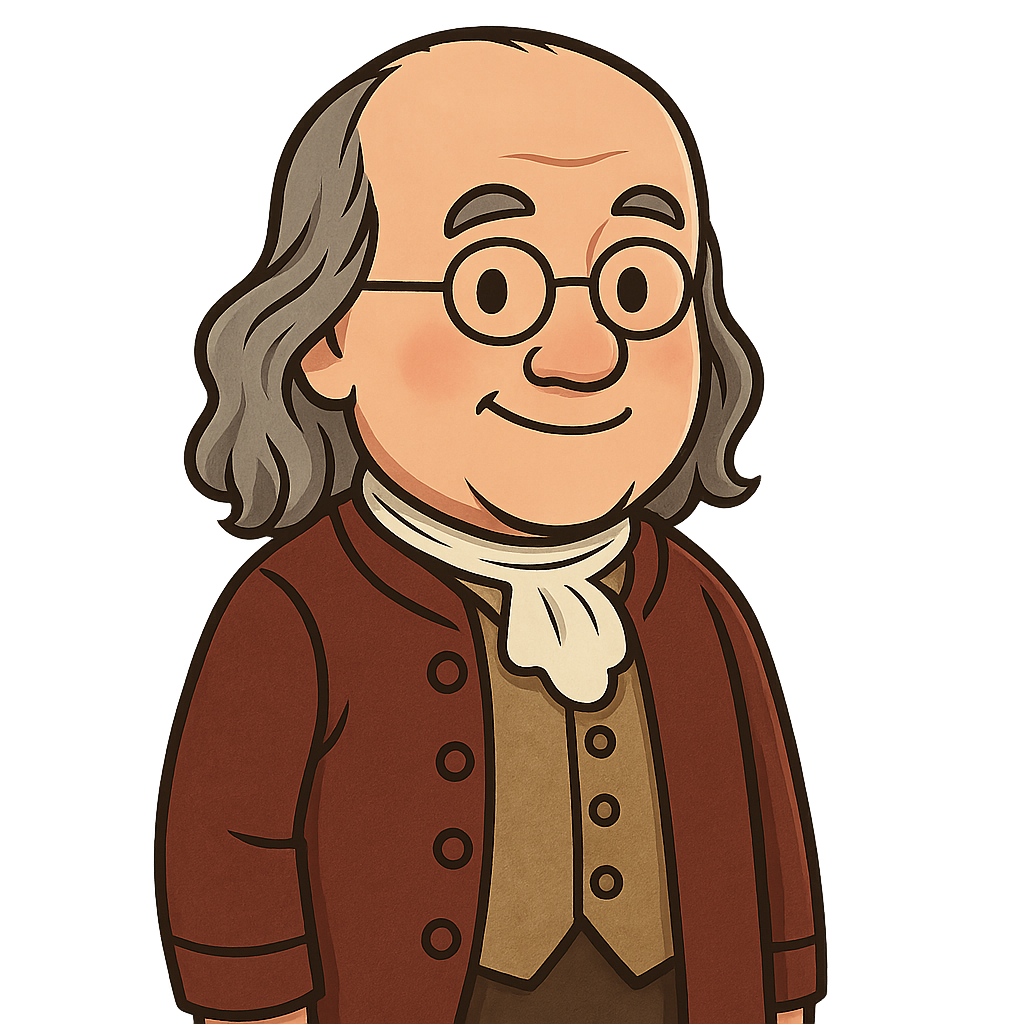
Benjamin Franklin: A Life of Curiosity and Invention
Hello, my name is Benjamin Franklin, and I am often remembered as an inventor, a writer, and one of the Founding Fathers of the United States. My story, however, begins not in a grand hall of politics, but in a bustling candlemaker's shop. I was born in Boston, Massachusetts, on January 17th, 1706, into a very large family—I was the fifteenth of seventeen children. From my earliest days, I had an insatiable hunger for knowledge. Books were my greatest treasure, and I read every single one I could find. My formal schooling ended when I was just ten, but my real education was just beginning. At twelve, I was apprenticed to my older brother, James, who ran a print shop. While I loved the trade of printing, my brother’s workshop often felt like a cage. He was a stern master and would not publish any of my own writing.
But I was determined to have my voice heard. I created a clever persona: a middle-aged, witty widow I named ‘Silence Dogood.’ I wrote letters filled with observations and advice, and at night, I would slip them under the front door of my brother’s newspaper office. To my delight, James published them, and they became incredibly popular all over Boston. He had no idea his own little brother was the author. This secret success taught me the power of the written word, but it also fueled my desire for freedom. In 1723, at the age of seventeen, I decided my future was not in Boston. I ran away, seeking my own fortune in the promising city of Philadelphia.
I arrived in Philadelphia a tired and hungry teenager, with only a few coins in my pocket. My first purchase was three large, puffy bread rolls. I walked down Market Street, a roll under each arm and another in my mouth, not knowing a soul. But I had a valuable trade and an unshakeable determination. I quickly found work in a print shop and, through relentless hard work and careful saving, I was able to open my very own printing business just a few years later. My shop became a great success. I began publishing a newspaper called the Pennsylvania Gazette and, in 1732, I started Poor Richard's Almanack. It was an annual pamphlet filled with weather forecasts, puzzles, and witty sayings like, “A penny saved is a penny earned,” and “Early to bed and early to rise, makes a man healthy, wealthy, and wise.” It became a bestseller in the American colonies.
My success, however, was never just about making money. I looked at the world around me and constantly saw ways to make it better. I believed that ordinary citizens could achieve great things when they worked together. Since I loved books so dearly, I thought everyone should have access to them. So, in 1731, I gathered a group of friends and we established the Library Company of Philadelphia, the very first lending library in America. Seeing the constant threat of fires in a city of wooden buildings, I organized the Union Fire Company in 1736, Philadelphia's first volunteer fire department. Later, when I saw that the sick often had no place to receive proper care, I helped raise the money to build the Pennsylvania Hospital, which opened in 1751. I learned that one person's idea, when shared and acted upon, can lift up an entire community.
Beyond my work as a printer and a citizen, my mind was always buzzing with questions about the natural world. I was endlessly curious. Of all the world’s mysteries, the one that fascinated me most was electricity. In my time, people knew it as static shock or saw it in parlor tricks, but I suspected it was something much grander. I believed that the spectacular, terrifying flashes of lightning in a thunderstorm were nothing more than a giant spark of the very same electricity. Many thought this idea was absurd and dangerous, but I had to know the truth. I devised a daring experiment to prove it. On a dark, stormy afternoon in June of 1752, I took my son, William, out to a field. We fashioned a kite from a large silk handkerchief, with a sharp wire attached to the top to attract the electrical charge.
The kite’s string was made of hemp, which would conduct electricity when it got wet from the rain. To protect myself, I held on to a dry silk ribbon tied to the end of the hemp string, and I took cover in a small shed. Attached to the string was a simple metal house key. As the kite danced in the stormy winds, I waited anxiously. For a while, nothing happened. Then, I noticed the loose fibers of the hemp string standing straight out. My heart pounded. I slowly reached out my knuckle toward the key. A spark jumped from the key to my hand. It was a small shock, but its meaning was immense. I had done it. I had proven that lightning was a form of electricity. This risky experiment was not just for the thrill of discovery; it led to one of my most important inventions: the lightning rod. This simple metal rod, placed on the roof of a building and connected to a wire running into the ground, provided a safe path for lightning to travel, saving countless homes and lives from fire.
As I grew older, my focus began to shift from the mysteries of science to the growing troubles of the American colonies. Our relationship with our ruler, Great Britain, was becoming increasingly tense. The colonies were growing, and many of us felt that we deserved a greater say in our own governance. I had spent many years in London representing Pennsylvania, and I saw firsthand that our pleas for fairness were being ignored. It became clear that we needed to forge our own destiny. In the hot summer of 1776, I was given the extraordinary honor of being part of a five-man committee tasked with drafting a document that would change the world. Working alongside brilliant men like Thomas Jefferson and John Adams, I helped write and edit the Declaration of Independence, our formal announcement to the world that we were a new, free nation.
Declaring independence was one thing; winning it was another. We had to fight a long and difficult war against the mighty British Empire. Our young country desperately needed allies. So, later that year, I sailed to France on a crucial diplomatic mission. My job was to convince the King of France to support our cause with ships, soldiers, and money. It was a challenging task, but I used my fame as a scientist and my skills as a negotiator to win the trust and friendship of the French people. Their support was a turning point in the war and was essential to our victory. Years later, after the war was won, our new nation needed a plan. In 1787, at the age of 81, I was the oldest delegate at the Constitutional Convention, where we debated and shaped the framework for our government, the United States Constitution, which still guides the nation today.
My long life, which spanned 84 years, came to a peaceful end on April 17th, 1790. When I looked back, I saw the boy who ran away from Boston had become a printer, an author, an inventor, a scientist, and a statesman. I never planned to be all of those things. I simply followed my curiosity, worked hard to improve myself, and tried to solve the problems I saw around me, whether it was a smoky fireplace or a nation in need of a government. My final message to you is this: never lose your sense of wonder. Stay curious, read widely, and don't be afraid to ask questions. Work hard to achieve your goals, but always remember to look for ways you can help your neighbors and improve your community. A single person, armed with knowledge and a desire to serve, has the power to change the world. Your journey is just beginning, and I have no doubt you will do amazing things.
Activities
Take a Quiz
Test what you learned with a fun quiz!
Get creative with colors!
Print a coloring book page of this topic.












 Free for Educators