English

Chien-Shiung Wu
Chien-Shiung Wu was a pioneering Chinese-American experimental physicist whose work on the Manhattan Project…
Reads at Grades 3–5 Listens at Grades 1–5
Print & create
Answer keys·No prep·Free with an account
28 worksheets · answer keys · full story · quiz · Ages 8-10 · CEFR B1
Plus adds 290,000+ more stories in 27 languages, audio for every one, and printables for all of them.
Just want Chien-Shiung Wu?

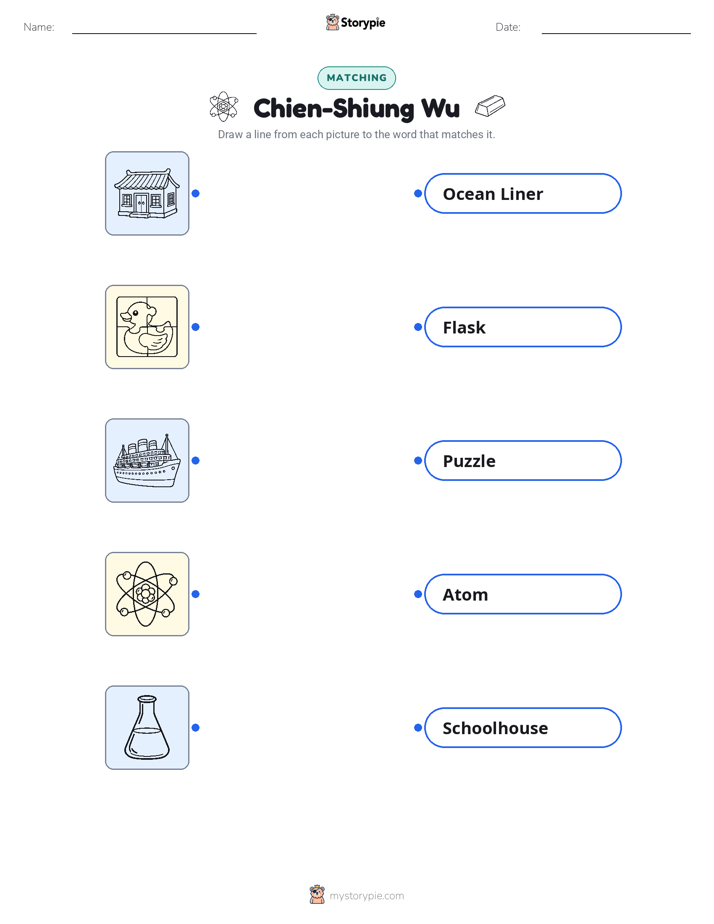
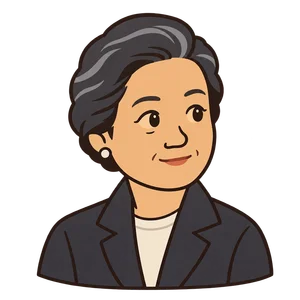
Hello! My name is Chien-Shiung Wu. I was born on May 31st, 1912, in a town in China called Liuhe. My father believed that girls deserved to go to school just as much as boys, which was a special idea back then. He even started his own school for girls, and I was one of his first students! I loved learning everything I could, from reading books to solving tricky puzzles. In 1923, when I was eleven, I left home to attend a special boarding school for girls who wanted to become teachers. My curiosity about the world just kept growing bigger and bigger.
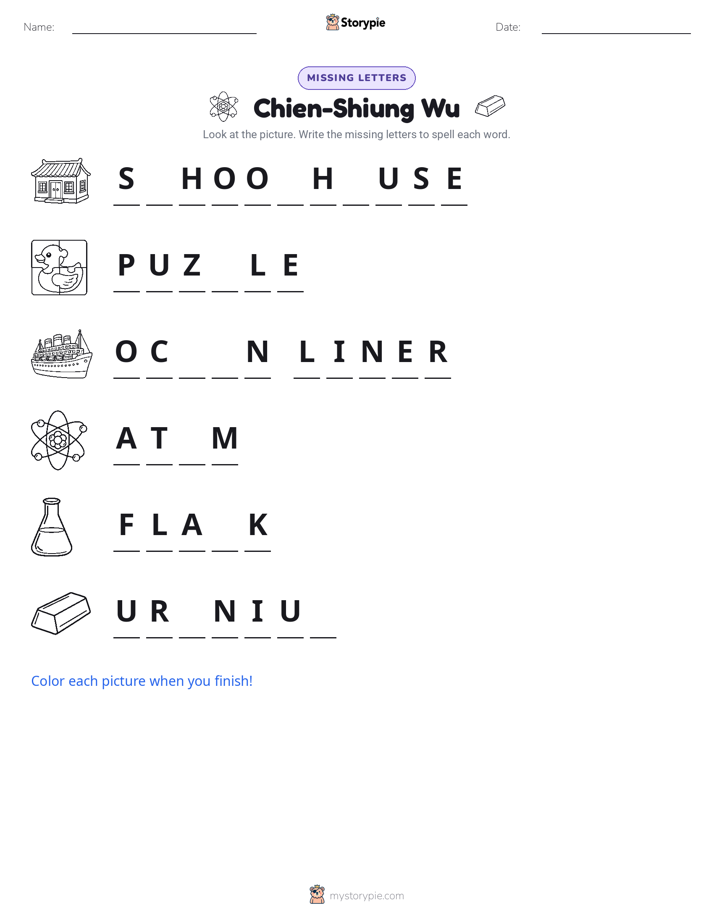
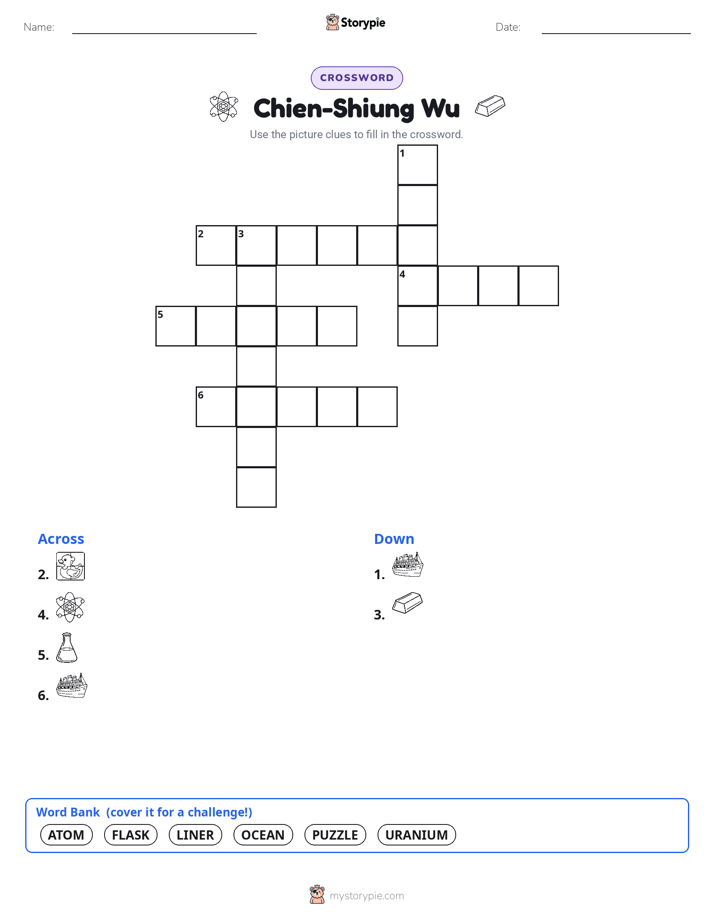
After finishing my studies in China at the National Central University in 1934, I knew I wanted to learn even more about physics—the science of how everything in the universe works. So, in 1936, I made a very big decision. I sailed on a ship all the way across the Pacific Ocean to America! It was a long journey, but I was so excited for the adventure. I went to the University of California, Berkeley, a famous school where many brilliant scientists worked. It was there that I studied tiny, invisible particles called atoms and earned my Ph.D. in physics in 1940. While I was there, I also met another wonderful physicist named Luke Chia-Liu Yuan. We fell in love and got married in 1942.
A few years later, during World War II, our country needed scientists to help with very important work. In 1944, I was invited to join a top-secret program called the Manhattan Project at Columbia University in New York City. My job was to help figure out a way to separate different kinds of uranium atoms. It was challenging, but my research was successful. After the war, two of my scientist friends, Tsung-Dao Lee and Chen-Ning Yang, came to me with a puzzling question. They had an idea that a fundamental rule of physics, called the law of conservation of parity, might not always be true. This law basically said that the universe shouldn't be able to tell the difference between left and right—that an event and its mirror image should behave the same way. Lee and Yang needed someone to prove it, and they asked for my help. I was known for being very careful and precise, so I designed a very clever experiment in 1956 to test their idea.
Chien-Shiung Wu
Hello! My name is Chien-Shiung Wu. I was born on May 31st, 1912, in a town in China called Liuhe. My father believed that girls deserved to go to school just as much as boys, which was a special idea back then. He even started his own school for girls, and I was one of his first students! I loved learning everything I could, from reading books to solving tricky puzzles. In 1923, when I was eleven, I left home to attend a special boarding school for girls who wanted to become teachers. My curiosity about the world just kept growing bigger and bigger.
After finishing my studies in China at the National Central University in 1934, I knew I wanted to learn even more about physics—the science of how everything in the universe works. So, in 1936, I made a very big decision. I sailed on a ship all the way across the Pacific Ocean to America! It was a long journey, but I was so excited for the adventure. I went to the University of California, Berkeley, a famous school where many brilliant scientists worked. It was there that I studied tiny, invisible particles called atoms and earned my Ph.D. in physics in 1940. While I was there, I also met another wonderful physicist named Luke Chia-Liu Yuan. We fell in love and got married in 1942.
A few years later, during World War II, our country needed scientists to help with very important work. In 1944, I was invited to join a top-secret program called the Manhattan Project at Columbia University in New York City. My job was to help figure out a way to separate different kinds of uranium atoms. It was challenging, but my research was successful. After the war, two of my scientist friends, Tsung-Dao Lee and Chen-Ning Yang, came to me with a puzzling question. They had an idea that a fundamental rule of physics, called the law of conservation of parity, might not always be true. This law basically said that the universe shouldn't be able to tell the difference between left and right—that an event and its mirror image should behave the same way. Lee and Yang needed someone to prove it, and they asked for my help. I was known for being very careful and precise, so I designed a very clever experiment in 1956 to test their idea.
My experiment was very tricky. I had to cool down atoms to extremely cold temperatures, colder than outer space! But after many long hours in the lab, I found the proof we were looking for. The results were shocking! My experiment showed that in some cases, the universe can tell the difference between left and right. The law of parity was broken! This discovery was a huge deal and changed physics forever. The next year, in 1957, my friends Lee and Yang were awarded the famous Nobel Prize for their idea. Even though my experiment was the proof, I was not given the award. While that was disappointing, I didn't let it stop me. I kept teaching, doing experiments, and encouraging everyone, especially young women, to fall in love with science just like I did.
I received many other honors for my work, including the Wolf Prize in Physics in 1978. I lived to be 84 years old. Today, people often call me the 'First Lady of Physics' or the 'Queen of Nuclear Research' because my experiments helped us see the universe in a completely new way, and I helped open doors for many more women to become scientists.
Wow facts
About
Chien-Shiung Wu was a pioneering Chinese-American experimental physicist whose work on the Manhattan Project and her famed 'Wu experiment' showed that parity is not conserved in weak nuclear interactions, especially in a process called beta decay, which is important in physics.
Take a Quiz
Question 1 of 5
Why did the scientists Tsung-Dao Lee and Chen-Ning Yang ask for Chien-Shiung Wu's help with their idea?
Explore next






Want to do even more?
Go beyond exploring. Unlock tools that turn every story into real learning.

Storypie Plus for families
Full stories, quizzes, and printables. Nights and car rides, sorted.
- Unlimited audio stories
- Create Mode: your child stars in the story
- Offline downloads
- Printable worksheets & coloring pages

Why Storypie for Schools
Students engaged. Prep in seconds. Evenings back to you.
- Worksheets & Quizzes
- Classroom Management
- Formative Assessment
- Custom Curriculum & Lesson Plans
- 27 Languages

Why Storypie for Homeschool
Curriculum done. They'll ask for more. Hours back in your day.
- Worksheet Generator
- First-Person Audio Stories
- Built-in Comprehension Quizzes
- Custom Curriculum & Lesson Plans
- Print & Go Activities