English

Chien-Shiung Wu
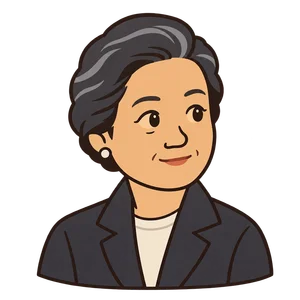
Chien-Shiung Wu was a pioneering Chinese-American experimental physicist whose work on the Manhattan Project…
Reads at Grades 6–8 Listens at Grades 4–8
Print & create
Answer keys·No prep·Free with an account
28 worksheets · answer keys · full story · quiz · Ages 10-12 · CEFR B2
Plus adds 290,000+ more stories in 27 languages, audio for every one, and printables for all of them.
Just want Chien-Shiung Wu?

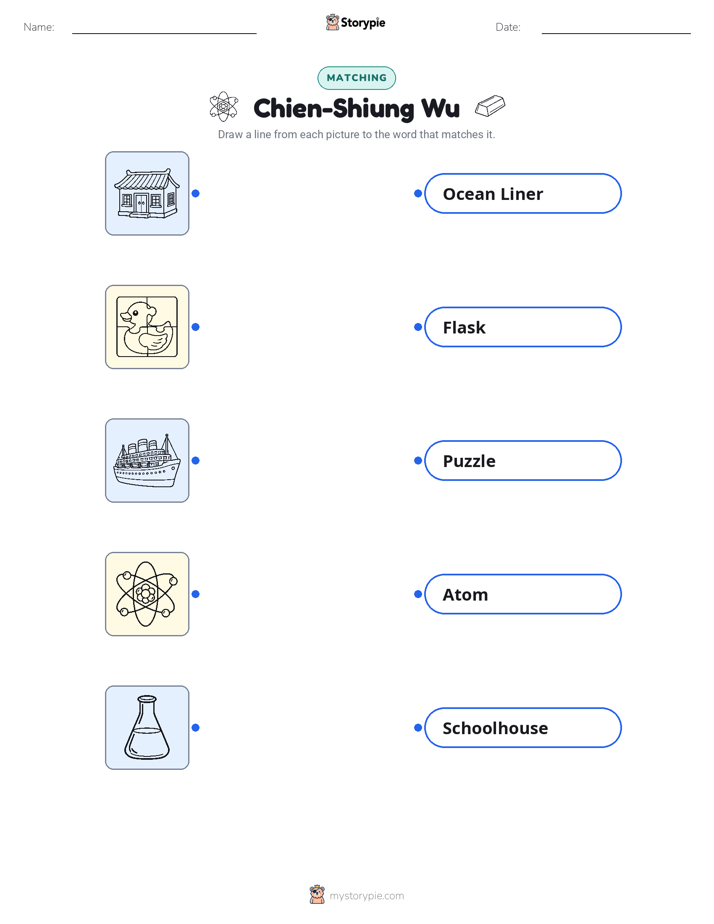
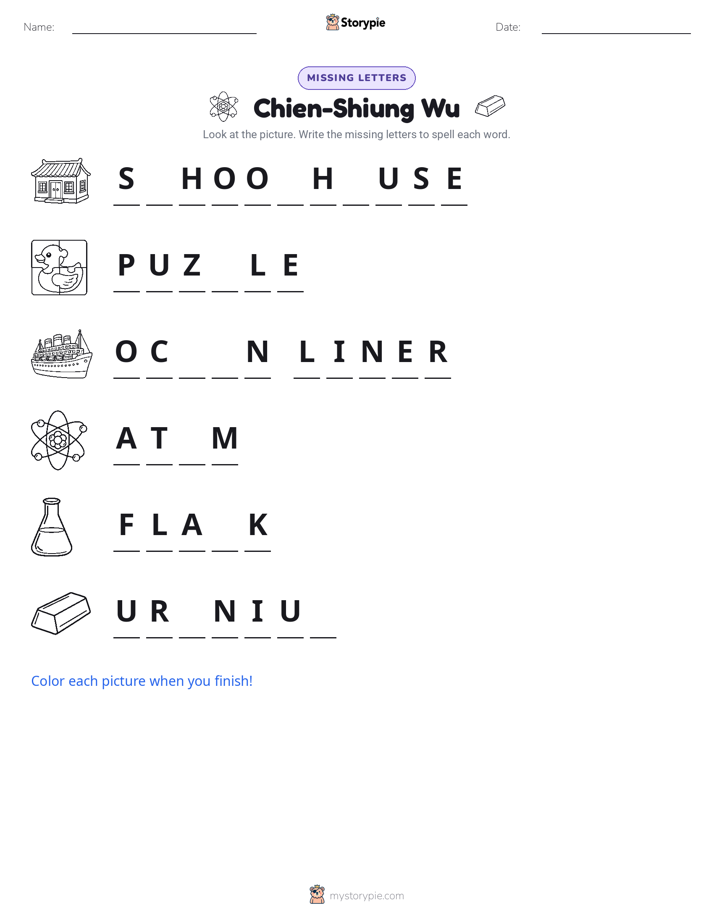
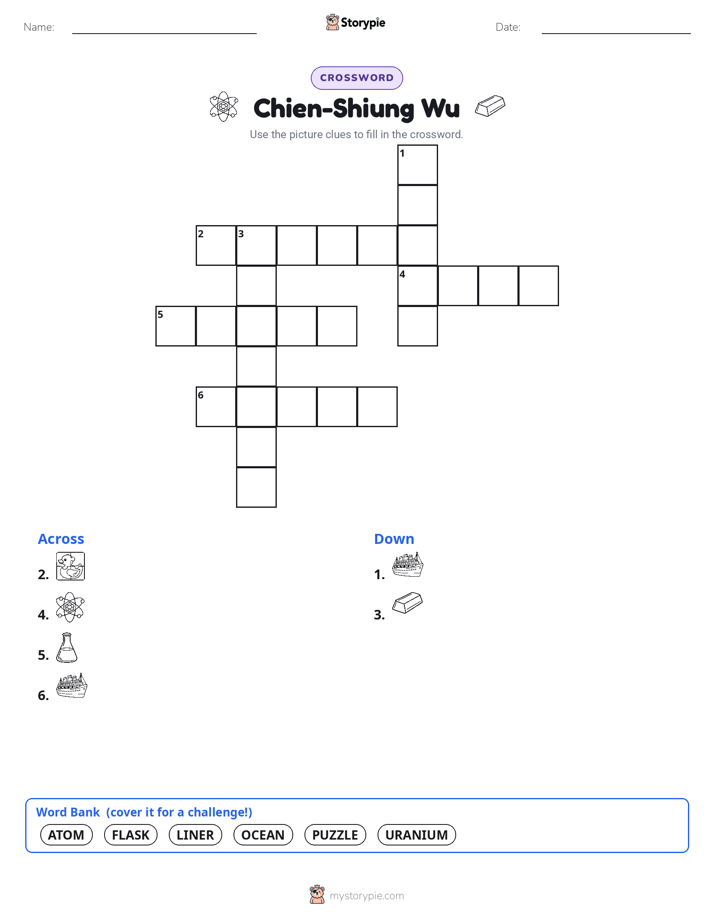
Hello! My name is Chien-Shiung Wu, and I was a physicist, which is a scientist who studies matter and energy. I was born on May 31st, 1912, in a small town near Shanghai, China. My father believed that girls should have the same chance to learn as boys, which was not a common idea back then. He even started a school just for girls, which I attended. From a young age, I was filled with curiosity and loved solving puzzles. I always wanted to understand how the world worked on its tiniest, most invisible levels, and this curiosity would guide my entire life.
My love for learning took me far from home. After excelling in my studies in China, I knew I had to go where the most exciting physics research was happening. In 1936, I sailed across the Pacific Ocean to America to study at the University of California, Berkeley. It was a difficult decision to leave my family, especially knowing I might not see them for a very long time because of the growing conflict between China and Japan. At Berkeley, I dove into the world of nuclear physics, the study of the tiny core, or nucleus, at the center of atoms. The work was challenging, but I loved it. I earned my doctorate degree in 1940 and quickly became known for my careful and precise experimental work, which became my trademark.
During World War II, my skills were needed for a top-secret project that would change the course of history. In 1944, I was recruited to join the Manhattan Project at Columbia University in New York City. This was a massive effort by the United States to build an atomic bomb. My specific job was to help develop a process to separate uranium atoms, which was a crucial and incredibly difficult part of the project. I was often the only woman in meetings filled with the world's top scientists, but I never let that intimidate me. I focused on the science, and my research helped solve a major problem that was holding back the project. My contributions were highly valued, and I proved that my skills were as sharp as anyone's.
Chien-Shiung Wu: The First Lady of Physics
Hello! My name is Chien-Shiung Wu, and I was a physicist, which is a scientist who studies matter and energy. I was born on May 31st, 1912, in a small town near Shanghai, China. My father believed that girls should have the same chance to learn as boys, which was not a common idea back then. He even started a school just for girls, which I attended. From a young age, I was filled with curiosity and loved solving puzzles. I always wanted to understand how the world worked on its tiniest, most invisible levels, and this curiosity would guide my entire life.
My love for learning took me far from home. After excelling in my studies in China, I knew I had to go where the most exciting physics research was happening. In 1936, I sailed across the Pacific Ocean to America to study at the University of California, Berkeley. It was a difficult decision to leave my family, especially knowing I might not see them for a very long time because of the growing conflict between China and Japan. At Berkeley, I dove into the world of nuclear physics, the study of the tiny core, or nucleus, at the center of atoms. The work was challenging, but I loved it. I earned my doctorate degree in 1940 and quickly became known for my careful and precise experimental work, which became my trademark.
During World War II, my skills were needed for a top-secret project that would change the course of history. In 1944, I was recruited to join the Manhattan Project at Columbia University in New York City. This was a massive effort by the United States to build an atomic bomb. My specific job was to help develop a process to separate uranium atoms, which was a crucial and incredibly difficult part of the project. I was often the only woman in meetings filled with the world's top scientists, but I never let that intimidate me. I focused on the science, and my research helped solve a major problem that was holding back the project. My contributions were highly valued, and I proved that my skills were as sharp as anyone's.
After the war, I continued my research at Columbia University, where I was presented with the greatest challenge of my career. In 1956, two of my colleagues, Tsung-Dao Lee and Chen-Ning Yang, came to me with a bold and fascinating idea. For decades, scientists believed in a fundamental rule of nature called the 'principle of conservation of parity.' In simple terms, this law said that the universe shouldn't have a preference for 'left' or 'right'—that an event and its mirror image should behave in the exact same way. Lee and Yang, who were theorists, suspected this wasn't always true for certain types of radioactive decay. They had the theory, but they needed an experimental physicist to design an experiment to prove it. They knew I was one of the few people in the world with the skill to conduct such a difficult and delicate experiment.
I accepted the challenge immediately. I was so dedicated to finding the answer that I canceled a planned trip back to China to work on it. My experiment was very complex and required incredible precision. It involved cooling a radioactive element called cobalt-60 to temperatures colder than outer space. By observing how the cobalt-60 atoms decayed at this extreme temperature, I could see if more particles flew off in one direction than another. Working tirelessly through the Christmas holiday of 1956, my team and I collected the data. In early January of 1957, the results were clear and astonishing: the law of parity was wrong! Nature did, in fact, have a 'handedness.' It was a revolutionary discovery that turned the world of physics upside down.
Later that year, in 1957, the Nobel Prize in Physics was awarded to Lee and Yang for the theory that led to my experiment. However, my experimental work, which provided the crucial proof, was not recognized by the Nobel committee. Many in the scientific community were upset by this oversight. While I was deeply disappointed, I refused to let it stop me from moving forward. I continued my important research and used my position to speak out against the unfair treatment of women and people of Asian descent in the field of science. I wanted to make sure that the scientists who came after me would be judged on the quality of their work and nothing else.
I taught and conducted research for many more years, receiving many other honors, including the first Wolf Prize in Physics in 1978. I lived to be 84 years old, and my life was filled with the joy of discovery. Today, I am remembered as the 'First Lady of Physics' for my groundbreaking experiment and my dedication to scientific truth. I hope my story inspires you to ask big questions, to work hard to find the answers, and to never be afraid to challenge what everyone else believes to be true.
Wow facts
About
Chien-Shiung Wu was a pioneering Chinese-American experimental physicist whose work on the Manhattan Project and her famed 'Wu experiment' showed that parity is not conserved in weak nuclear interactions, especially in a process called beta decay, which is important in physics.
Take a Quiz
Question 1 of 5
Summarize the main challenge Chien-Shiung Wu faced regarding the 'law of conservation of parity.'
Explore next






Want to do even more?
Go beyond exploring. Unlock tools that turn every story into real learning.

Storypie Plus for families
Full stories, quizzes, and printables. Nights and car rides, sorted.
- Unlimited audio stories
- Create Mode: your child stars in the story
- Offline downloads
- Printable worksheets & coloring pages

Why Storypie for Schools
Students engaged. Prep in seconds. Evenings back to you.
- Worksheets & Quizzes
- Classroom Management
- Formative Assessment
- Custom Curriculum & Lesson Plans
- 27 Languages

Why Storypie for Homeschool
Curriculum done. They'll ask for more. Hours back in your day.
- Worksheet Generator
- First-Person Audio Stories
- Built-in Comprehension Quizzes
- Custom Curriculum & Lesson Plans
- Print & Go Activities