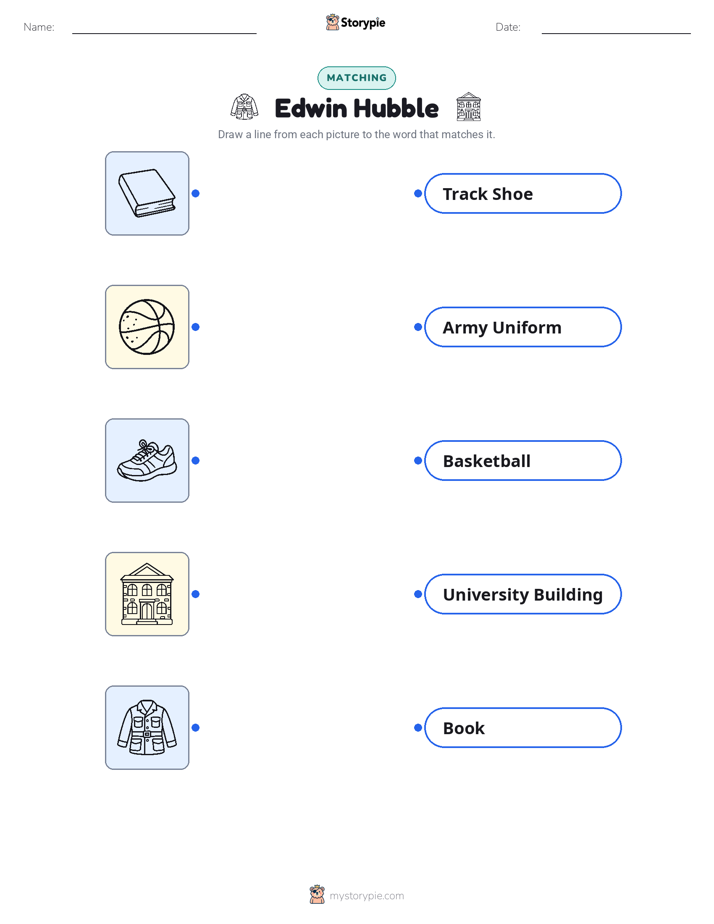
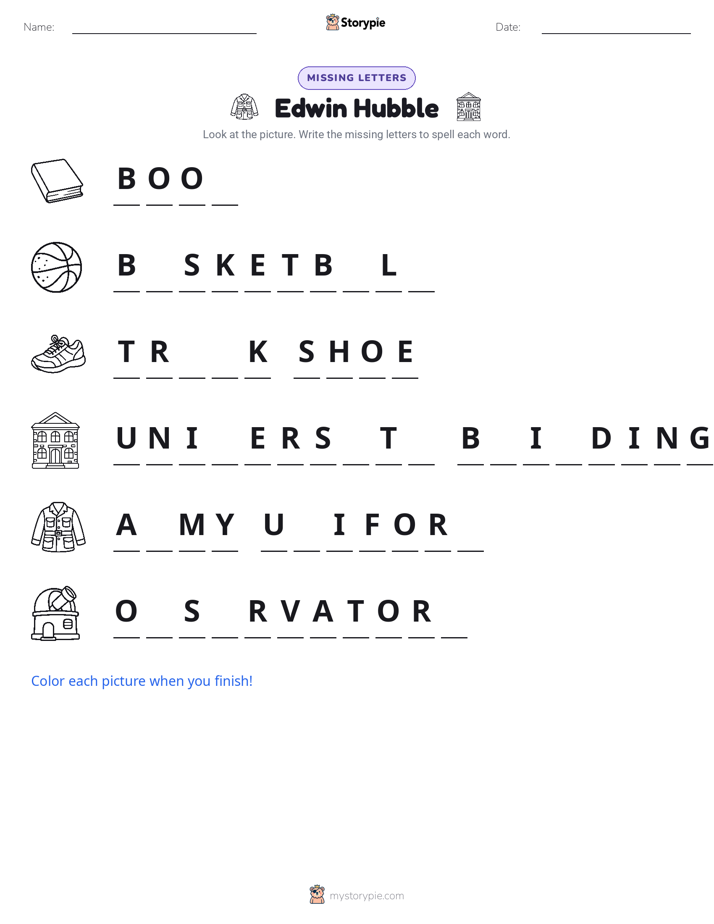
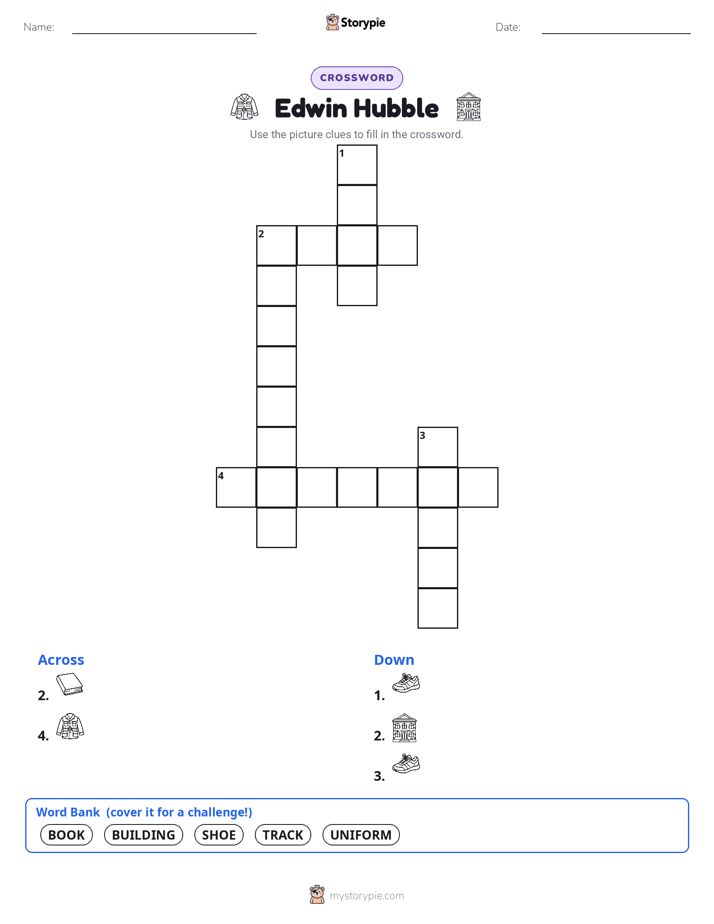
English


Edwin Hubble
Edwin Hubble was an American astronomer who proved that galaxies exist outside of the Milky Way and…
Reads at Grades 3–5 Listens at Grades 1–5
Print & create
Answer keys·No prep·Free with an account
28 worksheets · answer keys · full story · quiz · Ages 8-10 · CEFR B1
Plus adds 244,000+ more stories in 27 languages, audio for every one, and printables for all of them.
Just want Edwin Hubble?

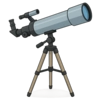
Hello! My name is Edwin Hubble, and I am an astronomer. That’s a fancy word for someone who studies stars, planets, and everything else in the vastness of space. I was born on November 20th, 1889, in a small town called Marshfield, Missouri. Even as a boy, I was fascinated by the night sky. On my eighth birthday, I got to look through my grandfather's big brass telescope for the first time, and I was hooked! I also loved reading adventure stories by authors like Jules Verne, who wrote about incredible journeys to the Moon. Besides stargazing, I was a busy kid who loved sports. I played basketball and was good at running and jumping in track and field. When I went to the University of Chicago, I studied the subjects I loved most: mathematics and astronomy.
My father wanted me to have a steady job, so I promised him I would become a lawyer. After college, I was chosen for a special scholarship that allowed me to go all the way to England to study at Oxford University in 1910. I studied law just like I promised, but my mind was always drifting back to the stars. When I returned home, I worked as a lawyer for about a year, but I knew it wasn't my true calling. So, I went back to school to get my advanced degree in astronomy. My studies were interrupted when World War I began. In 1917, I joined the army to serve my country. When the war ended, I was finally free to follow my lifelong dream. A famous astronomer had offered me a job before I left for the war, and I was so excited that the offer was still waiting for me when I returned.
Edwin Hubble
Hello! My name is Edwin Hubble, and I am an astronomer. That’s a fancy word for someone who studies stars, planets, and everything else in the vastness of space. I was born on November 20th, 1889, in a small town called Marshfield, Missouri. Even as a boy, I was fascinated by the night sky. On my eighth birthday, I got to look through my grandfather's big brass telescope for the first time, and I was hooked! I also loved reading adventure stories by authors like Jules Verne, who wrote about incredible journeys to the Moon. Besides stargazing, I was a busy kid who loved sports. I played basketball and was good at running and jumping in track and field. When I went to the University of Chicago, I studied the subjects I loved most: mathematics and astronomy.
My father wanted me to have a steady job, so I promised him I would become a lawyer. After college, I was chosen for a special scholarship that allowed me to go all the way to England to study at Oxford University in 1910. I studied law just like I promised, but my mind was always drifting back to the stars. When I returned home, I worked as a lawyer for about a year, but I knew it wasn't my true calling. So, I went back to school to get my advanced degree in astronomy. My studies were interrupted when World War I began. In 1917, I joined the army to serve my country. When the war ended, I was finally free to follow my lifelong dream. A famous astronomer had offered me a job before I left for the war, and I was so excited that the offer was still waiting for me when I returned.
In 1919, I started the best job in the world at the Mount Wilson Observatory, high on a mountain in California. I got to use the Hooker telescope, which was the most powerful telescope on Earth at the time! Back then, astronomers had a huge question they couldn't answer: Was our galaxy, the Milky Way, the entire universe? Or were the fuzzy patches of light we called 'nebulae' actually other galaxies, or 'island universes,' far, far away? I spent night after night, for years, taking photographs of one of these smudges, the Andromeda Nebula. Then, in 1923, I found something amazing in one of my photos: a special kind of blinking star called a Cepheid variable. These stars are like cosmic measuring sticks. By studying how it blinked, I could figure out how far away it was. My calculations showed that the Andromeda Nebula was almost a million light-years from Earth—much too far to be inside our own Milky Way! On January 1st, 1925, I announced my discovery. The universe was suddenly, unimaginably bigger than anyone had ever dreamed.
Discovering other galaxies was just the beginning. I continued to study them with my colleague, Milton Humason. We measured how fast the galaxies were moving and noticed a very peculiar pattern. Almost every galaxy was moving away from us! Not only that, but the galaxies that were farthest away were moving the fastest. It was like finding out you’re in the middle of a cosmic race where everyone is running away from you. In 1929, I published my findings. This idea became known as Hubble's Law. It was the first real proof that the universe is expanding. You can think of it like a loaf of raisin bread baking in the oven. As the dough rises, all the raisins move farther apart from each other. Our universe is a bit like that, constantly growing bigger.
I spent the rest of my life looking deeper into space, helping to design even bigger telescopes to unlock more of the universe's secrets. I lived to be 63 years old, and my work completely changed our picture of the cosmos. People no longer saw the universe as a single, quiet galaxy, but as a vast, dynamic place filled with billions of them. To honor my work, scientists in 1990 named one of the most important scientific instruments ever built after me: the Hubble Space Telescope. It orbits high above the Earth, taking breathtaking pictures of distant stars and galaxies. It continues my work, helping us understand the amazing, expanding universe that I first had the privilege to show to the world.
Wow facts
About
Edwin Hubble was an American astronomer who proved that galaxies exist outside of the Milky Way and discovered that the universe is expanding, a principle now known as Hubble's Law.
Take a Quiz
Question 1 of 5
What was the big question astronomers had before Edwin Hubble's discovery in 1925?
Explore next





Want to do even more?
Go beyond exploring. Unlock tools that turn every story into real learning.

Storypie Plus for families
Full stories, quizzes, and printables. Nights and car rides, sorted.
- Unlimited audio stories
- Create Mode: your child stars in the story
- Offline downloads
- Printable worksheets & coloring pages

Why Storypie for Schools
Students engaged. Prep in seconds. Evenings back to you.
- Worksheets & Quizzes
- Classroom Management
- Formative Assessment
- Custom Curriculum & Lesson Plans
- 27 Languages

Why Storypie for Homeschool
Curriculum done. They'll ask for more. Hours back in your day.
- Worksheet Generator
- First-Person Audio Stories
- Built-in Comprehension Quizzes
- Custom Curriculum & Lesson Plans
- Print & Go Activities