English


Emmy Noether
Emmy Noether was a groundbreaking German mathematician known for her landmark contributions to abstract…
Reads at Grades 6–8 Listens at Grades 4–8
Print & create
Answer keys·No prep·Free with an account
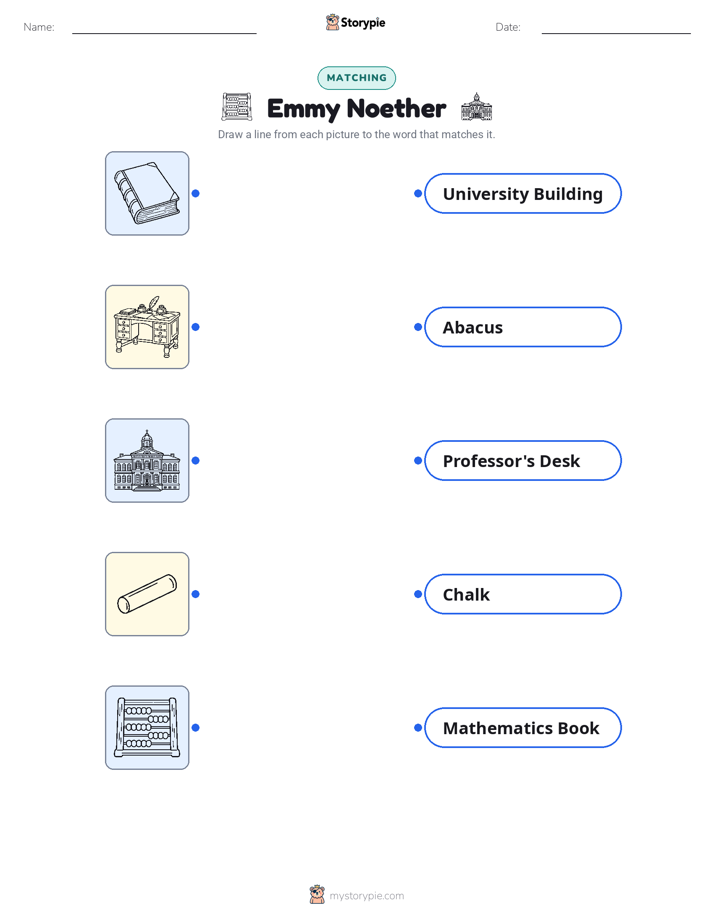
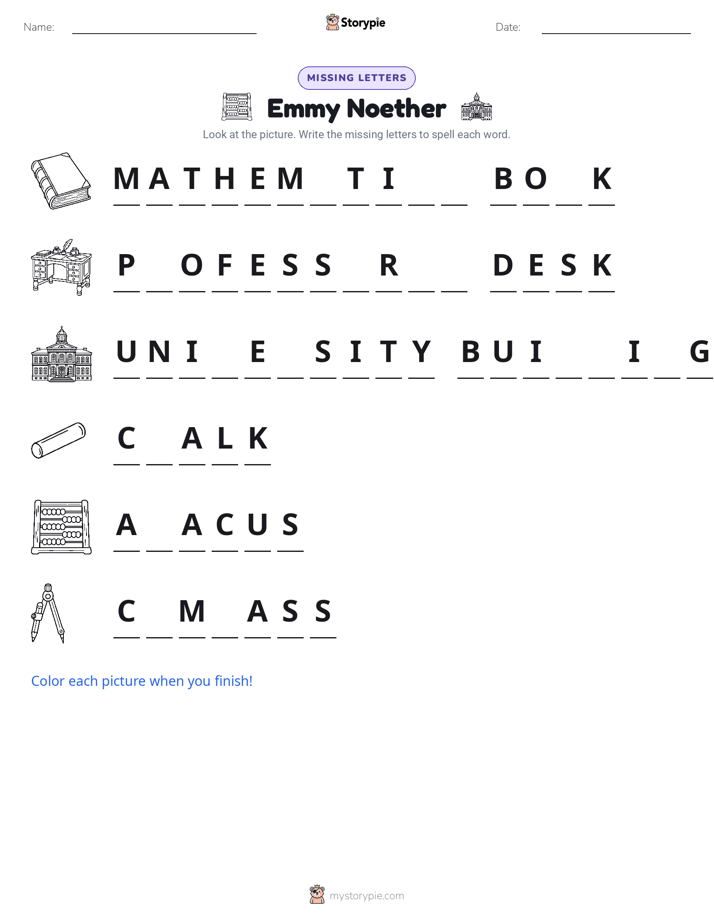
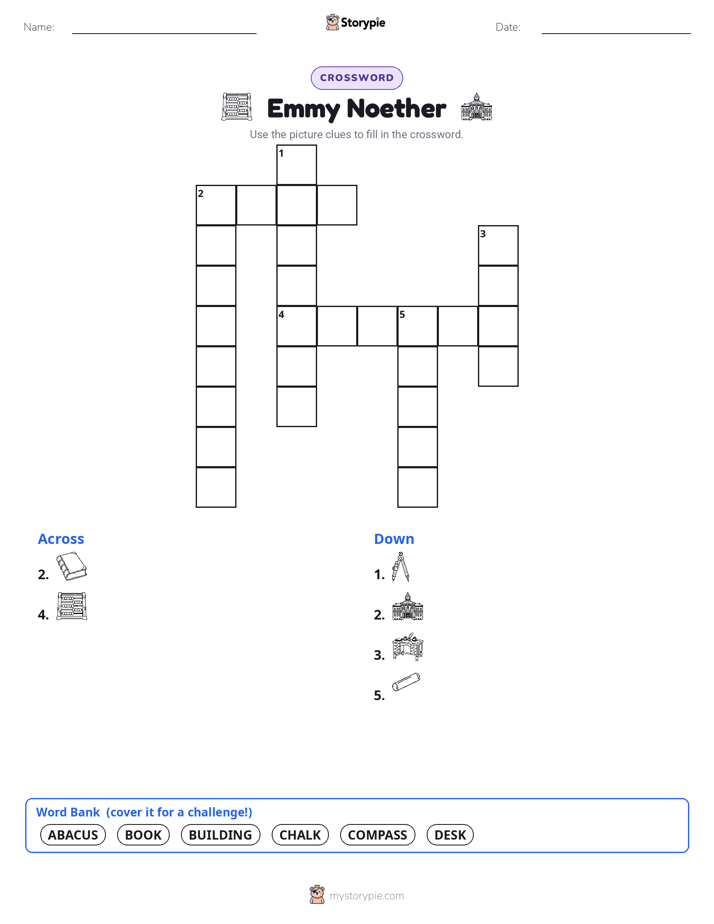
28 worksheets · answer keys · full story · quiz · Ages 10-12 · CEFR B2
Plus adds 290,000+ more stories in 27 languages, audio for every one, and printables for all of them.
Just want Emmy Noether?

Hello! My name is Emmy Noether, and I want to tell you about my love for the beautiful patterns of mathematics. I was born on March 23rd, 1882, in a town called Erlangen, Germany. My father, Max Noether, was a mathematics professor, so our home was always filled with fascinating ideas and numbers. In those days, girls were taught things like cooking and music, and while I learned those, my real passion was for solving puzzles. I loved thinking deeply about problems and finding the hidden logic within them, a skill that would shape my entire life.
When I finished school, I knew I wanted to study mathematics at a university, but there was a big problem: in the early 1900s, universities in Germany didn't officially allow women to be students. Can you imagine? I didn't let that stop me. From 1900 to 1902, I sat in on classes at the University of Erlangen, getting permission from each professor. It wasn't easy, but I was determined. Finally, the rules changed, and I was able to enroll properly. In 1907, I earned my doctorate in mathematics, proving that a woman's mind was just as capable of exploring the universe of numbers.
My work started to get noticed. In 1915, two of the world's most famous mathematicians, David Hilbert and Felix Klein, invited me to the University of Göttingen. It was the center of the mathematics world! They needed my help with a puzzle that was stumping even Albert Einstein in his new theory of general relativity. Even at Göttingen, I faced obstacles. The university refused to hire me as a professor because I was a woman. So, for years, I gave lectures listed under David Hilbert's name. It was during this time, in 1918, that I discovered my most famous idea, now called Noether's Theorem. In simple terms, it's a beautiful rule that connects two big ideas in physics: symmetry and conservation laws. For every symmetry you find in nature, there is a quantity that must be conserved. For example, the law of conservation of energy is directly connected to the fact that the laws of physics are the same today as they were yesterday.
Emmy Noether: The Woman Who Solved the Universe's Puzzles
Hello! My name is Emmy Noether, and I want to tell you about my love for the beautiful patterns of mathematics. I was born on March 23rd, 1882, in a town called Erlangen, Germany. My father, Max Noether, was a mathematics professor, so our home was always filled with fascinating ideas and numbers. In those days, girls were taught things like cooking and music, and while I learned those, my real passion was for solving puzzles. I loved thinking deeply about problems and finding the hidden logic within them, a skill that would shape my entire life.
When I finished school, I knew I wanted to study mathematics at a university, but there was a big problem: in the early 1900s, universities in Germany didn't officially allow women to be students. Can you imagine? I didn't let that stop me. From 1900 to 1902, I sat in on classes at the University of Erlangen, getting permission from each professor. It wasn't easy, but I was determined. Finally, the rules changed, and I was able to enroll properly. In 1907, I earned my doctorate in mathematics, proving that a woman's mind was just as capable of exploring the universe of numbers.
My work started to get noticed. In 1915, two of the world's most famous mathematicians, David Hilbert and Felix Klein, invited me to the University of Göttingen. It was the center of the mathematics world! They needed my help with a puzzle that was stumping even Albert Einstein in his new theory of general relativity. Even at Göttingen, I faced obstacles. The university refused to hire me as a professor because I was a woman. So, for years, I gave lectures listed under David Hilbert's name. It was during this time, in 1918, that I discovered my most famous idea, now called Noether's Theorem. In simple terms, it's a beautiful rule that connects two big ideas in physics: symmetry and conservation laws. For every symmetry you find in nature, there is a quantity that must be conserved. For example, the law of conservation of energy is directly connected to the fact that the laws of physics are the same today as they were yesterday.
After years of fighting, I finally won the right to teach under my own name in 1919. I became an official, though unpaid, professor. I absolutely loved working with students. I didn't just stand at the front of the room and lecture; we would all gather around, discuss, argue, and explore ideas together. My classroom was often messy and loud with excitement! My students were a passionate group, sometimes called the 'Noether Boys,' and they became some of the leading mathematicians of the next generation. Together, we explored a new, exciting field called abstract algebra, changing the way people thought about the very structure of mathematics.
My life in Germany changed dramatically in 1933. A new government, the Nazis, came to power. Because I was Jewish, I was dismissed from my position at the university I loved so much. It was a frightening and sad time for me and many others. But the world of science is like a big family. Friends, including Albert Einstein, helped me find a safe place to go. In late 1933, I sailed to the United States and began a new chapter, teaching at Bryn Mawr College, a women's college in Pennsylvania. I was so happy to be in a classroom again, sharing my love for mathematics with a new generation of students.
I enjoyed my time in America, but it was shorter than I expected. I lived to be 53 years old, passing away in 1935. Though my life had many challenges, I am so proud of the work I left behind. Today, physicists and mathematicians still use my ideas every day. Noether's Theorem is a cornerstone of modern physics, helping us understand everything from tiny particles to the entire universe. I hope my story reminds you that you should never let anyone tell you what you can or cannot do. If you have a passion, follow it with all your heart, because you just might change the world.
Wow facts
About
Emmy Noether was a groundbreaking German mathematician known for her landmark contributions to abstract algebra and theoretical physics, including Noether's theorem, which connects symmetry with conservation laws.
Take a Quiz
Question 1 of 5
What is the main idea of Emmy Noether's life story?
Explore next






Want to do even more?
Go beyond exploring. Unlock tools that turn every story into real learning.

Storypie Plus for families
Full stories, quizzes, and printables. Nights and car rides, sorted.
- Unlimited audio stories
- Create Mode: your child stars in the story
- Offline downloads
- Printable worksheets & coloring pages

Why Storypie for Schools
Students engaged. Prep in seconds. Evenings back to you.
- Worksheets & Quizzes
- Classroom Management
- Formative Assessment
- Custom Curriculum & Lesson Plans
- 27 Languages

Why Storypie for Homeschool
Curriculum done. They'll ask for more. Hours back in your day.
- Worksheet Generator
- First-Person Audio Stories
- Built-in Comprehension Quizzes
- Custom Curriculum & Lesson Plans
- Print & Go Activities