English

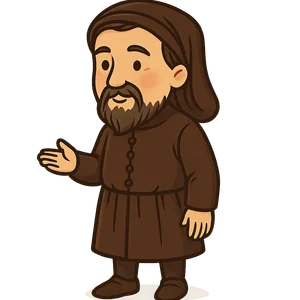
Geoffrey Chaucer
Geoffrey Chaucer was an English poet, author, and civil servant, best known for his masterpiece…
Reads at Grades 6–8 Listens at Grades 4–8
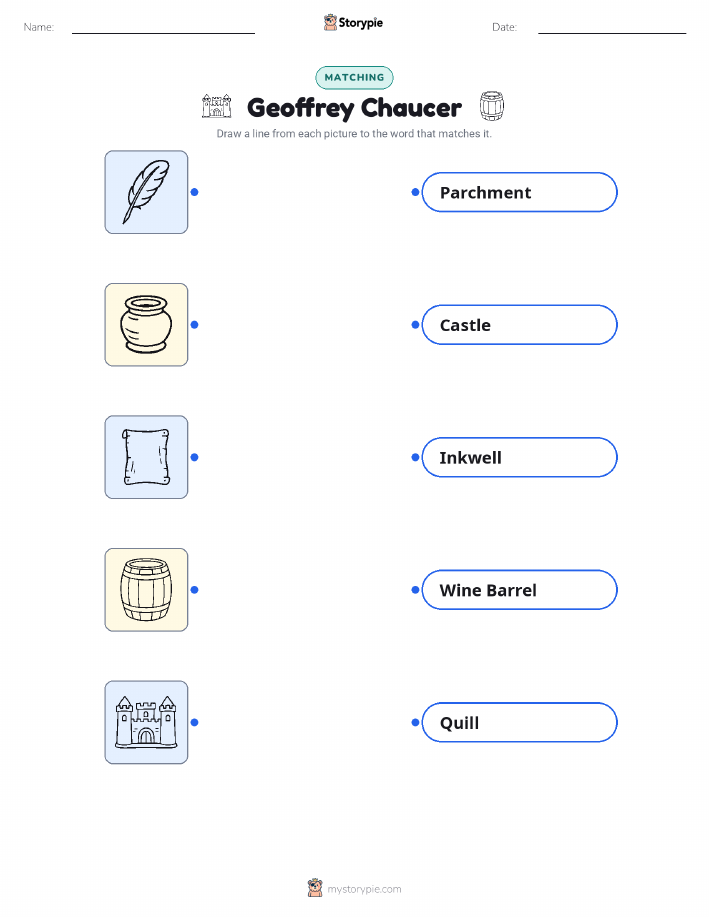
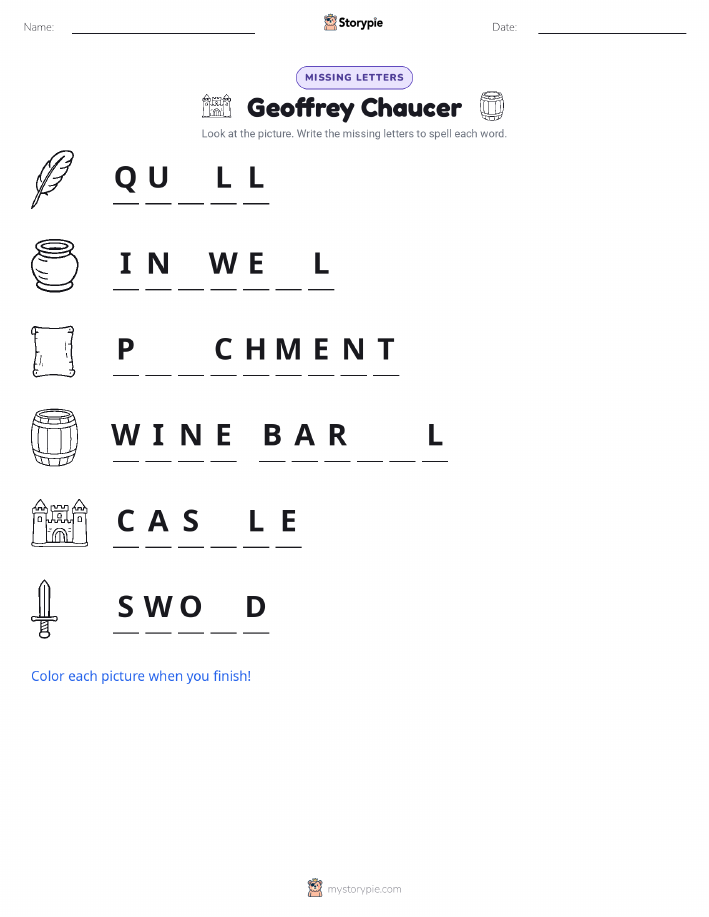
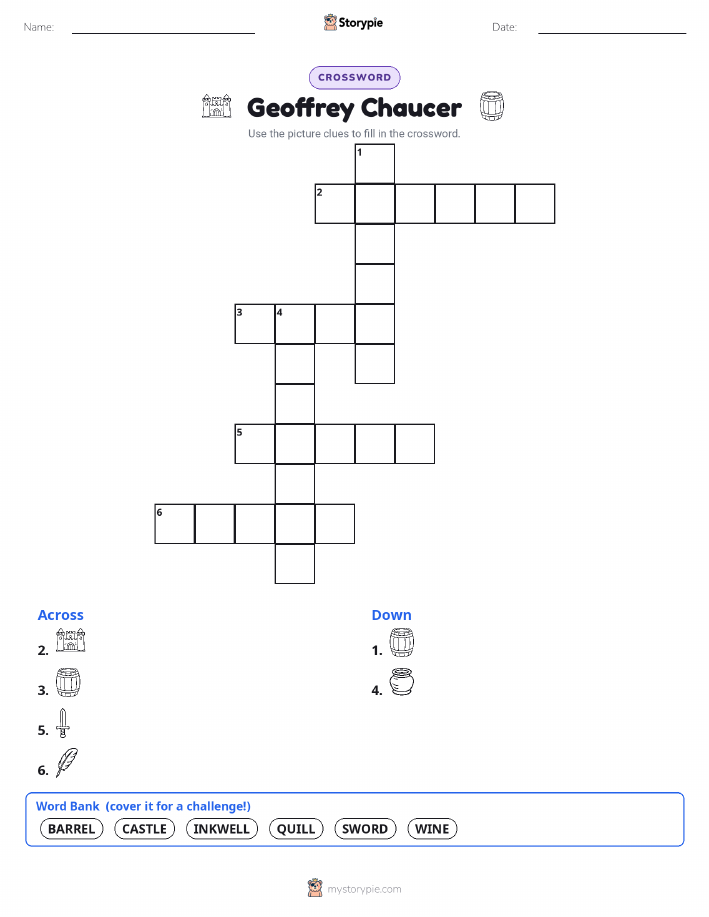
Print & create
Answer keys·No prep·Free with an account
28 worksheets · answer keys · full story · quiz · Ages 10-12 · CEFR B2
Plus adds 244,000+ more stories in 27 languages, audio for every one, and printables for all of them.
Just want Geoffrey Chaucer?
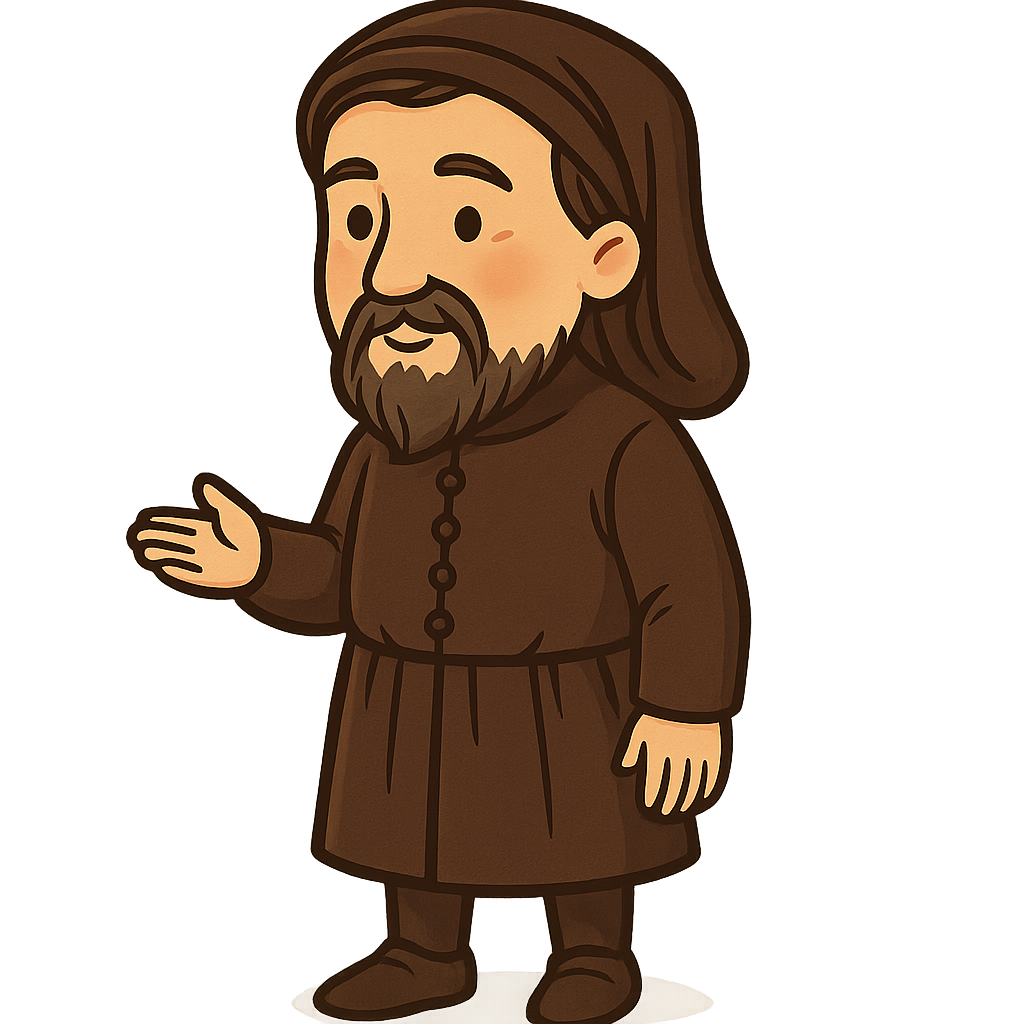
Hello! My name is Geoffrey Chaucer, and I would like to tell you the story of my life as a writer in medieval England. I was born in London sometime in the early 1340s into a world very different from yours. My family were vintners, which is a word for successful wine merchants. This meant we were comfortable, and our shop was a place where I could meet all kinds of interesting people. The London I knew was a city full of life—it was crowded, noisy, and sometimes even dangerous. A great tragedy struck when I was a boy. Around 1348, a terrible sickness called the Black Death spread across Europe, changing the world forever. Despite living in such challenging times, I was very lucky to receive an excellent education. I learned to read and write not only in English but also in French and Latin. These languages were very important because they were spoken by the powerful people at the royal court, and knowing them opened many doors for me.
My life took a very exciting turn around the year 1357, when I became a page in the household of a noblewoman, Elizabeth de Burgh. This was my very first step into the world of royalty and high society. A few years later, I joined the English army to fight in a long conflict with France, which historians now call the Hundred Years' War. In 1359, my time as a soldier came to a sudden halt during a siege of the city of Rheims. I was captured by the French army! It was a frightening time, but my story was not over. King Edward III of England thought I was an important person, and he paid my ransom to set me free. After that experience, I began working directly for the king. My role was that of a courtier and diplomat, which meant I traveled across Europe carrying important messages for the royal family. During these years, I married a wonderful woman named Philippa de Roet, who was a lady-in-waiting to the Queen. My life was filled with adventure, important responsibilities, and dedicated service to the kingdom.
Geoffrey Chaucer: The Father of English Literature
Hello! My name is Geoffrey Chaucer, and I would like to tell you the story of my life as a writer in medieval England. I was born in London sometime in the early 1340s into a world very different from yours. My family were vintners, which is a word for successful wine merchants. This meant we were comfortable, and our shop was a place where I could meet all kinds of interesting people. The London I knew was a city full of life—it was crowded, noisy, and sometimes even dangerous. A great tragedy struck when I was a boy. Around 1348, a terrible sickness called the Black Death spread across Europe, changing the world forever. Despite living in such challenging times, I was very lucky to receive an excellent education. I learned to read and write not only in English but also in French and Latin. These languages were very important because they were spoken by the powerful people at the royal court, and knowing them opened many doors for me.
My life took a very exciting turn around the year 1357, when I became a page in the household of a noblewoman, Elizabeth de Burgh. This was my very first step into the world of royalty and high society. A few years later, I joined the English army to fight in a long conflict with France, which historians now call the Hundred Years' War. In 1359, my time as a soldier came to a sudden halt during a siege of the city of Rheims. I was captured by the French army! It was a frightening time, but my story was not over. King Edward III of England thought I was an important person, and he paid my ransom to set me free. After that experience, I began working directly for the king. My role was that of a courtier and diplomat, which meant I traveled across Europe carrying important messages for the royal family. During these years, I married a wonderful woman named Philippa de Roet, who was a lady-in-waiting to the Queen. My life was filled with adventure, important responsibilities, and dedicated service to the kingdom.
My duties as a diplomat took me on incredible journeys, but the most life-changing of these were my trips to Italy in 1372 and again in 1378. Italy was the center of the Renaissance, a period of amazing new developments in art, science, and literature. While there, I discovered the works of brilliant writers like Dante Alighieri, Petrarch, and Boccaccio. I was truly amazed by their poems and stories. But what struck me the most was that they wrote in their own language, Italian, instead of the formal Latin that most scholars and writers used. Back in England, almost all important books were written in either French, the language of the court, or Latin, the language of the church. This gave me a powerful idea. I wondered, why couldn't we do the same in England? Why couldn't we create great works of literature in our own language, English? This thought inspired a new mission for me. I had already been writing poetry, including a piece called 'The Book of the Duchess' around 1368, but my travels convinced me to use my skills to elevate the English language through storytelling.
In 1374, I was appointed to an important government position as the Controller of Customs for the Port of London. My office was in a tower overlooking the river, and from there I saw people from every walk of life. I saw knights and sailors, monks and merchants, and farmers coming into the city. I listened to their conversations and imagined their stories, and this daily parade of humanity gave me the idea for my greatest work. Around 1387, I began writing 'The Canterbury Tales.' The book tells the story of about 30 pilgrims who meet at an inn on their way to the cathedral in Canterbury. To make the long journey more entertaining, the inn's host proposes a contest: each pilgrim will tell two stories on the way there and two on the way back. Through these characters, I wanted to create a snapshot of the medieval world I knew. I wrote about a noble Knight, a bold and funny woman called the Wife of Bath, a clever Miller, and many others. Each character’s story reveals something about their personality and their place in society. Most importantly, I wrote it all in Middle English, the everyday language people spoke, so that everyone, not just highly educated scholars, could enjoy it. I worked on this book for many years but never managed to finish all the stories I had planned.
In my later years, I continued to write while also serving the king in different roles. In 1399, I took a lease on a house located within the grounds of the famous Westminster Abbey in London. My life came to an end on October 25th, 1400. Because I was a respected servant of the king and a tenant of the abbey, I was given the great honor of being buried inside the church. Over the centuries, other famous writers were buried or honored with monuments near my tomb. Today, that part of Westminster Abbey is known all over the world as Poets' Corner. I am often called the 'Father of English Literature' because I helped prove that the English language was just as capable of creating beautiful, funny, and meaningful art as any other language. More than 600 years later, my Canterbury Tales are still read and studied in schools, offering a window into the medieval world I once called home.
Wow facts
About
Geoffrey Chaucer was an English poet, author, and civil servant, best known for his masterpiece, 'The Canterbury Tales.' He is often called the 'Father of English Literature' for popularizing the use of Middle English in literature.
Take a Quiz
Question 1 of 5
What motivated me to write 'The Canterbury Tales' in English?
Explore next




Want to do even more?
Go beyond exploring. Unlock tools that turn every story into real learning.

Storypie Plus for families
Full stories, quizzes, and printables. Nights and car rides, sorted.
- Unlimited audio stories
- Create Mode: your child stars in the story
- Offline downloads
- Printable worksheets & coloring pages

Why Storypie for Schools
Students engaged. Prep in seconds. Evenings back to you.
- Worksheets & Quizzes
- Classroom Management
- Formative Assessment
- Custom Curriculum & Lesson Plans
- 27 Languages

Why Storypie for Homeschool
Curriculum done. They'll ask for more. Hours back in your day.
- Worksheet Generator
- First-Person Audio Stories
- Built-in Comprehension Quizzes
- Custom Curriculum & Lesson Plans
- Print & Go Activities