English

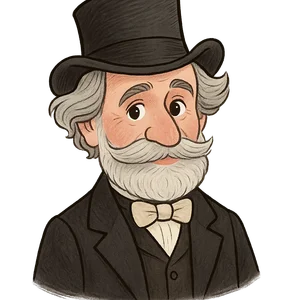
Giuseppe Verdi
Giuseppe Verdi was an Italian composer, primarily of opera…
Reads at Grades 3–5 Listens at Grades 1–5
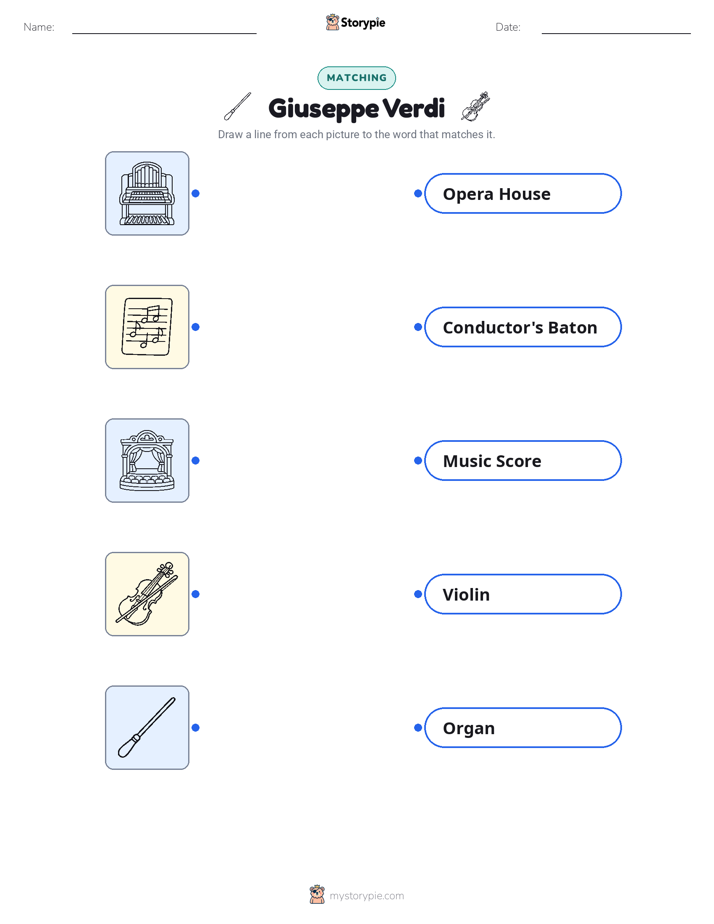
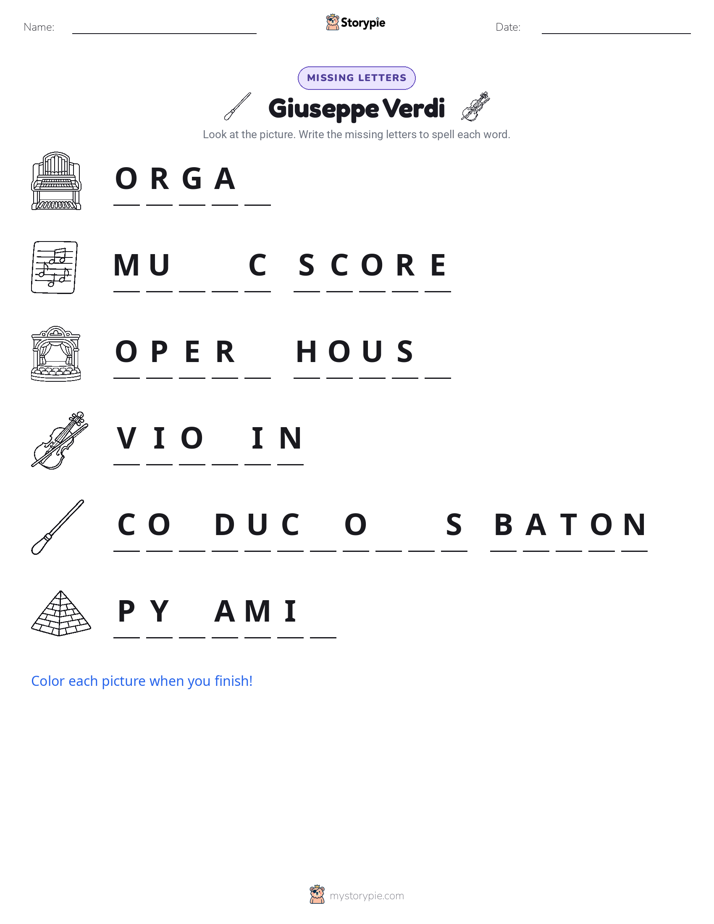
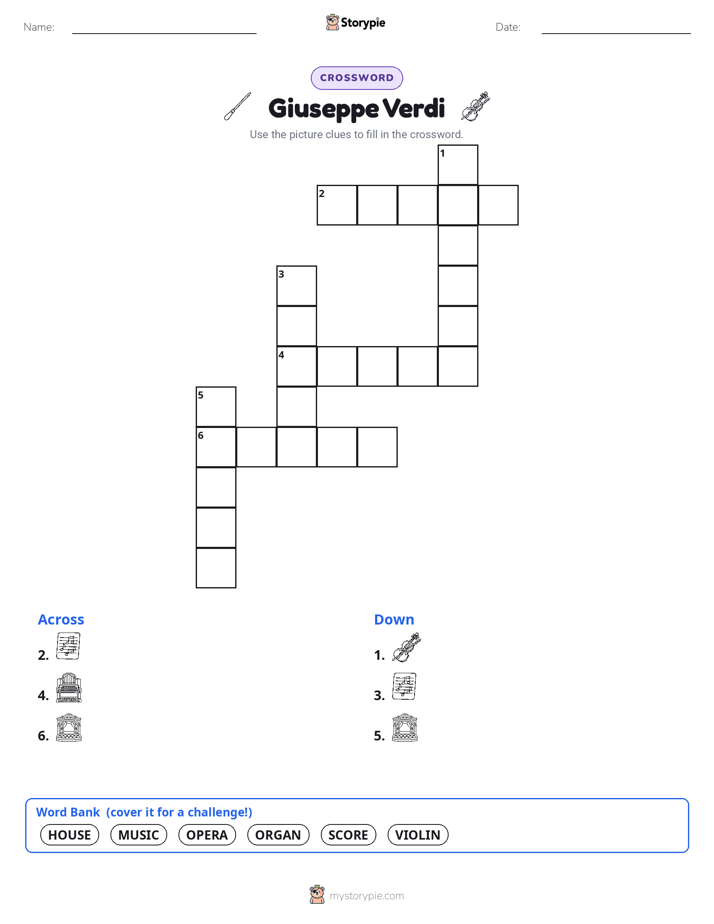
Print & create
Answer keys·No prep·Free with an account
28 worksheets · answer keys · full story · quiz · Ages 8-10 · CEFR B1
Plus adds 279,000+ more stories in 27 languages, audio for every one, and printables for all of them.
Just want Giuseppe Verdi?
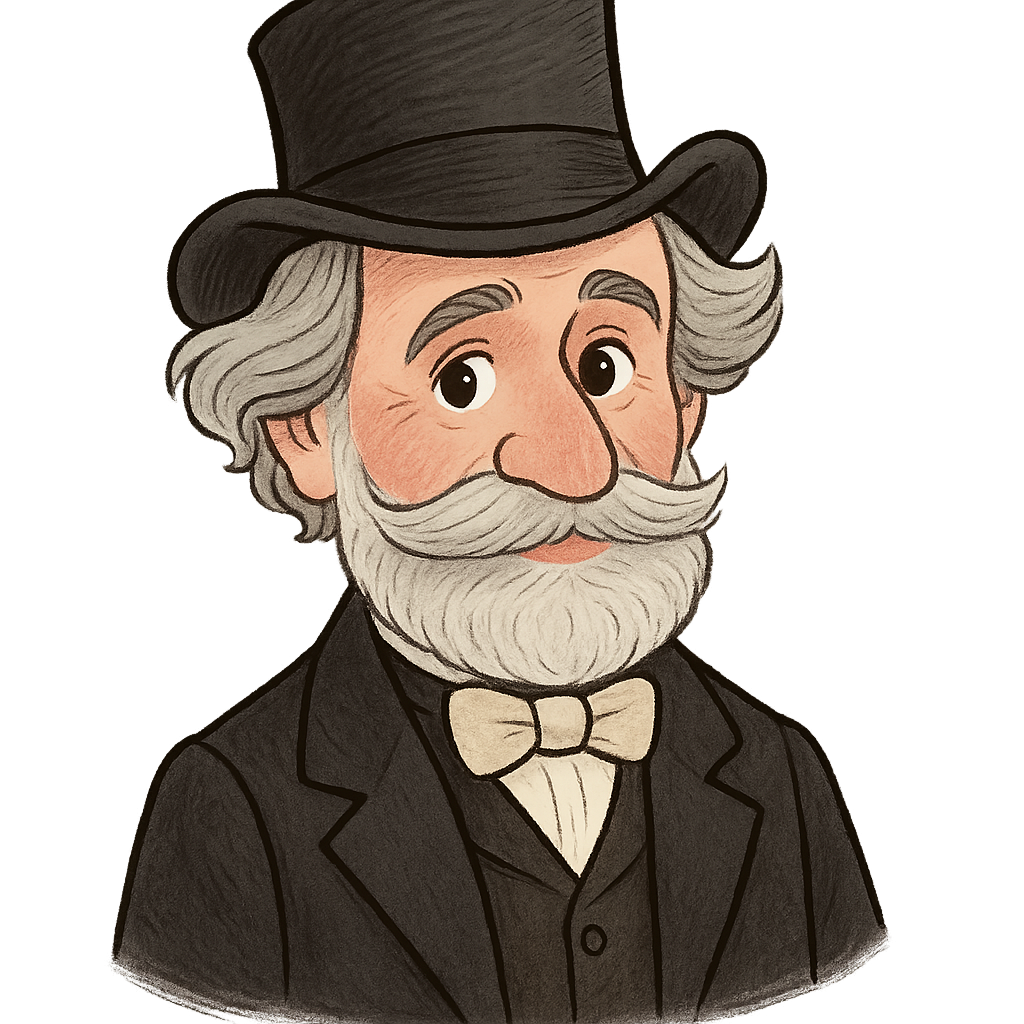
Hello! My name is Giuseppe Verdi, and I want to tell you the story of my life, which was filled with music. I was born on October 10th, 1813, in a small Italian village called Le Roncole. My parents ran a little inn, but from a very young age, the thing I loved most in the world was music. I felt its power in every sound. I learned to play the organ so well that by the time I was a boy, I was already playing for our whole church! A kind man named Antonio Barezzi saw how much I loved music and noticed my talent. He decided to help me by becoming my patron, which means he helped pay for my lessons. This was my chance to follow my big dream of becoming a composer.
Thanks to Mr. Barezzi's help, I moved to the nearby town of Busseto to study music seriously. I worked as hard as I could, practicing and learning everything about composing. In 1832, I traveled to a big city, Milan, to try to get into the famous Milan Conservatory, which was a very important music school. But they told me I was too old and that I didn't play the piano well enough. I was sad, but I refused to give up on my dream! I found a private teacher in Milan named Vincenzo Lavigna and continued my studies with him. A few years later, in 1836, I returned to Busseto and became the town's music master. That same year, I also married Mr. Barezzi's wonderful daughter, Margherita. It felt like my life was just beginning to find its rhythm.
The next few years were very difficult and filled with sadness. Between the years 1838 and 1840, my two small children and my dear wife Margherita all became very ill and passed away. My heart was broken, and I felt so lost that I wanted to stop writing music forever. But one day, a man from the famous La Scala opera house gave me a story to read. It was called *Nabucco*. The story was about people who missed their home and longed to be free. It inspired me, and the music started to pour out of me. I wrote a powerful song for the opera called 'Va, pensiero.' When *Nabucco* was performed for the first time on March 9th, 1842, the audience loved it! The music spoke to their hearts. It was a huge success and made me famous all over Italy.
Giuseppe Verdi: A Life in Music
Hello! My name is Giuseppe Verdi, and I want to tell you the story of my life, which was filled with music. I was born on October 10th, 1813, in a small Italian village called Le Roncole. My parents ran a little inn, but from a very young age, the thing I loved most in the world was music. I felt its power in every sound. I learned to play the organ so well that by the time I was a boy, I was already playing for our whole church! A kind man named Antonio Barezzi saw how much I loved music and noticed my talent. He decided to help me by becoming my patron, which means he helped pay for my lessons. This was my chance to follow my big dream of becoming a composer.
Thanks to Mr. Barezzi's help, I moved to the nearby town of Busseto to study music seriously. I worked as hard as I could, practicing and learning everything about composing. In 1832, I traveled to a big city, Milan, to try to get into the famous Milan Conservatory, which was a very important music school. But they told me I was too old and that I didn't play the piano well enough. I was sad, but I refused to give up on my dream! I found a private teacher in Milan named Vincenzo Lavigna and continued my studies with him. A few years later, in 1836, I returned to Busseto and became the town's music master. That same year, I also married Mr. Barezzi's wonderful daughter, Margherita. It felt like my life was just beginning to find its rhythm.
The next few years were very difficult and filled with sadness. Between the years 1838 and 1840, my two small children and my dear wife Margherita all became very ill and passed away. My heart was broken, and I felt so lost that I wanted to stop writing music forever. But one day, a man from the famous La Scala opera house gave me a story to read. It was called Nabucco. The story was about people who missed their home and longed to be free. It inspired me, and the music started to pour out of me. I wrote a powerful song for the opera called 'Va, pensiero.' When Nabucco was performed for the first time on March 9th, 1842, the audience loved it! The music spoke to their hearts. It was a huge success and made me famous all over Italy.
After the success of Nabucco, I entered a period of my life where I worked nonstop. I felt like a rower on a ship, always working, which is why people call these my 'galley years.' I wrote one opera after another, each telling a dramatic story. You might have heard of some of them. In 1851, I wrote Rigoletto. Just two years later, in 1853, I finished two more famous operas: Il trovatore and La traviata. My operas were full of big feelings—love, sadness, and bravery—and people connected with the powerful stories and beautiful melodies. During this time, I met a wonderful soprano singer named Giuseppina Strepponi. She understood my music and my heart, and in 1859, we were married. My music also became very important to the people of Italy, who were fighting to unite their country. My name, V.E.R.D.I., even became a secret code for their cause!
Even as I got older, I couldn't stop creating music. On December 24th, 1871, my grand opera Aida was performed for the first time in Cairo, Egypt. And when I was over 70 and 80 years old, I wrote two more operas based on plays by the famous writer William Shakespeare: Otello in 1887 and my only great comedy, Falstaff, in 1893. One of the last things I did was build a special home in Milan for retired musicians, which I called the Casa di Riposo per Musicisti, so they would always have a safe place to live. I lived a long and full life, reaching the age of 87. Today, my operas are still performed in theaters all over the world, and I hope my music continues to share powerful stories and touch people's hearts for many years to come.
Wow facts
About
Giuseppe Verdi was an Italian composer, primarily of opera, who became one of the most influential composers of the 19th century. His works, such as Rigoletto, La traviata, and Aida, are frequently performed in opera houses worldwide.
Take a Quiz
Question 1 of 5
Why was the period after his opera *Nabucco* called his 'galley years'?
Explore next



Want to do even more?
Go beyond exploring. Unlock tools that turn every story into real learning.

Storypie Plus for families
Full stories, quizzes, and printables. Nights and car rides, sorted.
- Unlimited audio stories
- Create Mode: your child stars in the story
- Offline downloads
- Printable worksheets & coloring pages

Why Storypie for Schools
Students engaged. Prep in seconds. Evenings back to you.
- Worksheets & Quizzes
- Classroom Management
- Formative Assessment
- Custom Curriculum & Lesson Plans
- 27 Languages

Why Storypie for Homeschool
Curriculum done. They'll ask for more. Hours back in your day.
- Worksheet Generator
- First-Person Audio Stories
- Built-in Comprehension Quizzes
- Custom Curriculum & Lesson Plans
- Print & Go Activities