English


Gloria Steinem
Gloria Steinem is an American journalist, social-political activist…
Reads at Grades 6–8 Listens at Grades 4–8
Print & create
Answer keys·No prep·Free with an account
28 worksheets · answer keys · full story · quiz · Ages 10-12 · CEFR B2
Plus adds 290,000+ more stories in 27 languages, audio for every one, and printables for all of them.
Just want Gloria Steinem?

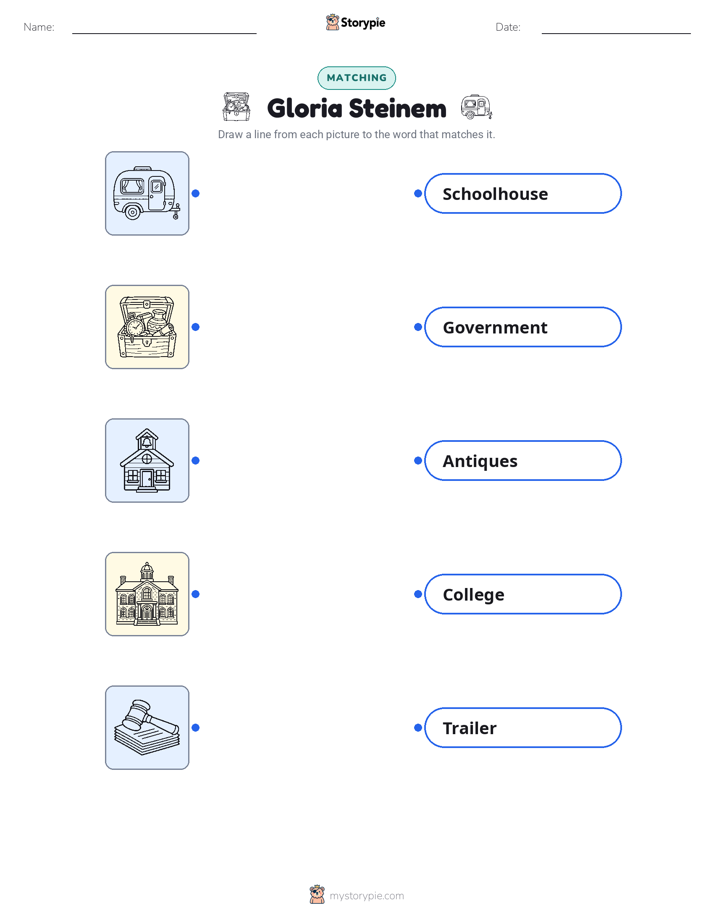
Hello, my name is Gloria Steinem, and I've spent my life as a writer and activist, fighting for fairness and equality for all people. My story begins in a time and place that shaped everything I came to believe. I was born on March 25th, 1934, in Toledo, Ohio. My childhood wasn't like that of most kids I knew. My father was an antiques dealer who loved being on the road, so for many years, our home was a house trailer that we pulled all across the country. It was an exciting way to grow up, but it also meant I didn't attend school in a regular classroom until I was about 11 years old. This experience taught me to be independent and to learn from the world around me. A big change came in 1944 when my parents separated. I settled down in Toledo to take care of my mother, who struggled with her health for many years. Watching her, I saw how talented and intelligent she was, but also how society didn't give her the same opportunities as men to follow her own dreams. This was one of the first times I realized that the world wasn't always fair, especially for women, and a small seed of an idea was planted in my mind: things had to change.
After finishing high school, I was eager to continue my education and went to Smith College, where I studied government. It was there that I began to understand the systems and rules that shape our world. After I graduated in 1956, a wonderful opportunity came my way: I received a fellowship to study and travel in India for two years. That trip opened my eyes in so many ways. I lived in Indian villages and saw how people, especially women, worked together at a grassroots level—from the ground up—to solve their own problems and improve their communities. I learned about the nonviolent protest methods of Mahatma Gandhi and saw how social structures, like the caste system, could unfairly limit a person's potential from birth. When I returned to the United States, I moved to New York City, full of purpose. I wanted to be a serious journalist who wrote about important political and social issues. However, in the early 1960s, most newspaper and magazine editors expected female writers to cover topics like fashion, cooking, and home decorating. To prove I was capable of more, I took on a daring assignment in 1963. I went undercover and worked as a waitress, known as a Playboy Bunny, to expose the poor pay and difficult working conditions. My article, 'A Bunny's Tale,' made a big splash and got a lot of attention, but it also had an unexpected consequence. For a while, some people didn't take me seriously as a political writer because of it.
Gloria Steinem
Hello, my name is Gloria Steinem, and I've spent my life as a writer and activist, fighting for fairness and equality for all people. My story begins in a time and place that shaped everything I came to believe. I was born on March 25th, 1934, in Toledo, Ohio. My childhood wasn't like that of most kids I knew. My father was an antiques dealer who loved being on the road, so for many years, our home was a house trailer that we pulled all across the country. It was an exciting way to grow up, but it also meant I didn't attend school in a regular classroom until I was about 11 years old. This experience taught me to be independent and to learn from the world around me. A big change came in 1944 when my parents separated. I settled down in Toledo to take care of my mother, who struggled with her health for many years. Watching her, I saw how talented and intelligent she was, but also how society didn't give her the same opportunities as men to follow her own dreams. This was one of the first times I realized that the world wasn't always fair, especially for women, and a small seed of an idea was planted in my mind: things had to change.
After finishing high school, I was eager to continue my education and went to Smith College, where I studied government. It was there that I began to understand the systems and rules that shape our world. After I graduated in 1956, a wonderful opportunity came my way: I received a fellowship to study and travel in India for two years. That trip opened my eyes in so many ways. I lived in Indian villages and saw how people, especially women, worked together at a grassroots level—from the ground up—to solve their own problems and improve their communities. I learned about the nonviolent protest methods of Mahatma Gandhi and saw how social structures, like the caste system, could unfairly limit a person's potential from birth. When I returned to the United States, I moved to New York City, full of purpose. I wanted to be a serious journalist who wrote about important political and social issues. However, in the early 1960s, most newspaper and magazine editors expected female writers to cover topics like fashion, cooking, and home decorating. To prove I was capable of more, I took on a daring assignment in 1963. I went undercover and worked as a waitress, known as a Playboy Bunny, to expose the poor pay and difficult working conditions. My article, 'A Bunny's Tale,' made a big splash and got a lot of attention, but it also had an unexpected consequence. For a while, some people didn't take me seriously as a political writer because of it.
The real turning point in my life, the moment I went from being a journalist to a dedicated activist, happened in 1969. I was sent to cover a meeting where women were gathering to speak publicly about personal experiences that had always been kept private and silent. As I sat there and listened to their honest and courageous stories, I felt what I later called a 'click' moment—a sudden, clear, and powerful realization. I understood that their problems were my problems, and that these weren't just personal issues but political ones. I knew I couldn't simply be a neutral observer writing about the movement from the outside; I had to be part of it. I proudly began to call myself a feminist. This led me to co-found a new kind of magazine in 1971 with other incredible women, including my friend Dorothy Pitman Hughes. We wanted to create a publication written by women, for women, that talked about the real issues we faced. We called it 'Ms.' magazine. The first full issue was published in 1972, and it sold out across the country in just eight days. This proved that women were ready and eager for stories that reflected their true lives, careers, and their fight for equality. That same year, in 1971, I also helped create the National Women's Political Caucus, an organization dedicated to recruiting, training, and supporting women who wanted to run for political office. For many years, I traveled all over the country, giving speeches and working to pass the Equal Rights Amendment (ERA), a proposed amendment to the Constitution that would guarantee equal legal rights for all American citizens, regardless of their gender.
My work for equality did not end in the 1970s; it has been the journey of my entire life. I have continued to write books, give speeches, and help organize movements for a more just and fair world. I soon realized that the fight for women's rights is connected to the fight for fairness for all people. True equality means creating a world where every person, no matter their race, background, or identity, has the chance to live up to their fullest and most unique potential. It is about recognizing that we are all linked together. In 2013, I was deeply honored to receive the Presidential Medal of Freedom from President Barack Obama for my life's work. Today, I am still active, still writing, and still speaking out. I have always believed that real, lasting change doesn't come from the top down, but from the bottom up. It happens when people start talking to one another, sharing their stories, and realizing that they are not alone in their struggles or their hopes. My greatest wish is that you will look at the world around you, find what you believe is unfair, and understand that your voice, your story, and your actions have the power to make a difference.
Wow facts
About
Gloria Steinem is an American journalist, social-political activist, and a leading figure of the feminist movement in the late 20th and early 21st centuries.
Take a Quiz
Question 1 of 5
Why did Gloria Steinem go undercover as a Playboy Bunny in 1963?
Explore next






Want to do even more?
Go beyond exploring. Unlock tools that turn every story into real learning.

Storypie Plus for families
Full stories, quizzes, and printables. Nights and car rides, sorted.
- Unlimited audio stories
- Create Mode: your child stars in the story
- Offline downloads
- Printable worksheets & coloring pages

Why Storypie for Schools
Students engaged. Prep in seconds. Evenings back to you.
- Worksheets & Quizzes
- Classroom Management
- Formative Assessment
- Custom Curriculum & Lesson Plans
- 27 Languages

Why Storypie for Homeschool
Curriculum done. They'll ask for more. Hours back in your day.
- Worksheet Generator
- First-Person Audio Stories
- Built-in Comprehension Quizzes
- Custom Curriculum & Lesson Plans
- Print & Go Activities