English

Hipparchus
Hipparchus was an ancient Greek astronomer, geographer, and mathematician…
Reads at Grades 6–8 Listens at Grades 4–8
Print & create
Answer keys·No prep·Free with an account
28 worksheets · answer keys · full story · quiz · Ages 10-12 · CEFR B2
Plus adds 164,000+ more stories in 27 languages, audio for every one, and printables for all of them.
Just want Hipparchus?
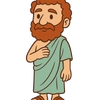
Hello! My name is Hipparchus. I was born a very long time ago, around the year 190 BCE, in a city called Nicaea in ancient Greece. Even as a young boy, I was completely fascinated by the night sky. I would lie outside for hours, watching the moon travel across the darkness and seeing the stars twinkle like tiny diamonds. I didn't just see pretty lights; I saw patterns and puzzles. I wondered: How far away are those stars? Do they move? And what is our Earth's place among them? These questions sparked a fire in my mind that would guide my entire life's work.
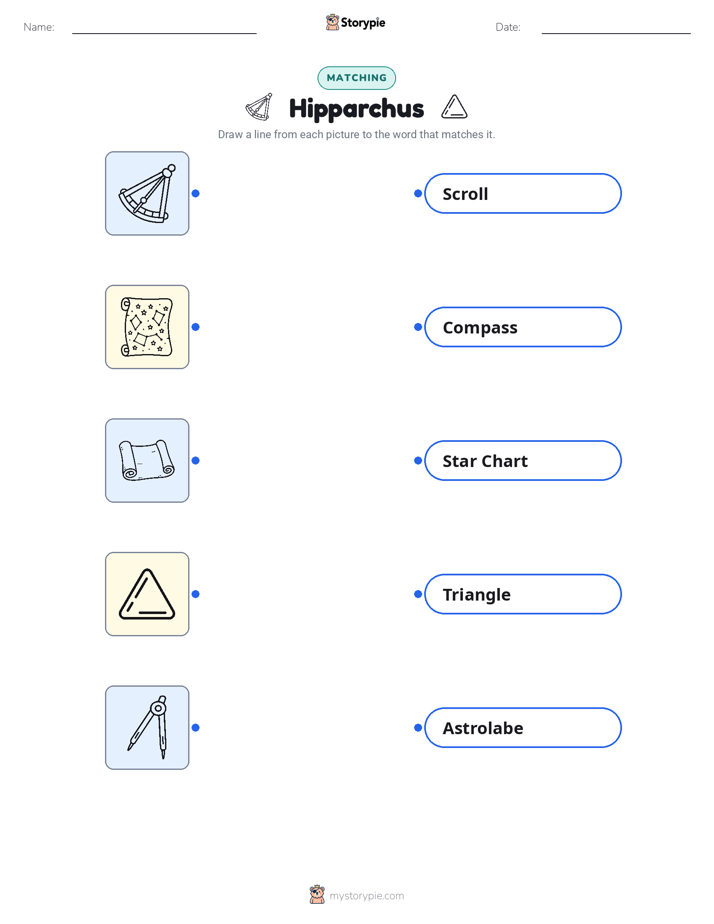
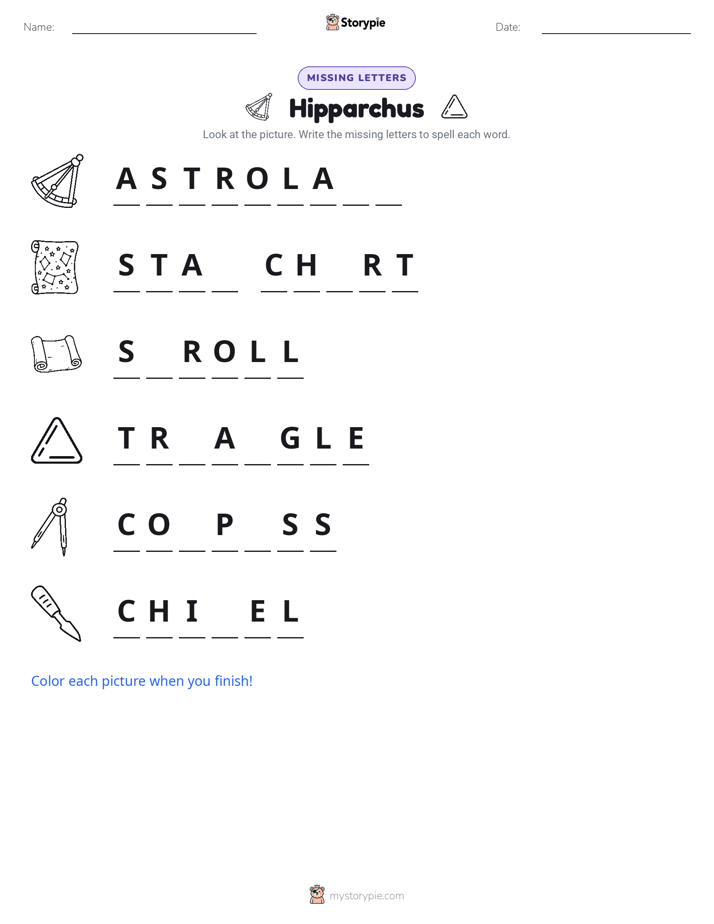
To answer my big questions, I knew I couldn't just guess. I needed to observe and measure, very carefully. I did much of my most important work on the beautiful Greek island of Rhodes, starting around 162 BCE. There, I built an observatory and used special tools like the astrolabe and the armillary sphere to pinpoint the exact locations of stars and planets. As I gathered my data, I realized that to make sense of my measurements, I needed a special kind of mathematics that didn't quite exist yet. So, I decided I would have to invent it myself to truly understand the heavens.
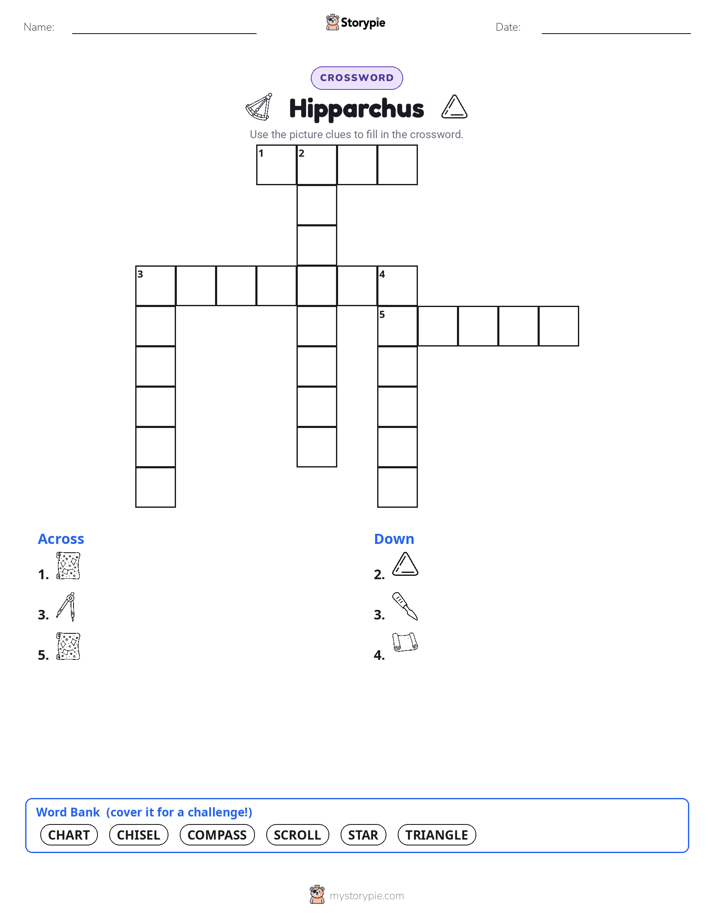
One of my biggest projects, which took me many years between 147 and 127 BCE, was to create a complete map of the stars. Night after night, I would measure the position of each star I could see. I also came up with a system to rank them by how bright they appeared to us from Earth. I called the brightest stars 'first magnitude' and the faintest ones 'sixth magnitude.' My star catalog listed the precise coordinates and brightness for over 850 stars. It was the very first of its kind and provided a detailed snapshot of the heavens for future generations to study.
Hipparchus: The Father of Astronomy
Hello! My name is Hipparchus. I was born a very long time ago, around the year 190 BCE, in a city called Nicaea in ancient Greece. Even as a young boy, I was completely fascinated by the night sky. I would lie outside for hours, watching the moon travel across the darkness and seeing the stars twinkle like tiny diamonds. I didn't just see pretty lights; I saw patterns and puzzles. I wondered: How far away are those stars? Do they move? And what is our Earth's place among them? These questions sparked a fire in my mind that would guide my entire life's work.
To answer my big questions, I knew I couldn't just guess. I needed to observe and measure, very carefully. I did much of my most important work on the beautiful Greek island of Rhodes, starting around 162 BCE. There, I built an observatory and used special tools like the astrolabe and the armillary sphere to pinpoint the exact locations of stars and planets. As I gathered my data, I realized that to make sense of my measurements, I needed a special kind of mathematics that didn't quite exist yet. So, I decided I would have to invent it myself to truly understand the heavens.
One of my biggest projects, which took me many years between 147 and 127 BCE, was to create a complete map of the stars. Night after night, I would measure the position of each star I could see. I also came up with a system to rank them by how bright they appeared to us from Earth. I called the brightest stars 'first magnitude' and the faintest ones 'sixth magnitude.' My star catalog listed the precise coordinates and brightness for over 850 stars. It was the very first of its kind and provided a detailed snapshot of the heavens for future generations to study.
While making my star catalog, I made my most famous discovery. I found older star charts from astronomers who lived more than a century before me. When I compared their measurements to my own, I noticed something strange. The positions of all the stars had shifted ever so slightly in the same direction. After much calculation, around 128 BCE, I figured out the reason: it wasn't the stars that had moved, but the Earth itself! I discovered that our planet has a very slow wobble on its axis, like a spinning top that is starting to slow down. We now call this discovery the 'precession of the equinoxes.'
Remember how I said I needed a new kind of math? To calculate the positions of stars and predict eclipses, I needed to understand the relationship between the angles and sides of triangles. This branch of math is now called trigonometry, and many people call me its father. I created the first 'table of chords,' which was a tool that let me solve any triangle. This invention was essential for turning my careful observations of the sky into a scientific model of the cosmos, allowing me to calculate distances and positions with greater accuracy than ever before.
I lived a full life dedicated to understanding the cosmos and passed away around 120 BCE. Although most of my original books have been lost to time, my discoveries were so important that they were saved and studied by later astronomers, like the famous Ptolemy. My star catalog, my discovery of precession, and the mathematical tools I invented laid the foundation for astronomy for more than 1,500 years. My work showed that with careful observation and mathematics, we could begin to understand the vast universe around us.
Wow facts
About
Hipparchus was an ancient Greek astronomer, geographer, and mathematician, considered one of the greatest astronomers of antiquity for his systematic observations, discovery of the precession of the equinoxes, and creation of the first comprehensive star catalog.
Take a Quiz
Question 1 of 5
Based on the story, what was Hipparchus's main goal in his work?
Explore next






Want to do even more?
Go beyond exploring. Unlock tools that turn every story into real learning.

Storypie Plus for families
Full stories, quizzes, and printables. Nights and car rides, sorted.
- Unlimited audio stories
- Create Mode: your child stars in the story
- Offline downloads
- Printable worksheets & coloring pages

Why Storypie for Schools
Students engaged. Prep in seconds. Evenings back to you.
- Worksheets & Quizzes
- Classroom Management
- Formative Assessment
- Custom Curriculum & Lesson Plans
- 27 Languages

Why Storypie for Homeschool
Curriculum done. They'll ask for more. Hours back in your day.
- Worksheet Generator
- First-Person Audio Stories
- Built-in Comprehension Quizzes
- Custom Curriculum & Lesson Plans
- Print & Go Activities