English

John Harrison
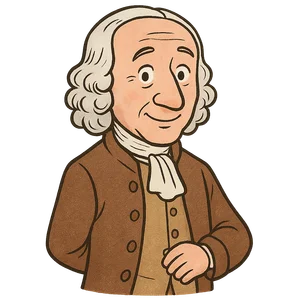
John Harrison was a self-educated English carpenter and clockmaker who invented the marine chronometer…
Reads at Grades 3–5 Listens at Grades 1–5
Print & create
Answer keys·No prep·Free with an account
28 worksheets · answer keys · full story · quiz · Ages 8-10 · CEFR B1
Plus adds 208,000+ more stories in 27 languages, audio for every one, and printables for all of them.
Just want John Harrison?

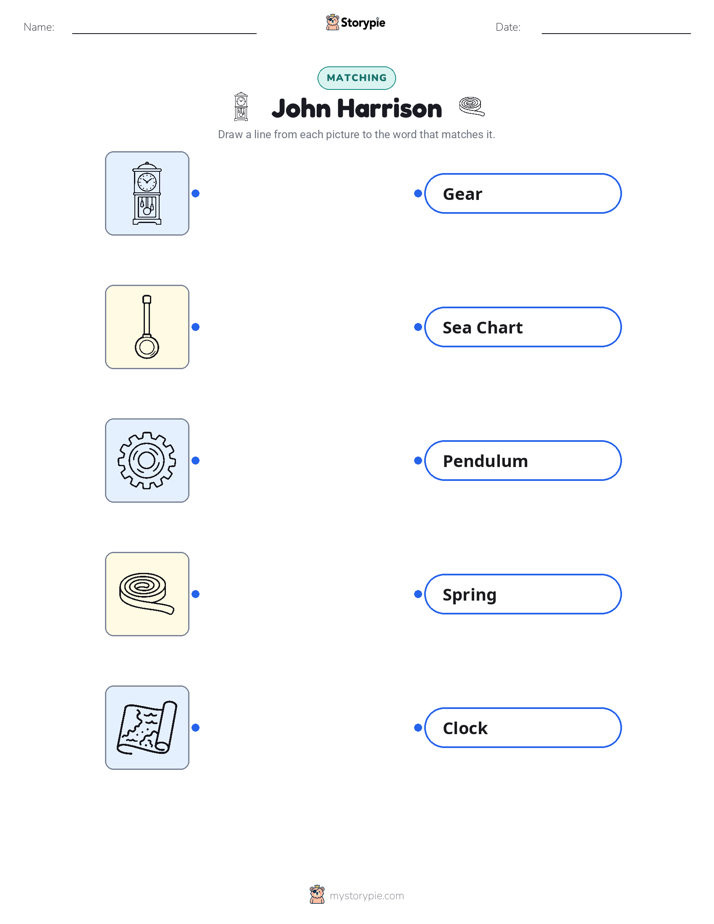
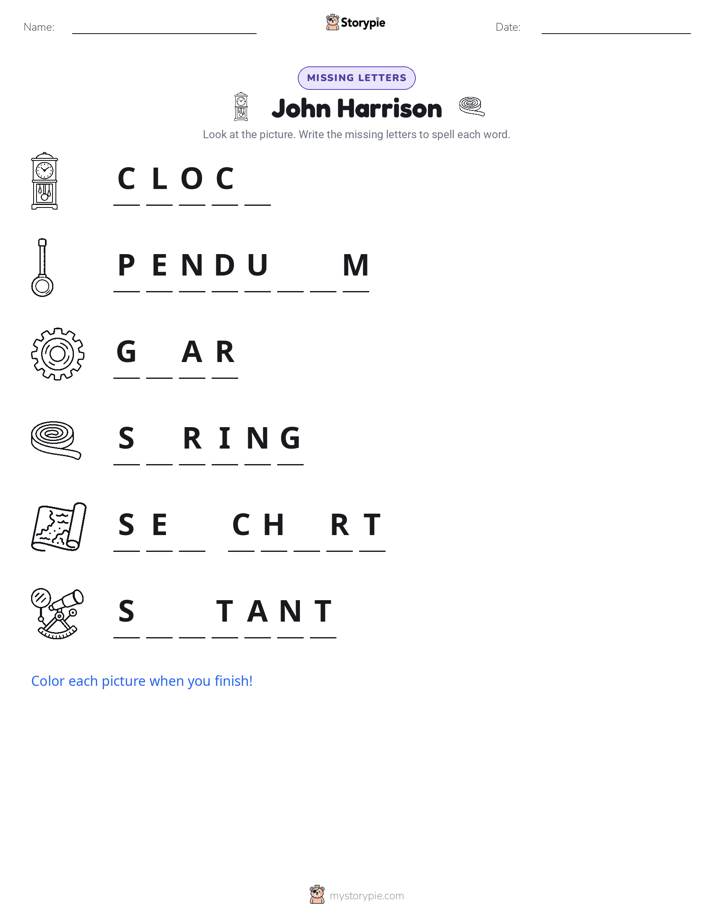
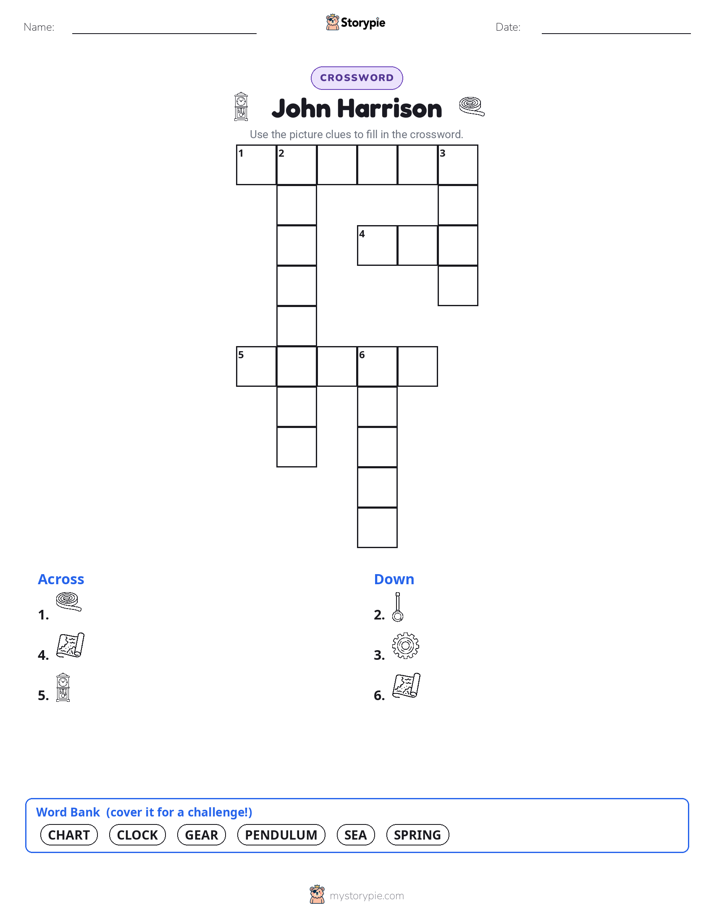
Hello, my name is John Harrison. My story begins on March 24th, 1693, in a small village in Yorkshire, England. My father was a carpenter, and from him, I learned how to work carefully with wood. From a very young age, I was completely fascinated with how things worked. I loved taking things apart and putting them back together, just to understand the secrets hidden inside. Most of all, I loved clocks. The steady tick-tock of their gears and pendulums felt like magic to me. I wanted to understand how they measured something you couldn't even see: time. In 1713, when I was only 20 years old, I decided to build my own clock. I didn't have much metal, so I used what I knew best—wood. I carefully carved the gears and all the tiny pieces, and when I was finished, I had a working clock made almost entirely of wood. This was the start of my lifelong journey, a passion for making things with perfect precision and inventing new ways to solve old problems.
In my time, sailing across the great oceans was one of the most dangerous jobs in the world. The biggest reason was a puzzle that no one could solve: the problem of longitude. Sailors could figure out how far north or south they were by looking at the sun and stars, but they had no accurate way of knowing their east-west position on the vast, empty sea. Because of this, ships would get terribly lost, sometimes for months, running out of food and water. Sometimes, they would crash into rocks they didn't know were there. A terrible shipwreck in 1707, where many sailors lost their lives, made the British government realize something had to be done. In 1714, they passed the Longitude Act. It offered a huge prize, like winning the lottery today, to anyone who could invent a practical way to find longitude at sea. Scientists and astronomers all had ideas, but the best solution was actually simple to understand, yet incredibly hard to do. It required a clock, one so accurate that it could keep perfect time on a rocking, swaying ship through storms and changing weather. Everyone thought this was completely impossible.
John Harrison: The Clockmaker Who Saved Sailors
Hello, my name is John Harrison. My story begins on March 24th, 1693, in a small village in Yorkshire, England. My father was a carpenter, and from him, I learned how to work carefully with wood. From a very young age, I was completely fascinated with how things worked. I loved taking things apart and putting them back together, just to understand the secrets hidden inside. Most of all, I loved clocks. The steady tick-tock of their gears and pendulums felt like magic to me. I wanted to understand how they measured something you couldn't even see: time. In 1713, when I was only 20 years old, I decided to build my own clock. I didn't have much metal, so I used what I knew best—wood. I carefully carved the gears and all the tiny pieces, and when I was finished, I had a working clock made almost entirely of wood. This was the start of my lifelong journey, a passion for making things with perfect precision and inventing new ways to solve old problems.
In my time, sailing across the great oceans was one of the most dangerous jobs in the world. The biggest reason was a puzzle that no one could solve: the problem of longitude. Sailors could figure out how far north or south they were by looking at the sun and stars, but they had no accurate way of knowing their east-west position on the vast, empty sea. Because of this, ships would get terribly lost, sometimes for months, running out of food and water. Sometimes, they would crash into rocks they didn't know were there. A terrible shipwreck in 1707, where many sailors lost their lives, made the British government realize something had to be done. In 1714, they passed the Longitude Act. It offered a huge prize, like winning the lottery today, to anyone who could invent a practical way to find longitude at sea. Scientists and astronomers all had ideas, but the best solution was actually simple to understand, yet incredibly hard to do. It required a clock, one so accurate that it could keep perfect time on a rocking, swaying ship through storms and changing weather. Everyone thought this was completely impossible.
I knew I could solve the longitude problem with a clock, and I spent decades of my life working on it. My first attempt was a large, complicated machine I called H1. I finished building it in 1735, and the very next year, in 1736, it was tested on a voyage at sea. It worked surprisingly well for a first try, much better than anyone expected. But I was not satisfied. I knew I could make it even better, smaller, and more accurate. So, I went back to my workshop and began building my next clocks, which I called H2 and then H3. With each new clock, I invented clever new parts to make them work better. I created special metal strips that wouldn't bend or warp in hot or cold weather, which helped the clocks keep steady time no matter the temperature. My greatest creation, my masterpiece, was H4. I completed it in 1759, and it was a beautiful timekeeper that looked more like a large pocket watch than a giant clock. In 1761, H4 was sent on a long sea trial to Jamaica. After months at sea, it had kept nearly perfect time. I had done it. I had built an amazing sea clock and solved the problem of longitude.
Even though my sea clock H4 had proven itself on the long voyage, getting the prize money was another battle entirely. The group in charge of the prize was called the Board of Longitude. They were mostly astronomers and important gentlemen who were skeptical of my work. They couldn't believe that a simple carpenter like me, with no fancy university education, could solve a scientific problem that had stumped the greatest minds. For many years, they refused to give me the full prize money, always asking for more tests and more proof. It was incredibly frustrating. Finally, I decided to ask for help from the highest person in the land: King George III. The king was fascinated by science and inventions, and he agreed to test my final clock himself at his palace. After seeing how perfectly it worked, he helped me. With the king's support, Parliament finally recognized my achievement in 1773, and I was at last awarded the prize money I had worked my entire life to earn.
My long journey came to a peaceful end. I lived to be 83 years old, passing away on my birthday, March 24th, 1776. My invention, which came to be known as the marine chronometer, completely changed the world. For the first time, sailors could navigate the oceans safely, knowing exactly where they were. My sea clocks helped map the entire globe and made travel safer for everyone who set sail. My story shows that with enough determination, patience, and a love for solving puzzles, anyone can create something that makes a difference in the world.
Wow facts
About
John Harrison was a self-educated English carpenter and clockmaker who invented the marine chronometer, a long-sought-after device for solving the problem of calculating longitude at sea.
Take a Quiz
Question 1 of 5
Why was it so hard for sailors to know their longitude at sea?
Explore next






Want to do even more?
Go beyond exploring. Unlock tools that turn every story into real learning.

Storypie Plus for families
Full stories, quizzes, and printables. Nights and car rides, sorted.
- Unlimited audio stories
- Create Mode: your child stars in the story
- Offline downloads
- Printable worksheets & coloring pages

Why Storypie for Schools
Students engaged. Prep in seconds. Evenings back to you.
- Worksheets & Quizzes
- Classroom Management
- Formative Assessment
- Custom Curriculum & Lesson Plans
- 27 Languages

Why Storypie for Homeschool
Curriculum done. They'll ask for more. Hours back in your day.
- Worksheet Generator
- First-Person Audio Stories
- Built-in Comprehension Quizzes
- Custom Curriculum & Lesson Plans
- Print & Go Activities