English

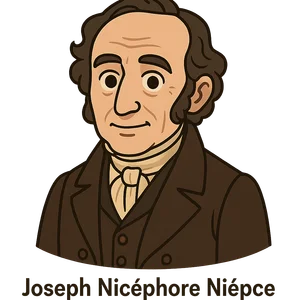
Joseph Nicéphore Niépce
Joseph Nicéphore Niépce was a French inventor who created heliography, the world's first photographic process…
Reads at Grades 6–8 Listens at Grades 4–8
Print & create
Answer keys·No prep·Free with an account
28 worksheets · answer keys · full story · quiz · Ages 10-12 · CEFR B2
Plus adds 244,000+ more stories in 27 languages, audio for every one, and printables for all of them.
Just want Joseph Nicéphore Niépce?
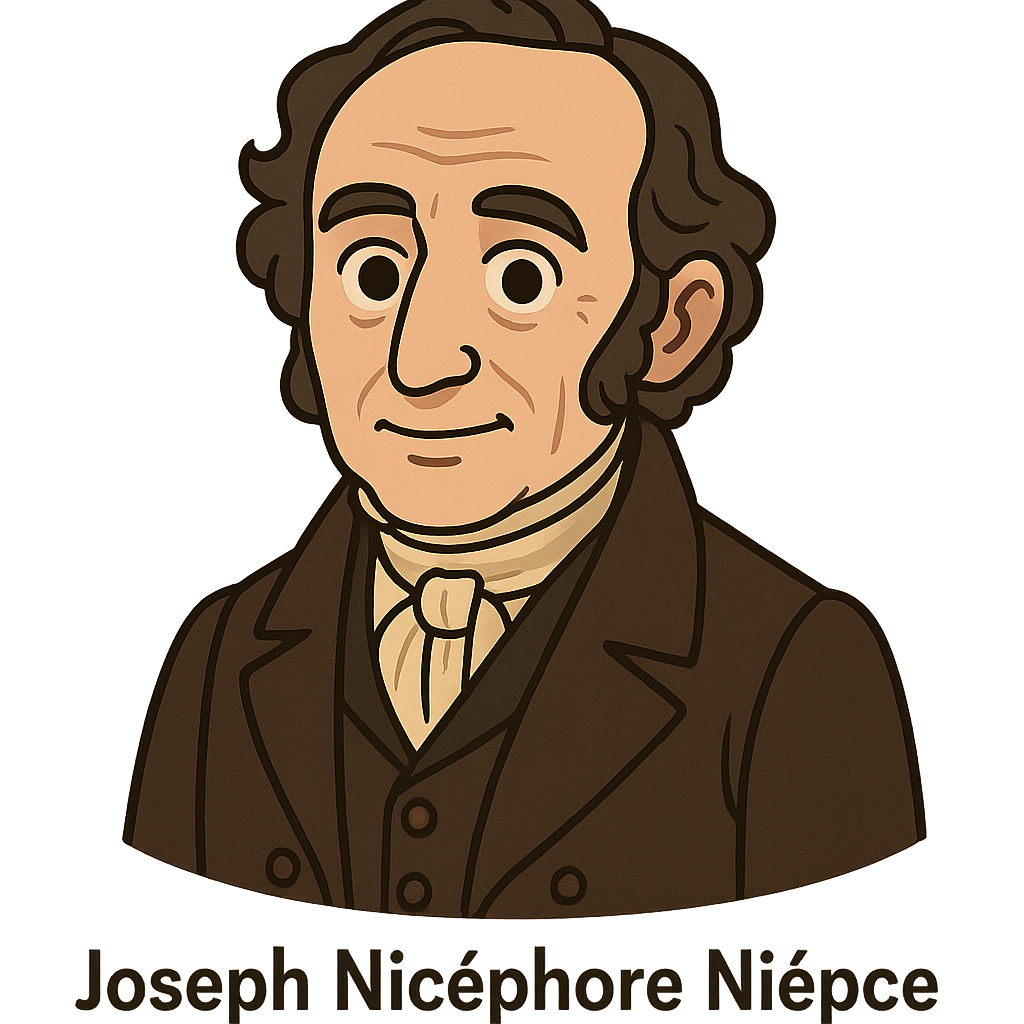
Hello, my name is Joseph Nicéphore Niépce, and I am known as the inventor who captured the world’s very first photograph. My story begins long before that famous picture, in a time of great change and discovery. I was born on March 7th, 1765, in the town of Chalon-sur-Saône, France. My family was well-to-do, which gave me the freedom to explore the world around me. From a young age, I was fascinated by science and how things worked. This curiosity was a gift my family always encouraged, allowing me to conduct experiments and dream up new ideas. As a young man, I served my country as a staff officer in the French army under the famous leader Napoleon. It was an exciting time, but my health was not strong enough for military life. This turned out to be a blessing in disguise, as it allowed me to leave the army and return to my estate to dedicate my life to my true passion: invention.
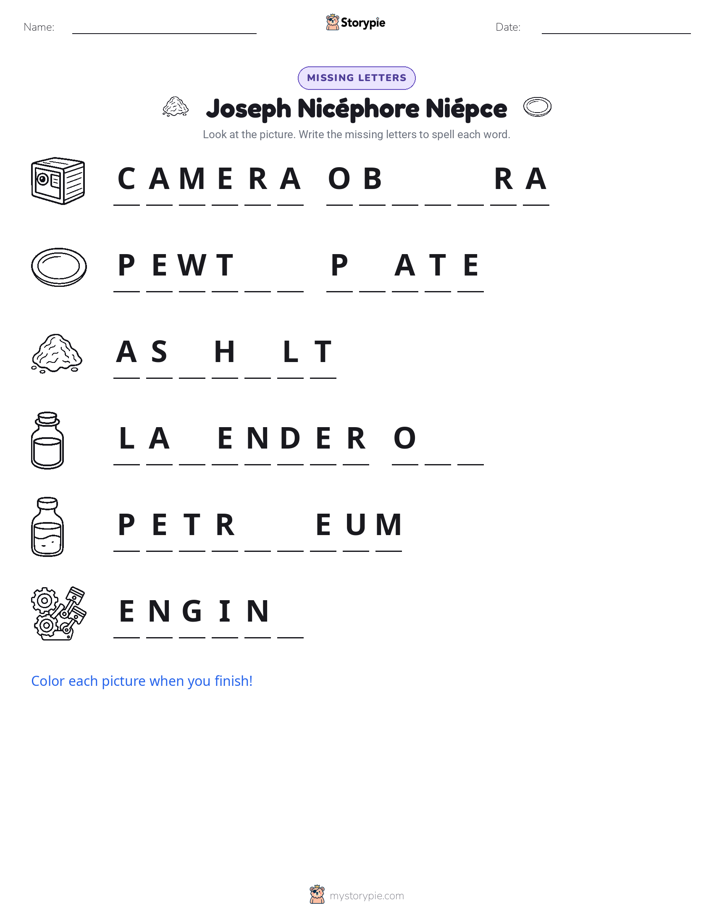
I was not alone in my passion for creating new things. My greatest collaborator was my dear brother, Claude. Together, we spent countless hours in our workshop, dreaming and building. Our first major success was an invention we called the Pyréolophore. It was one of the world's first internal combustion engines, a truly revolutionary idea for the time. Our engine worked by using the controlled explosion of fine coal dust to push a piston, which in turn could propel a boat. We demonstrated its power on the Saône river, where our boat chugged along against the current, amazing everyone who saw it. Our hard work paid off when, in 1807, Emperor Napoleon Bonaparte himself granted us a ten-year patent for the Pyréolophore. This achievement was a great honor and proved that our ideas had real power. My work on this engine showed that my mind was always looking for new ways to solve problems, a skill that would become very important in my next great challenge.
Joseph Nicéphore Niépce: The Man Who Drew with the Sun
Hello, my name is Joseph Nicéphore Niépce, and I am known as the inventor who captured the world’s very first photograph. My story begins long before that famous picture, in a time of great change and discovery. I was born on March 7th, 1765, in the town of Chalon-sur-Saône, France. My family was well-to-do, which gave me the freedom to explore the world around me. From a young age, I was fascinated by science and how things worked. This curiosity was a gift my family always encouraged, allowing me to conduct experiments and dream up new ideas. As a young man, I served my country as a staff officer in the French army under the famous leader Napoleon. It was an exciting time, but my health was not strong enough for military life. This turned out to be a blessing in disguise, as it allowed me to leave the army and return to my estate to dedicate my life to my true passion: invention.
I was not alone in my passion for creating new things. My greatest collaborator was my dear brother, Claude. Together, we spent countless hours in our workshop, dreaming and building. Our first major success was an invention we called the Pyréolophore. It was one of the world's first internal combustion engines, a truly revolutionary idea for the time. Our engine worked by using the controlled explosion of fine coal dust to push a piston, which in turn could propel a boat. We demonstrated its power on the Saône river, where our boat chugged along against the current, amazing everyone who saw it. Our hard work paid off when, in 1807, Emperor Napoleon Bonaparte himself granted us a ten-year patent for the Pyréolophore. This achievement was a great honor and proved that our ideas had real power. My work on this engine showed that my mind was always looking for new ways to solve problems, a skill that would become very important in my next great challenge.
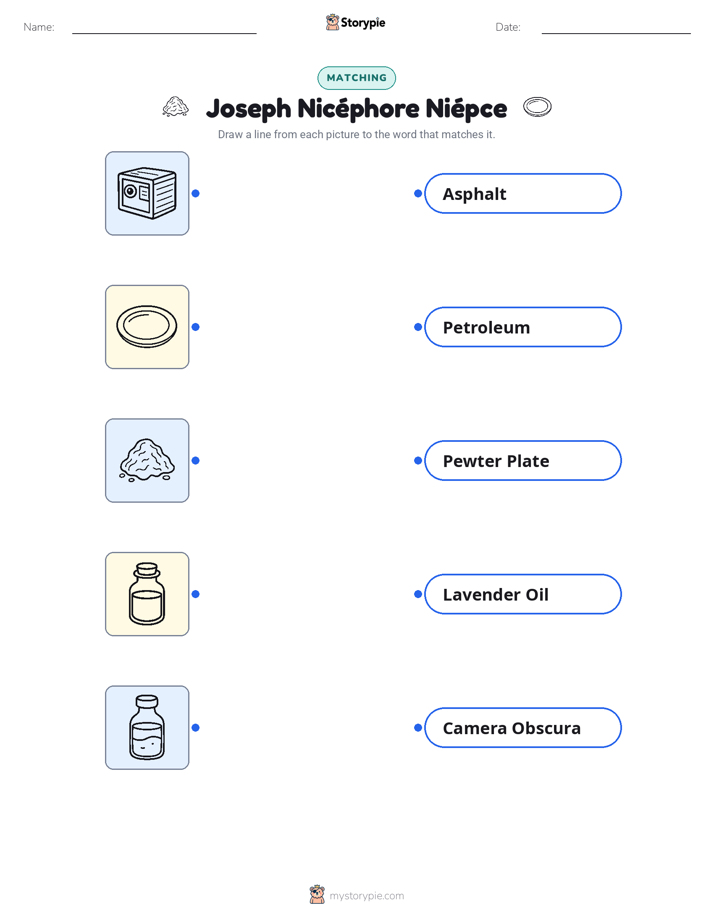
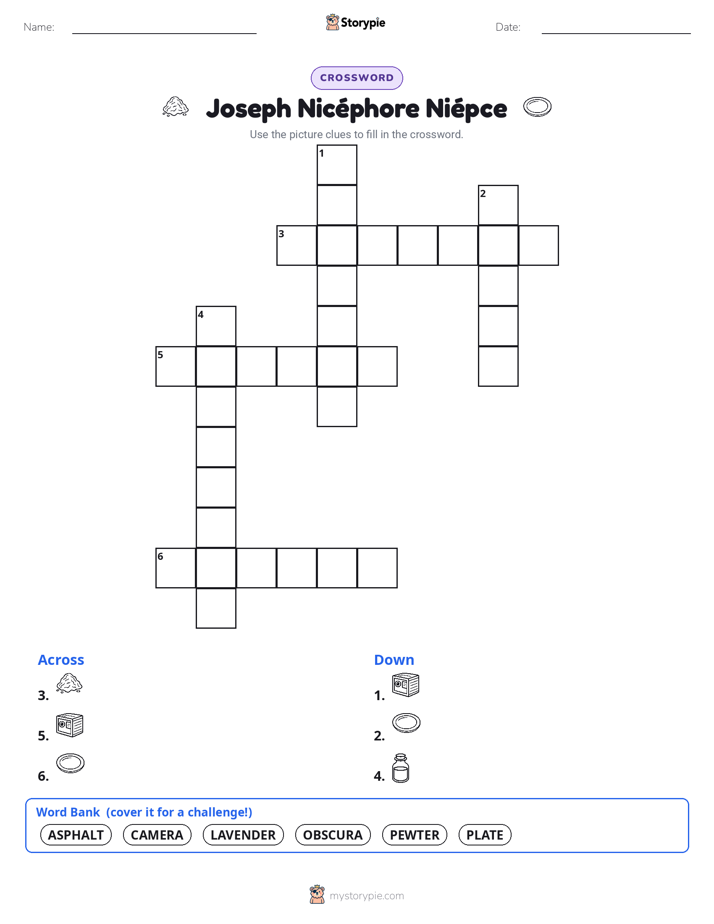
My attention later turned to a popular new art form called lithography, which involved drawing on a special stone to make prints. The problem was, I was not a very skilled artist. I could see the images in my mind, but my hands could not draw them well. This frustration led me to a monumental idea: what if I could make light itself do the drawing for me? I began experimenting with a device called a camera obscura, which is like a dark box that projects an image of the outside world onto a surface inside. My quest was to find a substance that would change when exposed to light, capturing that projected image permanently. It was a long and difficult journey filled with trial and error. I tested many different materials, but none worked quite right. Finally, after years of experiments, I discovered that a type of natural asphalt called Bitumen of Judea was sensitive to light. When I coated a plate with it and exposed it to an image, the parts hit by light would harden. I called my new process 'Heliography,' a name that comes from the Greek words for 'sun-drawing'.
My years of dedication and countless experiments all led to one incredible moment. In either 1826 or 1827, at my country home called Le Gras, I finally succeeded. I prepared a pewter plate by coating it with my light-sensitive bitumen mixture. Then, I placed it inside a camera obscura and pointed the device out an upstairs window, aiming it at the view of the buildings and courtyard outside. Now, all I could do was wait. This was not a quick snapshot like the pictures you know today; the exposure took many hours, as the sun slowly moved across the sky. I had to be incredibly patient. When I believed enough time had passed, I took the plate to my workshop. I carefully washed it with a mixture of lavender oil and white petroleum, which dissolved the parts of the bitumen that hadn't been hardened by the light. As the unhardened material washed away, a faint, blurry image emerged. It was the view from my window, permanently captured on the plate. It was the world's first photograph from nature, a true 'sun-drawing'.
After achieving this breakthrough, I hoped the world would immediately see the importance of my discovery. However, gaining recognition was not easy. My process was very slow, and the results were not perfectly clear. Around this time, I learned of another inventor in Paris who was also trying to capture images with light. His name was Louis Daguerre. He was a talented artist and showman, and he was fascinated by my work. After we began writing to each other, we realized that by working together, we might be able to perfect the process I had started. We decided to become official partners, signing an agreement on December 14th, 1829. Our shared goal was to refine my heliography process, specifically to make the exposure time much shorter and the images sharper. We believed that together, we could turn this scientific curiosity into a practical invention that anyone could use.
I dedicated my life to invention, but I did not get to see our shared project reach its final form. I lived to be 68 years old, passing away in 1833. After my death, my partner, Louis Daguerre, continued our experiments and eventually created a new, faster process he called the daguerreotype, which became very famous. For many years, his name was the one most associated with the invention of photography, and my pioneering work was not widely known. However, history eventually remembered my contribution. Today, that first blurry image, 'View from the Window at Le Gras,' is treasured in a museum, and I am honored as the person whose persistence first proved that we could capture a moment in time forever.
Wow facts
About
Joseph Nicéphore Niépce was a French inventor who created heliography, the world's first photographic process, and took the earliest surviving photograph from nature in 1826 or 1827.
Take a Quiz
Question 1 of 5
What was the main problem that motivated Joseph Nicéphore Niépce to invent photography?
Explore next




Want to do even more?
Go beyond exploring. Unlock tools that turn every story into real learning.

Storypie Plus for families
Full stories, quizzes, and printables. Nights and car rides, sorted.
- Unlimited audio stories
- Create Mode: your child stars in the story
- Offline downloads
- Printable worksheets & coloring pages

Why Storypie for Schools
Students engaged. Prep in seconds. Evenings back to you.
- Worksheets & Quizzes
- Classroom Management
- Formative Assessment
- Custom Curriculum & Lesson Plans
- 27 Languages

Why Storypie for Homeschool
Curriculum done. They'll ask for more. Hours back in your day.
- Worksheet Generator
- First-Person Audio Stories
- Built-in Comprehension Quizzes
- Custom Curriculum & Lesson Plans
- Print & Go Activities