English

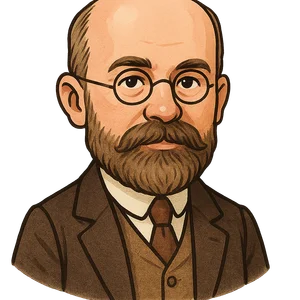
Karl Ferdinand Braun
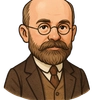
Karl Ferdinand Braun was a German physicist, inventor, and Nobel laureate in physics.
Reads at Grades 6–8 Listens at Grades 4–8
Print & create
Answer keys·No prep·Free with an account
28 worksheets · answer keys · full story · quiz · Ages 10-12 · CEFR B2
Plus adds 244,000+ more stories in 27 languages, audio for every one, and printables for all of them.
Just want Karl Ferdinand Braun?
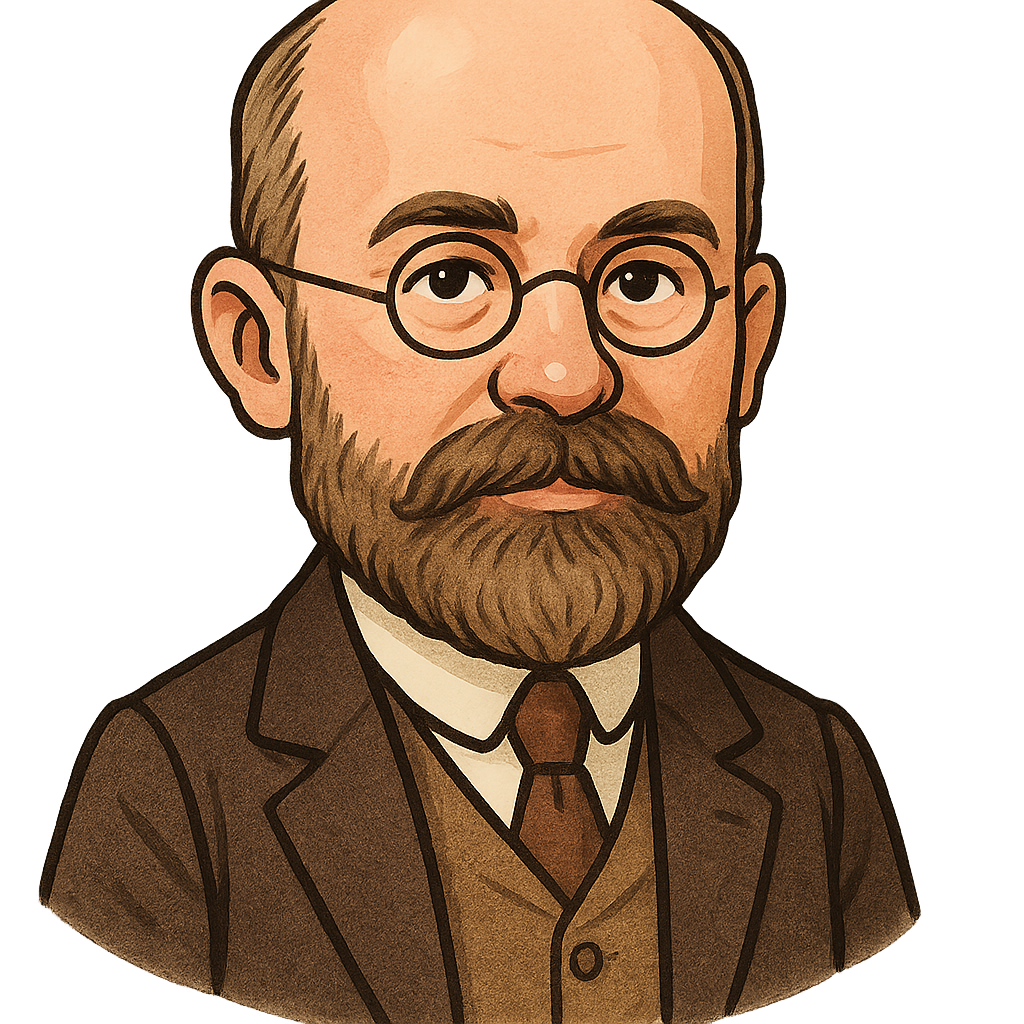
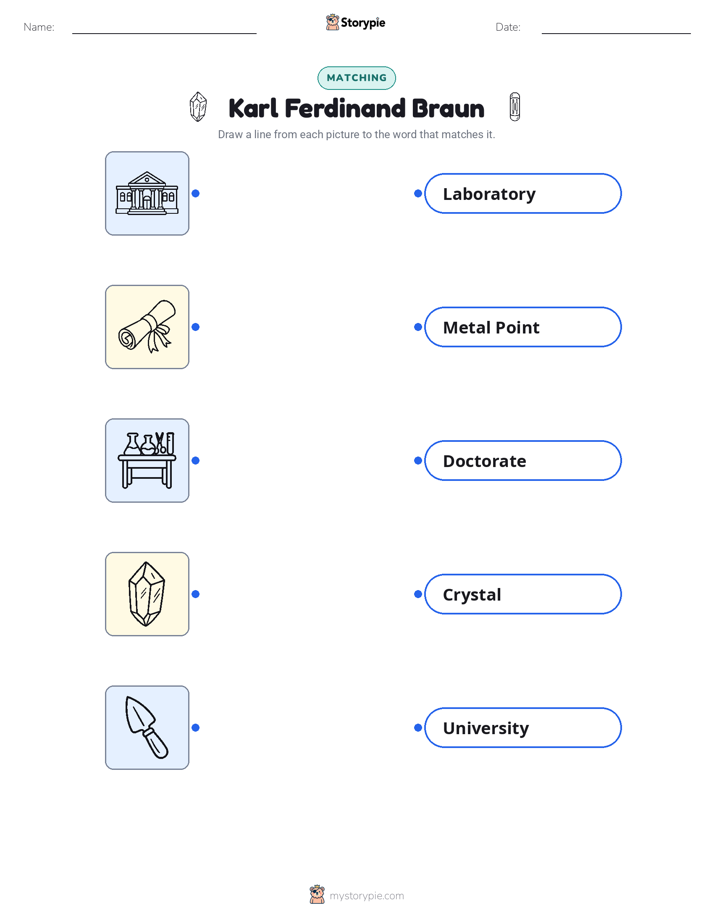
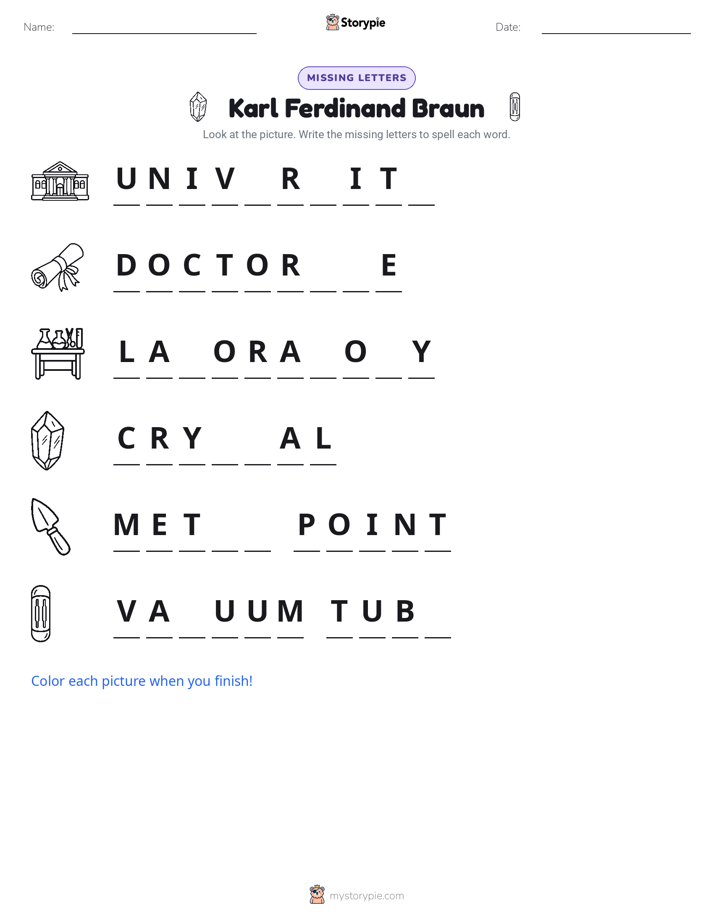
Hello, my name is Karl Ferdinand Braun, and I am a physicist and inventor who helped shape the world of electronics. My story begins on June 6th, 1850, in a town called Fulda, which is in the country we now know as Germany. Even as a young boy, I was filled with a deep curiosity about the world around me. I wasn't just content to see how something worked; I had to understand the principles behind it. This passion for science stayed with me throughout my education. I pursued my interests at the university level, where I had the great fortune of studying under the brilliant physicist Hermann von Helmholtz. He was a wonderful teacher who encouraged my inquisitive nature. My hard work paid off, and in 1872, I earned my doctorate from the prestigious University of Berlin. My formal education was complete, but my journey of discovery was just beginning.
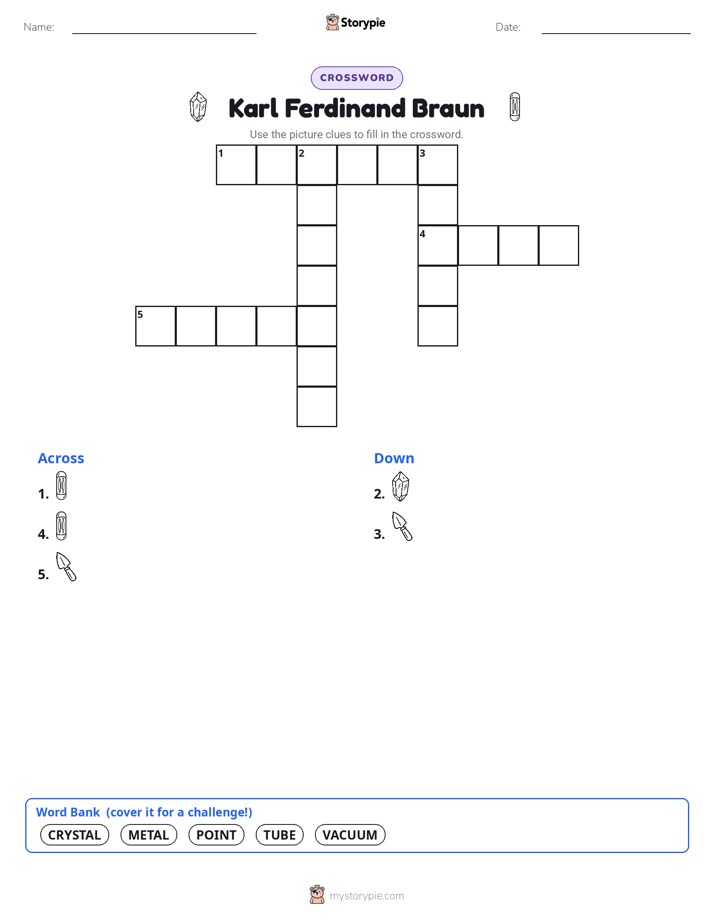
After finishing my studies, I took a position as a teacher. It was during this time, in 1874, that I made my first significant breakthrough. While conducting experiments in my simple laboratory, I was exploring the properties of various crystals and metals. I passed an electrical current through them and noticed something truly remarkable. When I touched a metal point to certain types of crystals, the electricity would only flow in one direction. It was like a one-way street for electrical current! If I tried to make it flow backward, it would stop completely. This phenomenon became known as the 'point-contact rectifier effect.' At the time, I couldn't have known the full importance of my discovery. Decades later, this principle became the foundation for the crystal radio detector, and my finding is now recognized as the very first semiconductor device, a building block of all modern electronics.
Karl Ferdinand Braun: The Man Who Painted with Electrons
Hello, my name is Karl Ferdinand Braun, and I am a physicist and inventor who helped shape the world of electronics. My story begins on June 6th, 1850, in a town called Fulda, which is in the country we now know as Germany. Even as a young boy, I was filled with a deep curiosity about the world around me. I wasn't just content to see how something worked; I had to understand the principles behind it. This passion for science stayed with me throughout my education. I pursued my interests at the university level, where I had the great fortune of studying under the brilliant physicist Hermann von Helmholtz. He was a wonderful teacher who encouraged my inquisitive nature. My hard work paid off, and in 1872, I earned my doctorate from the prestigious University of Berlin. My formal education was complete, but my journey of discovery was just beginning.
After finishing my studies, I took a position as a teacher. It was during this time, in 1874, that I made my first significant breakthrough. While conducting experiments in my simple laboratory, I was exploring the properties of various crystals and metals. I passed an electrical current through them and noticed something truly remarkable. When I touched a metal point to certain types of crystals, the electricity would only flow in one direction. It was like a one-way street for electrical current! If I tried to make it flow backward, it would stop completely. This phenomenon became known as the 'point-contact rectifier effect.' At the time, I couldn't have known the full importance of my discovery. Decades later, this principle became the foundation for the crystal radio detector, and my finding is now recognized as the very first semiconductor device, a building block of all modern electronics.
My most famous invention came many years later, in 1897. The world was buzzing with discoveries about electricity, but it was an invisible force. I wanted to change that. I wondered, could I find a way to actually see the patterns of electrical waves? This question led me to develop a device that would become known as the 'Braun tube.' It was a special kind of glass vacuum tube, sealed with a flat screen at one end. This screen was coated with a material that would glow whenever it was struck by a beam of electrons. Inside the tube, I created a device that would shoot a stream of these electrons toward the screen. The truly clever part was how I controlled this beam. By placing powerful magnets around the neck of the tube, I could bend the electron stream up and down, or side to side. This allowed me to guide the beam across the screen, 'painting' a visual representation of an electrical wave. This invention was the first cathode-ray tube oscilloscope, and it laid the groundwork for technologies that would change the world, becoming the great-grandfather of both television screens and computer monitors.
Inspired by the groundbreaking work of Guglielmo Marconi in wireless telegraphy, or what we now call radio, I turned my attention to this exciting new field. Marconi had shown it was possible to send messages through the air without wires, but I believed the technology could be improved to send signals much farther. I began designing new transmitter circuits. By creating a spark-gap transmitter that was separate from the antenna circuit, I was able to generate much more powerful and stable radio waves. This innovation made it possible to send wireless messages over vast distances, even across oceans. To receive these long-distance signals, I remembered my discovery from 1874. I developed a sensitive crystal detector using the 'rectifier effect' I had observed so many years before. It was a perfect example of how one scientific discovery can lead to another. In recognition of our contributions to the development of wireless telegraphy, Mr. Marconi and I were jointly awarded the Nobel Prize in Physics in 1909. It was a tremendous honor that I cherish deeply.
My life took an unexpected turn in 1915 when I traveled to the United States. I went to New York City to serve as a witness in a patent lawsuit concerning radio technology. While I was there, World War I broke out in Europe. Because I was a German citizen, I was not permitted to travel back to my home country. I spent the remainder of my life in Brooklyn, separated from my homeland. I lived to be 67 years old. Though I never saw Germany again, I am proud that my work helped build the foundations of our modern, connected world. The 'Braun tube' became the heart of the first televisions, and the semiconductor principles I discovered are now found inside almost every electronic device you can imagine, from phones to computers. My hope was always that science would bring people closer together, and I am grateful that my discoveries helped make that possible.
Wow facts
About
Karl Ferdinand Braun was a German physicist, inventor, and Nobel laureate in physics. His invention of the cathode ray tube (CRT) laid the foundation for modern television and his contributions to radio technology were fundamental to the development of wireless communication.
Take a Quiz
Question 1 of 5
What was the main purpose of the 'Braun tube' that Karl Ferdinand Braun invented in 1897?
Explore next



Want to do even more?
Go beyond exploring. Unlock tools that turn every story into real learning.

Storypie Plus for families
Full stories, quizzes, and printables. Nights and car rides, sorted.
- Unlimited audio stories
- Create Mode: your child stars in the story
- Offline downloads
- Printable worksheets & coloring pages

Why Storypie for Schools
Students engaged. Prep in seconds. Evenings back to you.
- Worksheets & Quizzes
- Classroom Management
- Formative Assessment
- Custom Curriculum & Lesson Plans
- 27 Languages

Why Storypie for Homeschool
Curriculum done. They'll ask for more. Hours back in your day.
- Worksheet Generator
- First-Person Audio Stories
- Built-in Comprehension Quizzes
- Custom Curriculum & Lesson Plans
- Print & Go Activities