English


Leonhard Euler
Leonhard Euler was a pioneering Swiss mathematician, physicist, astronomer…
Reads at Grades 6–8 Listens at Grades 4–8
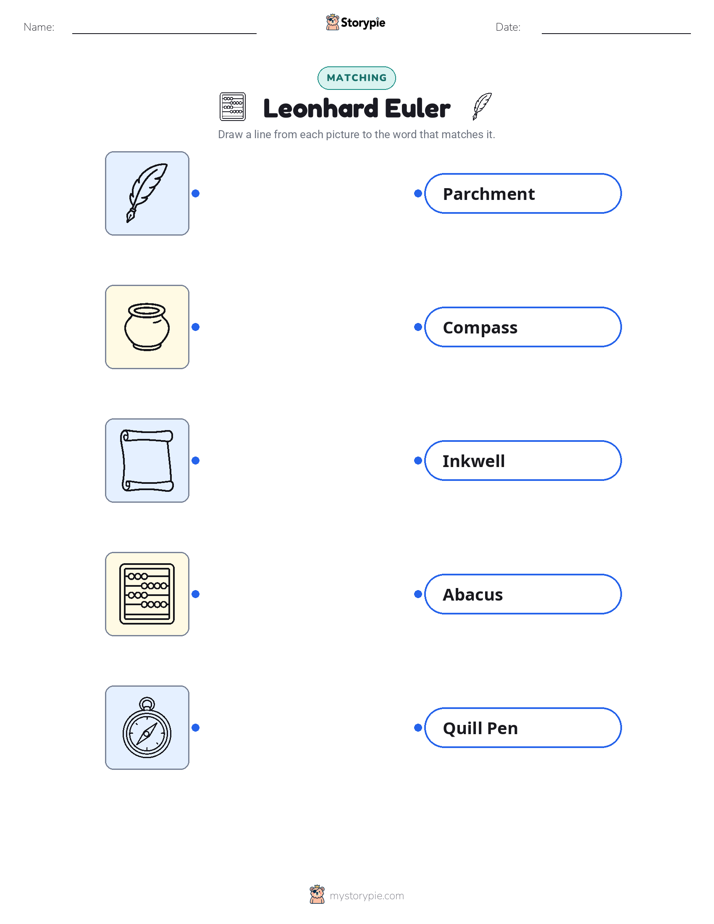
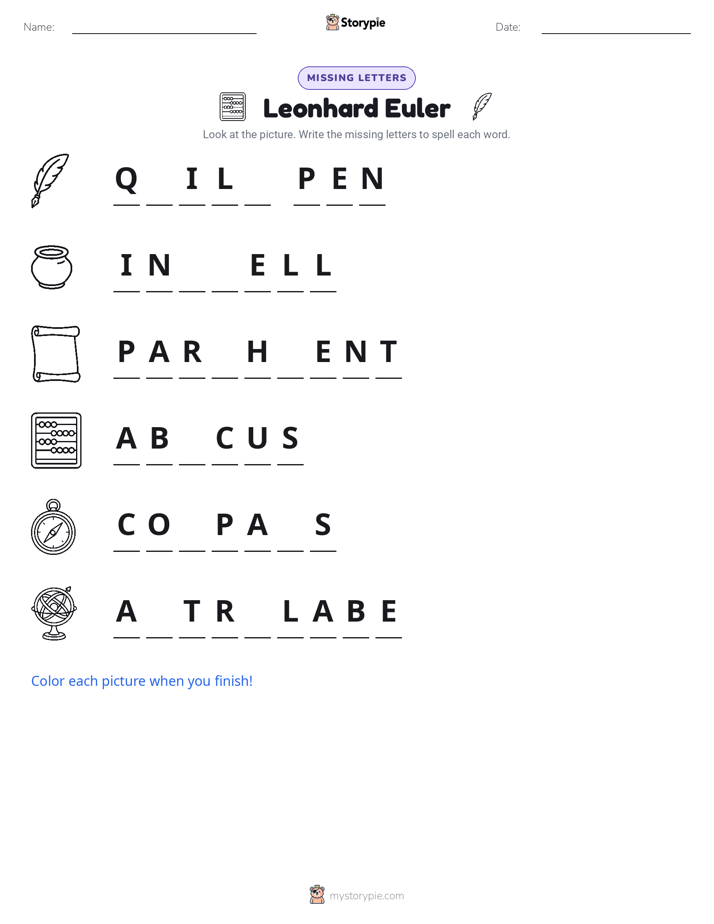
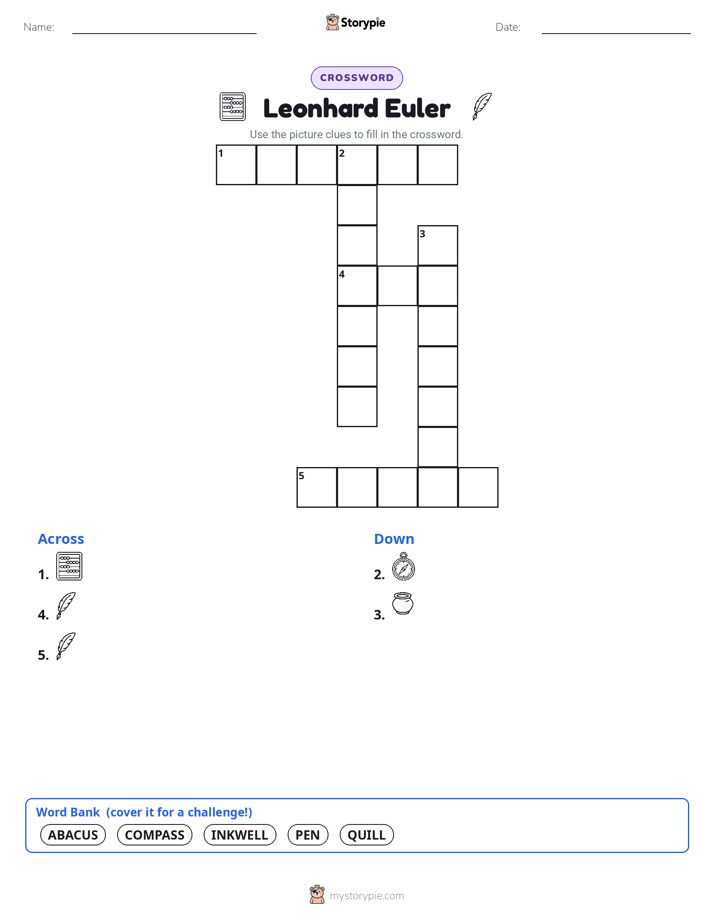
Print & create
Answer keys·No prep·Free with an account
28 worksheets · answer keys · full story · quiz · Ages 10-12 · CEFR B2
Plus adds 244,000+ more stories in 27 languages, audio for every one, and printables for all of them.
Just want Leonhard Euler?
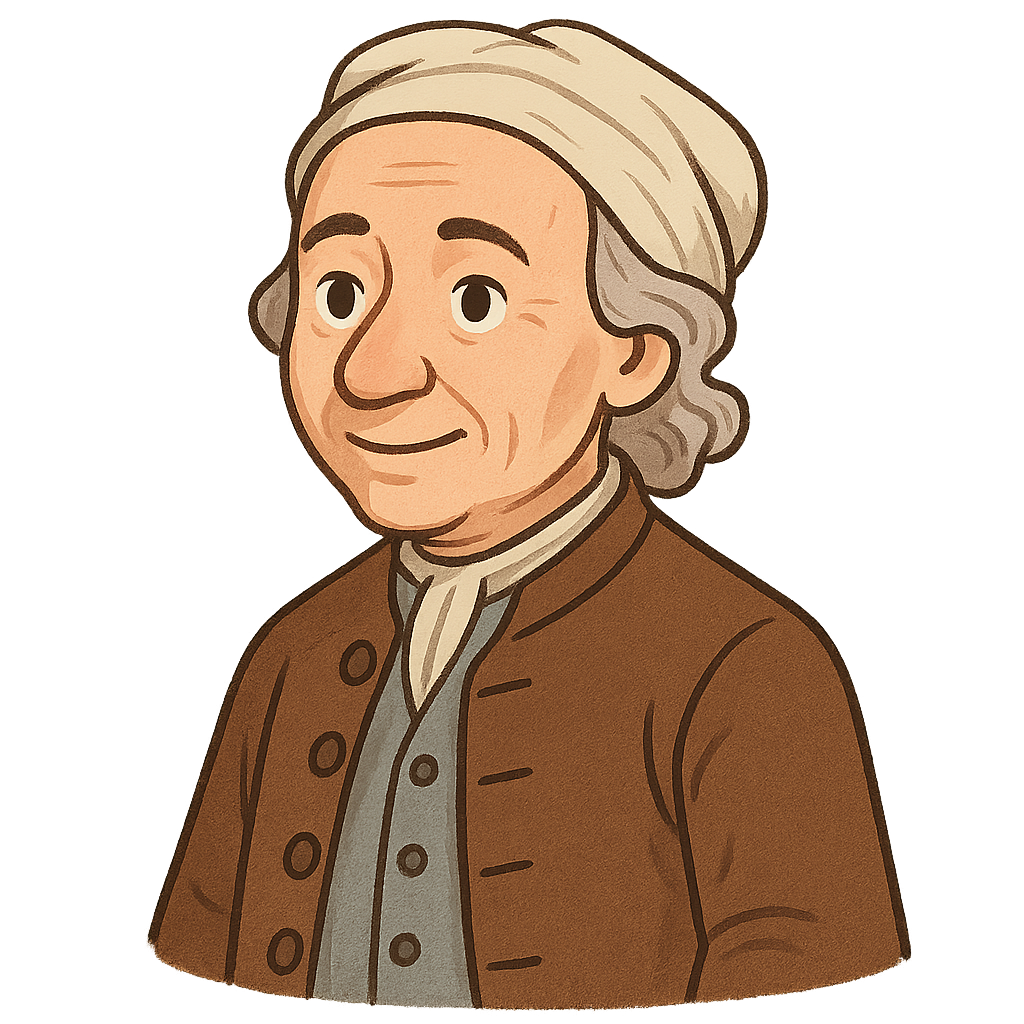
Hello, my name is Leonhard Euler, and my world has always been one of numbers. I was born in the beautiful city of Basel, Switzerland, on April 15th, 1707. My father was a pastor, but his love for mathematics was something he passed down to me. He was my first teacher, and he ignited a spark in me that grew into a lifelong passion. From a young age, I found that I had an exceptional memory, which was very helpful for remembering long and complex formulas. This ability, combined with my love for learning, allowed me to enter the University of Basel in 1720 when I was only 13 years old. It was an exciting time, and it became even more so when I met the famous mathematician Johann Bernoulli. He saw my potential and became my mentor, guiding my studies and challenging me to explore the deepest corners of mathematics. This early encouragement set the course for my entire life.
In 1727, my journey took me far from home to a new and vibrant city: St. Petersburg, Russia. I had been invited to join the prestigious Imperial Russian Academy of Sciences. My work there was incredibly varied and exciting. While mathematics was my main focus, my curiosity led me to explore many other fields. I worked on problems in physics, designed maps for the vast Russian Empire, and even advised the Russian navy. Life was not just about work, however. It was in St. Petersburg that I married and started my family, which brought me great joy. Around 1738, I faced a significant challenge when I lost the sight in my right eye due to illness. Some might have seen this as a reason to slow down, but I saw it as a problem to be solved. I was determined not to let it stop me. I continued my research with even more focus, learning to rely on my memory and my mind's eye to see the patterns and equations that so fascinated me.
Leonhard Euler: A Mind Full of Numbers
Hello, my name is Leonhard Euler, and my world has always been one of numbers. I was born in the beautiful city of Basel, Switzerland, on April 15th, 1707. My father was a pastor, but his love for mathematics was something he passed down to me. He was my first teacher, and he ignited a spark in me that grew into a lifelong passion. From a young age, I found that I had an exceptional memory, which was very helpful for remembering long and complex formulas. This ability, combined with my love for learning, allowed me to enter the University of Basel in 1720 when I was only 13 years old. It was an exciting time, and it became even more so when I met the famous mathematician Johann Bernoulli. He saw my potential and became my mentor, guiding my studies and challenging me to explore the deepest corners of mathematics. This early encouragement set the course for my entire life.
In 1727, my journey took me far from home to a new and vibrant city: St. Petersburg, Russia. I had been invited to join the prestigious Imperial Russian Academy of Sciences. My work there was incredibly varied and exciting. While mathematics was my main focus, my curiosity led me to explore many other fields. I worked on problems in physics, designed maps for the vast Russian Empire, and even advised the Russian navy. Life was not just about work, however. It was in St. Petersburg that I married and started my family, which brought me great joy. Around 1738, I faced a significant challenge when I lost the sight in my right eye due to illness. Some might have seen this as a reason to slow down, but I saw it as a problem to be solved. I was determined not to let it stop me. I continued my research with even more focus, learning to rely on my memory and my mind's eye to see the patterns and equations that so fascinated me.
My path led me to Germany in 1741, where I accepted an invitation from King Frederick the Great to join the Berlin Academy. This was an incredibly productive period in my life. In 1748, I published one of my most important books, Introductio in analysin infinitorum, which means 'Introduction to the Analysis of the Infinite'. This book helped organize many ideas in mathematics and became a guide for generations of students and scholars. During my time in Berlin, I also helped to standardize many of the mathematical symbols you might recognize today. I popularized the use of the Greek letter π (pi) for the ratio of a circle's circumference to its diameter, the letter 'e' for the base of the natural logarithm, and the function notation f(x) to describe a relationship between variables. I also tackled a famous puzzle called the Seven Bridges of Königsberg. The people of the town wondered if it was possible to walk across all seven bridges without crossing the same one twice. By analyzing the problem abstractly, I proved it was impossible and, in doing so, laid the foundation for an entirely new field of mathematics that studies networks and connections.
In 1766, I received another invitation I could not refuse, this time from Empress Catherine the Great, to return to St. Petersburg. I was happy to go back to the city where I had started my career. However, a few years after my return, I faced my greatest challenge yet. A cataract in my remaining good eye left me almost completely blind. But the universe of numbers, formulas, and ideas did not disappear; it simply moved from the page into my mind. I realized that my work did not have to stop. With the dedicated help of my sons, who would write down the equations and proofs as I spoke them, my productivity actually increased. I would sit in the dark, my mind alight with calculations, and dictate my discoveries. I explored the motion of the moon, the principles of mechanics, and countless other subjects. My memory became my blackboard, and my imagination was my guide. Blindness did not end my vision; it only changed how I saw the world of mathematics.
I lived a long and very full life, surrounded by my family and the endless wonders of mathematics. I lived to be 76 years old. After I was gone, my work continued to shape the world. I am remembered as one of the most productive and influential mathematicians in history. I had written so many papers and books that the St. Petersburg Academy continued to publish my work for nearly 50 years after my life ended. The next time you see symbols like π or f(x) in your math class, you can remember my story. They are part of a universal language I helped build, a language that allows us to describe the world in incredible ways. I hope my life shows you that with passion and determination, you can overcome any obstacle and find your own joy in discovery.
Wow facts
About
Leonhard Euler was a pioneering Swiss mathematician, physicist, astronomer, and engineer who made foundational discoveries in many areas of mathematics, such as graph theory and calculus, and introduced much of modern mathematical terminology and notation.
Take a Quiz
Question 1 of 5
What were two major challenges Leonhard Euler faced in his life, and how did he respond to them according to the story?
Explore next






Want to do even more?
Go beyond exploring. Unlock tools that turn every story into real learning.

Storypie Plus for families
Full stories, quizzes, and printables. Nights and car rides, sorted.
- Unlimited audio stories
- Create Mode: your child stars in the story
- Offline downloads
- Printable worksheets & coloring pages

Why Storypie for Schools
Students engaged. Prep in seconds. Evenings back to you.
- Worksheets & Quizzes
- Classroom Management
- Formative Assessment
- Custom Curriculum & Lesson Plans
- 27 Languages

Why Storypie for Homeschool
Curriculum done. They'll ask for more. Hours back in your day.
- Worksheet Generator
- First-Person Audio Stories
- Built-in Comprehension Quizzes
- Custom Curriculum & Lesson Plans
- Print & Go Activities